She would, of course, lose the primaries. But it would be endlessly amusing to watch Republican presidential candidates balance the need to win over the Tea Partiers who support her with the desire to not torpedo their general election bid. Best of luck to them on that.

March 24, 2011
Bachmann Exploring a Run
Michele Bachmann (R-MN) of Tea Party fame is toying with a run on the White House. This would make for an outstanding debate. Amongst her many memorable comments include encouraging Minnesotans to engage in an armed revolution and leading her own witch hunts against "anti-American" members of Congress.


March 18, 2011
President Kim's Great Misstep
To date, President Kim has maintained an extended honeymooner's popularity at Dartmouth. Even as Mr. Kim has faced increasing scrutiny from students, he has appeared as strong as ever amongst alumni. That may be about to change.
Though it has received little attention in Dartmouth's mainstream press, Mr. Kim plans on opening a new office in the financial district of Boston, Mass. Mr. Kim claims that the new space -- which will likely cost more than $300,000 per annum -- is a necessary step toward better management of the endowment.
Critics are crying foul. Joe Asch, erstwhile petition candidate for trustee, writes over on Dartblog:
Setting up premises in Boston is hardly necessary for the good management of Dartmouth’s money. The College’s leading investment maven, billionaire Chairman of the Board of Trustees Steve Mandel, does an excellent job running Lone Pine Capital from Greenwich. [...] Technology has brought us a long way from open outcry trading in a crowded stock exchange pit.
March 15, 2011
Dartmouth's (latest) meaningless election
The Dartmouth Association of Alumni must really be trying to reach me. They sent me an email, they mailed me a letter, and they sent me another email all to get me to cast my ballot in the 2011 Trustee and AoA Executive Committee election! And the deadline is only a month away!! With all that effort, this election must be pretty important, so I signed in using the codes they sent to view this ballot:

That's right, one vote for every one candidate. No write ins. No democracy. They even made a handy little button you can press to automatically vote for all of the preselected, election-guaranteed 'candidates'.

That's right, one vote for every one candidate. No write ins. No democracy. They even made a handy little button you can press to automatically vote for all of the preselected, election-guaranteed 'candidates'.
March 11, 2011
#13: Seven Samurai (1954) conquers the West of the Far East
 (Part of my series on watching every movie in the IMDB's top 250)
What do The Dirty Dozen, X-Men, The Sandlot, The Oceans 11(+ n) Series, and pretty much every heist movie have in common? They all owe their plot lineage to Seven Samurai.
Seven Samurai follows the plight of a farming village in Japan just after the Ashikaga shogunate of the 1500s, and their quest to enlist the support of Seven ronin samurai to help defend themselves against gangs of raiding marauders. What follows is a simple three-act set-up -- the conflict and recruiting, the development and cohesion, and the mission and farewell-- that has come to define such movies made subsequently. As in the modern movies mentioned above, each character is brought into the group because of the unique contributions that he can bring to the mission. The themes of honorable 'hired guns' coming to rescue innocents (especially helpless, undeveloped sexy female characters) from violent lawlessness are all common to American Westerns and therefore will be familiar to modern audiences. However, given the timeframe that the movie was made, it is clear that these themes are meant to send a political message against the samurai-inspired militarist ideals exhibited by Japan in WWII.
March 2, 2011
Social Space: The Long Goodbye
It's long been a cause célèbre for Parkhurst to wrest social spaces from the monopolizing Greek community. When the prime option for students to socialize is a fraternity basement, the argument goes, we would expect higher incidents of drinking and related transgressions.
Curious, then, that the College is announcing the renovation of Thayer Dining Hall into a pay-per-meal venue, where students will have to cough up eight dollars just to enter. Reflecting back on my time in Hanover -- not so long ago! -- I recall many nights spent regaling with friends at Food Court while sipping a coffee and nothing more. Food Court was a safe, comfortable social space for those who wanted to temporarily escape the stress of final exams and term papers. Food Court was, in short, a reliable social space for students to join, relax and engage.
No more. By placing a steep price on entry, few students will care to join a group of friends on a whim. Ate an early dinner? Too bad. You're not likely to pay eight dollars to join your friends' later dinner just to spend time with them.
And what message does this send students, anyway? The all-you-can-eat style surely incentivizes overindulgence and waste. Not to mention the additional cost -- on top of what were already exorbitant DDS prices.
What a curious move, indeed. Why write the rules so that your $30 million investment hinders your stated efforts in other areas of College life?
One has to wonder how students will react to this. Or perhaps if the administration cares at all.
March 1, 2011
Review: Snuff- Where the reader gets screwed.
 Reading Chuck Palahniuk's novels have convinced me of one simple fact: that ever since Fight Club, ol' Chuck is coasting.
Snuff tells the story of a come-back-seeking porno actress trying to break the world group-sex record, as told by the 600 men waiting off-camera to screw her. Now Fight Club was and remains one of the most brilliant books I've ever read, but the disjointed narrative style, repetition, disaffected characters, and aggressive violence that served that book so well have frankly flopped in his other work. Instead we are left with a gross and simple little story. Gross in the childish way where the point is to shock the reader but too immature to be effective or engaging. Group sex is naughty. Peeing on a floor where people walk on bare feet is gross. Guzzling ranch dip, scooping it up with the same chip every time, is something mommy would never let us do.
February 1, 2011
#92: The Apartment (1960)
 (Part of my series on watching every movie in the IMDB's top 250). Think of it as a 22-year-old's analysis of classic American cinema.
Some movies age well. The Apartment did not. There is really nothing in the movie (using your flat as a shag-pad for your co-workers, blatantly porking your secretaries, open nepotism, sexism, smoking constantly, drinking early) that would be acceptable at a major corporation today. But more importantly the premise is not very believable and the romance of the movie is almost completely confined to a game of cards. The plot centers around a love triangle that is basically awkward and the ending was glued on with little regard for the plot's concluding acts.
January 31, 2011
#84: All About Eve (1950)
 (Part of my series on watching every movie in the IMDB's top 250)
All About Eve is easily the cleverest movie I've ever seen, dialogue-wise. Despite the fact that I was watching it with company, on more than one occasion I rewound the movie just so that I could appreciate all the nuances of particularly well-crafted line.
All About Eve is also one of the few movies where every single premise is believable. It tells the story of a freshly 40-year-old stage actress who grows anxious that she's getting too old to play 20-somethings characters like she used to, and grows increasingly paranoid that the raving (and very attractive) 20-something-year-old fan that she just hired as a valet will be the one to take her spot. It's a story that very closely mirrors the actual lives of the actors in the movie, making their portrayal so much more convincing. In a way it's like a really well written reality show-- to the point that you may forget you're watching a movie at all.
January 30, 2011
#69: Modern Times
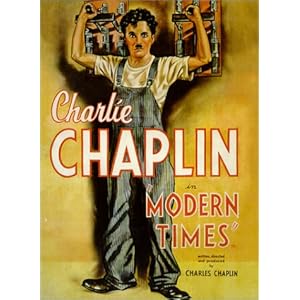 (Part of my series on watching every movie of the IMDB's top 250)
I had always been shown clips of Modern Times in high school as artistic examples of the feeling of dehumanization that modernization and mechanization created at the start of the last century. I was please to discover that Modern Times is so much more than that and is, in fact a rather cute and very enjoyable movie. While much of the comedy is in Charlie Chaplin's famous slap-stick style, it's actually rather clever and unpredictable in ways that make it mature and laugh-out-loud funny even today. The satire is there, but it's really much more pantomime, though Chaplin never gets tiring or awkward. As someone who grew up on Cartoon Network, I can see the artistic and comedic influence of Modern Time throughout decades of subsequent cartoons and today appreciate it as a very fine movie.
January 29, 2011
#29. It's a Wonderful Life (1946)
 (Part of my series on watching every movie of the IMDB's top 250) Every family has a movie they traditionally watch on Christmas. For some families that movie is A Christmas Story or one of the many versions of Dickens's A Christmas Carol. In my family -- we being Italian -- that movie was, of course, The Godfather. And so it wasn't until now that I finally watched this most celebrated of Christmasy movies, It's a Wonderful Life.
In no other movie have I seen such an idealistic portrayal of American civilization throughout the many phases of the early twentieth century. Nor have there been many characters quite as sympathetic and American as the ones played by Jimmy Stewart. In this movie, it's somewhat difficult to pull off given the fact that the 'aww shucks' character of George Bailey (played by Stewart) is a tragic one. He lives exactly the opposite life he wanted for himself in order to satisfy the needs and desires of those around him. He instantly and methodically does what is right, at high cost to himself. And in doing so, grows resentful of a business, community, and family that does not seem to appreciate the sacrifices he has made, and he grows jealous of those who enjoy success in everything he's wanted to do.
Tackling IMDB's Top 250 Movies
 Finding every blockbuster around me in New York closed, I stopped by my local public library and found exactly where all those old DVDs went. Rows and rows, and drawers and drawers of free DVDs all at my disposal -- 100 items at a time, for 7-day rentals each -- presented too great an opportunity for me to pass up. I knew exactly where to start. Out came the blackberry, IMDB's list top-250 movies, and my eye at the top. This was to become my mission: to see them all. And not the old lady, blocking the 'S' shelf as she slowly reads each movie back, or the family man with the shopping card full of Dora the Explorer DVDs will stop me!
After printing out the full list at home, I found that of the 250 titles, I had already viewed 98 of them. Not quite a failing grade on the cinematic literacy test, but certainly not enough to win me prizes on Jeopardy either. But with the simple dedication to view one movie a day for the next 152 days, I can finish my task by June 20th of this year.
While this means that I'll finally get around to viewing classics -- the kind that make friends and parents alike recoil in disgust when they learn I haven't seem them -- it also means viewing a considerable number made pre-color and pre-sound. In my experience, these 'ancestor' movies continue to receive high ratings, not based on the pleasurably of viewing them today, but rather based on the reactions they generated in their own time, and their influence on the great movies of the contemporary cinematic age. Will The Apartment be as good as its inspired descendant American Beauty? Will The Great Dictator still be relevant satire some 70 years after Hitler? Time and three tons of popcorn will tell.
December 3, 2010
An Open Letter to the Alumni Council
This morning, I submitted a letter to the Alumni Council representative from my own Class of 2009. In it, I urged Mr. Lane to push for fair reviews of electoral processes, particularly in light of our recent analysis of the 2010 alumni elections. The full letter is below.
Andrew,
In response to your recent request for input from members of the Class of 2009, I wish to address a concern about alumni elections.
Before, during and after the elections, many members of the Alumni Council and its nominated candidates decried the negativity of the petition candidates, including Joe Asch ’79 and the Dartmouth United slate. These claims seemed particularly unusual to me considering the negative tone that many Council-nominated candidates used over the course of the election.
As I recently posted on The Little Green Blog, Mr. Replogle and Mr. Kondracke – both of whom you supported – mentioned and attacked Mr. Asch several times on their websites and in their official communications. Mr. Asch, by contrast, never mentioned his opponent -- by name or otherwise -- on his website.
The Alumni Council did not rebuke the attacks leveled against Mr. Asch. Councilors also did not refute claims that Mr. Asch opposed funding for needy students or that he is a racist. Such base attacks are unbecoming members of the Dartmouth fellowship and deserved the unwavering disapproval of the Alumni Council and its nominated candidates.
The Alumni Council was also silent on the scurrilous attacks published on the website “Joe VS Dartmouth.” Typically I would dismiss such an attack site as an inevitable evil of campaigns. This site, however, was directly tied to Mr. Replogle’s campaign. The site was published by Chris Allen, who also designed Mr. Replogle’s and Mr. Kondracke’s websites, and was publicly advertised by Mr. Kondracke at alumni events.
I hope that these issues will be honestly discussed at this weekend’s Council meeting. A fair evaluation of the campaign tactics used in the 2010 alumni elections will reveal, as I posted on The Little Green Blog, that most negativity was directed at the petition candidates, not by them.
In considering rules to curb the negativity of future campaigns, the Council should adopt measures that ensure that the nomination process is open and transparent, that all candidates have fair access to mailing lists, and that all alumni are given a fair chance to assess the Council’s nominees and petition for office if they so desire.
Further, I hope that you will encourage Council members to discourage negative campaigning from all sides. Using this meeting as a chance to weaken the hand of future petition candidates while ignoring the considerable negativity expressed by the Council’s nominees would be a regrettable result.
Please remember that, while we may disagree on how best to govern the College on the Hill, we are – as President Wright said in our commencement ceremony – “ever a part of Dartmouth undying as Dartmouth is forever a part of [us].” Let us be worthy of that distinction and design future rules for alumni elections accordingly.
I hope this finds you well,
Brice D. L. Acree ‘09
Webmaster, Class of 2009
**
In response to your recent request for input from members of the Class of 2009, I wish to address a concern about alumni elections.
Before, during and after the elections, many members of the Alumni Council and its nominated candidates decried the negativity of the petition candidates, including Joe Asch ’79 and the Dartmouth United slate. These claims seemed particularly unusual to me considering the negative tone that many Council-nominated candidates used over the course of the election.
As I recently posted on The Little Green Blog, Mr. Replogle and Mr. Kondracke – both of whom you supported – mentioned and attacked Mr. Asch several times on their websites and in their official communications. Mr. Asch, by contrast, never mentioned his opponent -- by name or otherwise -- on his website.
The Alumni Council did not rebuke the attacks leveled against Mr. Asch. Councilors also did not refute claims that Mr. Asch opposed funding for needy students or that he is a racist. Such base attacks are unbecoming members of the Dartmouth fellowship and deserved the unwavering disapproval of the Alumni Council and its nominated candidates.
The Alumni Council was also silent on the scurrilous attacks published on the website “Joe VS Dartmouth.” Typically I would dismiss such an attack site as an inevitable evil of campaigns. This site, however, was directly tied to Mr. Replogle’s campaign. The site was published by Chris Allen, who also designed Mr. Replogle’s and Mr. Kondracke’s websites, and was publicly advertised by Mr. Kondracke at alumni events.
I hope that these issues will be honestly discussed at this weekend’s Council meeting. A fair evaluation of the campaign tactics used in the 2010 alumni elections will reveal, as I posted on The Little Green Blog, that most negativity was directed at the petition candidates, not by them.
In considering rules to curb the negativity of future campaigns, the Council should adopt measures that ensure that the nomination process is open and transparent, that all candidates have fair access to mailing lists, and that all alumni are given a fair chance to assess the Council’s nominees and petition for office if they so desire.
Further, I hope that you will encourage Council members to discourage negative campaigning from all sides. Using this meeting as a chance to weaken the hand of future petition candidates while ignoring the considerable negativity expressed by the Council’s nominees would be a regrettable result.
Please remember that, while we may disagree on how best to govern the College on the Hill, we are – as President Wright said in our commencement ceremony – “ever a part of Dartmouth undying as Dartmouth is forever a part of [us].” Let us be worthy of that distinction and design future rules for alumni elections accordingly.
I hope this finds you well,
Brice D. L. Acree ‘09
Webmaster, Class of 2009
December 2, 2010
An Assessment of Negative Campaigning
As the Alumni Council meets this weekend to discuss, in part, how to curb negative campaigning in alumni elections, one must ask the obvious question: whom should we blame for negativity? Members of Dartmouth Undying seem to take as a matter of course that petition candidates are injecting bile into the system, but further inspection rebuffs this claim. Someone should set the record straight.
A recent content analysis by Little Green Blog considers the websites for John Replogle ’88 and Mort Kondracke ‘60, the Alumni Council-nominated candidates for Trustee in 2010, and Mr. Replogle’s petition opponent Joe Asch ‘79. Our findings were as follows:
The Context
A common theme from erstwhile College president Wright’s office, particularly during the height of the Lone Pine Revolution, was to belittle petition candidates as negative and divisive politicians. Supporters of Wright and the Alumni Council nominees, such as Jonathan Hancock ’06, called on petitioners to end their campaign of “stoking divisiveness and negativity at Dartmouth”.
After the most recent round of alumni elections, prominent Dartmouth leaders were just as quick to decry the negativity of the campaign. President Kim remarked that new rules should be adopted to calm the “acrid, negative [and] angry campaigning.” Martha Beattie ’76, President of Dartmouth Undying (a group supporting Alumni Council nominees) referred to the result, which strongly favored her slate of candidates, as a call by alumni to end “contentious elections.”
The Findings
Despite alumni councilors and Dartmouth Undying bemoaning the negativity of the petitioners in the last election, the websites of the trustee candidates points to a different conclusion.
Mr. Asch: The website for Mr. Asch does not specifically target Mr. Replogle or reference the Dartmouth Undying slate. On his site, Mr. Asch frequently states his support for President Kim while also supporting fiscal prudence and a restoration of parity on the Board of Trustees. Some letters of support published on Mr. Asch’s site do make thinly veiled references to his opponents, but no outwardly negative attacks are made.
In total, Mr. Replogle’s name appears zero times on Mr. Asch’s site. Mr. Kondracke’s name likewise never appears. Mr. Asch’s site makes no reference to Dartmouth Undying or the Alumni Council nominees for other offices. (The only reference to the above parties comes in a letter linked to on the site in which Mr. Asch attempts to respond to the attack website “Joe VS Dartmouth”. Even in this letter, Mr. Asch does not critique either Mr. Replogle or Mr. Kondracke, only indicating that Mr. Kondracke urged audience members at a round table in Minneapolis to visit the “Joe VS Dartmouth”.)
Mr. Replogle and Mr. Kondracke: The websites for Mr. Replogle and Mort Kondracke ’60 (who ran unopposed for the other open seat on the Board) are a different story. Mr. Replogle and Mr Kondracke published many letters that were openly critical of Mr. Asch, in addition to publishing independent critiques of Mr. Replogle’s opponent. A letter from Phil Kron, Gene Kron and Jim Adler calls Mr. Asch a micromanager, claims he is “ill equipped to serve on the Board of Trustees” in addition to mocking Mr. Asch for an letter supporting Mr. Replogle signed by several members of the Class of 1979.
In another letter published on the sites of Mr. Replogle and Mr. Kondracke, Merle Adelman ’80, a former acting president of the Association of Alumni, accuses Mr. Asch of a “flip flop” on the alumni lawsuit blocking the Board’s 2007 expansion. Weighing in on the letter, Mr. Kondracke and Mr. Replogle intone that the letter proves “Asch will say whatever it takes to get himself elected.”
In total, Mr. Asch’s name appears 16 times on Mr. Replogles site, with a conservative estimate of eight instances where Mr. Asch is criticized or attacked. Mr. Asch’s name appears 15 times on Mr. Kondracke’s website, with a conservative estimate of seven instances where Mr. Asch is criticized or attacked. (This latter figure is particularly noteworthy considering that Mr. Kondracke faced no opposition in the campaign, from Mr. Asch or otherwise.)
Attacks From Without: Mr. Asch was also the subject of a particularly negative website entitled “Joe VS Dartmouth” which derided Mr. Asch’s qualifications and character. Typically this brand of attack site would not be considered a part of the Replogle-Kondracke campaign, except that the engineer of the site also built and maintained the campaign sites for Mr. Replogle and Mr. Kondracke. Neither candidate explicitly condemned the site, either. In fact, Mr. Kondracke publicly directed traffic to the site on at least one occasion.
“Joe VS Dartmouth” advances several negative claims about Mr. Asch, including that Mr. Asch hid aspects of his business past (in reality, Mr. Asch had once mistakenly paid taxes to the U.S. instead of the French government, and the issue had been amicably resolved), that he opposes Pell Grants and federal support for needy students, and that he “denigrates” supporters of Dartmouth’s Greek system. The scant support for these claims is often taken wildly out of context or is overtly false.
Conclusion
The board at Little Green Blog makes no normative claims about negative campaigning in alumni elections -- that question is beyond the scope of this study. Instead, we hope to provide alumni with useful facts with which to analyze the 2010 alumni elections.
The campaigns of Mr. Replogle and Mr. Kondracke seem more vociferously negative when we consider the campaign site “Joe VS Dartmouth” which was built and maintained by an active member of the Replogle-Kondracke team and publicly advertised by Mr. Kondracke. The entire site was dedicated to attacking Mr. Asch’s qualifications and character. The claims published on the site often relied on information drawn out of context or ad hominem attacks.
Disclosure Statement
The directorate of Little Green Blog endorsed Mr. Asch’s campaign for the Board. This report’s primary author and publisher submitted an endorsement letter for Mr. Asch as well as other commentary on the election.
It would be easy to use this information to dismiss our findings. Readers would be remiss in doing so. We urge readers to visit the sites linked above and explore them. The numbers speak for themselves.
While our opinions of Mr. Ach moved us to support him in the election, we were not a part of his campaign and are not in close communication with him at the present time. The findings reported herein are based not on subjective evaluations but on factual content analysis of four websites frequented during the election. Final judgment of our methods of course rests with the reader.
A recent content analysis by Little Green Blog considers the websites for John Replogle ’88 and Mort Kondracke ‘60, the Alumni Council-nominated candidates for Trustee in 2010, and Mr. Replogle’s petition opponent Joe Asch ‘79. Our findings were as follows:
The Context
A common theme from erstwhile College president Wright’s office, particularly during the height of the Lone Pine Revolution, was to belittle petition candidates as negative and divisive politicians. Supporters of Wright and the Alumni Council nominees, such as Jonathan Hancock ’06, called on petitioners to end their campaign of “stoking divisiveness and negativity at Dartmouth”.
After the most recent round of alumni elections, prominent Dartmouth leaders were just as quick to decry the negativity of the campaign. President Kim remarked that new rules should be adopted to calm the “acrid, negative [and] angry campaigning.” Martha Beattie ’76, President of Dartmouth Undying (a group supporting Alumni Council nominees) referred to the result, which strongly favored her slate of candidates, as a call by alumni to end “contentious elections.”
The Findings
Despite alumni councilors and Dartmouth Undying bemoaning the negativity of the petitioners in the last election, the websites of the trustee candidates points to a different conclusion.
Mr. Asch: The website for Mr. Asch does not specifically target Mr. Replogle or reference the Dartmouth Undying slate. On his site, Mr. Asch frequently states his support for President Kim while also supporting fiscal prudence and a restoration of parity on the Board of Trustees. Some letters of support published on Mr. Asch’s site do make thinly veiled references to his opponents, but no outwardly negative attacks are made.
In total, Mr. Replogle’s name appears zero times on Mr. Asch’s site. Mr. Kondracke’s name likewise never appears. Mr. Asch’s site makes no reference to Dartmouth Undying or the Alumni Council nominees for other offices. (The only reference to the above parties comes in a letter linked to on the site in which Mr. Asch attempts to respond to the attack website “Joe VS Dartmouth”. Even in this letter, Mr. Asch does not critique either Mr. Replogle or Mr. Kondracke, only indicating that Mr. Kondracke urged audience members at a round table in Minneapolis to visit the “Joe VS Dartmouth”.)
Mr. Replogle and Mr. Kondracke: The websites for Mr. Replogle and Mort Kondracke ’60 (who ran unopposed for the other open seat on the Board) are a different story. Mr. Replogle and Mr Kondracke published many letters that were openly critical of Mr. Asch, in addition to publishing independent critiques of Mr. Replogle’s opponent. A letter from Phil Kron, Gene Kron and Jim Adler calls Mr. Asch a micromanager, claims he is “ill equipped to serve on the Board of Trustees” in addition to mocking Mr. Asch for an letter supporting Mr. Replogle signed by several members of the Class of 1979.
In another letter published on the sites of Mr. Replogle and Mr. Kondracke, Merle Adelman ’80, a former acting president of the Association of Alumni, accuses Mr. Asch of a “flip flop” on the alumni lawsuit blocking the Board’s 2007 expansion. Weighing in on the letter, Mr. Kondracke and Mr. Replogle intone that the letter proves “Asch will say whatever it takes to get himself elected.”
In total, Mr. Asch’s name appears 16 times on Mr. Replogles site, with a conservative estimate of eight instances where Mr. Asch is criticized or attacked. Mr. Asch’s name appears 15 times on Mr. Kondracke’s website, with a conservative estimate of seven instances where Mr. Asch is criticized or attacked. (This latter figure is particularly noteworthy considering that Mr. Kondracke faced no opposition in the campaign, from Mr. Asch or otherwise.)
Attacks From Without: Mr. Asch was also the subject of a particularly negative website entitled “Joe VS Dartmouth” which derided Mr. Asch’s qualifications and character. Typically this brand of attack site would not be considered a part of the Replogle-Kondracke campaign, except that the engineer of the site also built and maintained the campaign sites for Mr. Replogle and Mr. Kondracke. Neither candidate explicitly condemned the site, either. In fact, Mr. Kondracke publicly directed traffic to the site on at least one occasion.
“Joe VS Dartmouth” advances several negative claims about Mr. Asch, including that Mr. Asch hid aspects of his business past (in reality, Mr. Asch had once mistakenly paid taxes to the U.S. instead of the French government, and the issue had been amicably resolved), that he opposes Pell Grants and federal support for needy students, and that he “denigrates” supporters of Dartmouth’s Greek system. The scant support for these claims is often taken wildly out of context or is overtly false.
Conclusion
The board at Little Green Blog makes no normative claims about negative campaigning in alumni elections -- that question is beyond the scope of this study. Instead, we hope to provide alumni with useful facts with which to analyze the 2010 alumni elections.
This analysis is not exhaustive. The staff at Little Green Blog could not include a comprehensive survey of all reported communications during the course of the campaign. (A cursory glance, however, points to more negativity from Mr. Asch's opponents, including the rather spurious and unsupported charge that Mr. Asch "has demonstrated racism on numerous occasions.")
That said, candidates' official websites can reveal the general timbre of their electoral efforts and allow for the most reliable analysis of the strategies employed by each campaign. Mr. Asch, whatever our personal assessments of his merits as a candidate, made a painstaking effort to put forth only a positive campaign message. As we showed, Mr. Asch did not critique his opponent or the Dartmouth Undying slate in his web communications. This strategy stands in stark contrast to the websites of Mr. Replogle and Mr. Kondracke, which each mention Mr. Asch more than a dozen times, frequently criticizing him.
The campaigns of Mr. Replogle and Mr. Kondracke seem more vociferously negative when we consider the campaign site “Joe VS Dartmouth” which was built and maintained by an active member of the Replogle-Kondracke team and publicly advertised by Mr. Kondracke. The entire site was dedicated to attacking Mr. Asch’s qualifications and character. The claims published on the site often relied on information drawn out of context or ad hominem attacks.
Disclosure Statement
The directorate of Little Green Blog endorsed Mr. Asch’s campaign for the Board. This report’s primary author and publisher submitted an endorsement letter for Mr. Asch as well as other commentary on the election.
It would be easy to use this information to dismiss our findings. Readers would be remiss in doing so. We urge readers to visit the sites linked above and explore them. The numbers speak for themselves.
While our opinions of Mr. Ach moved us to support him in the election, we were not a part of his campaign and are not in close communication with him at the present time. The findings reported herein are based not on subjective evaluations but on factual content analysis of four websites frequented during the election. Final judgment of our methods of course rests with the reader.
November 17, 2010
The Great Class Gift Debate
Toward the end of the last academic year, the senior class (the Class of 2010) engaged in the annual ritual of raising funds for the "senior class gift". In an effort to top the Class of 2009's 96 percent participation rate, the '10s attempted to solicit contributions from 100 percent of seniors. Inspired, the Class of 1960 agreed to donate $1,000 for every percent of the '10 class that participated, and an additional $100,000 if the class reached 100 percent participation.
For those who have not yet been subjected to the class gift campaign, it is quite the ordeal. A committee of your peers, charged with meeting ever higher expectations, have access to the names of all seniors who have not contributed. They contact these seniors repeatedly until they give. The process, though effective, has more than a few drawbacks. Other than being devilishly annoying, it also risks putting undue pressure on seniors to contribute when they may not care to do so.
This happened in the last campaign. The name of the last holdout, who had her own reasons for not donating to the class gift, was released. She was criticized in College media (including an attack by a former contributor to this blog). The ensuing controversy earned Dartmouth a spot in The Chronicle of Higher Education for the coercive pressure placed on seniors to donate.
Today, Senior VP for Advancement Carrie Pelzel submitted an explanation to Dartmouth alumni. She claims that the issue was unfortunate, but not evidence of a systematic problem with Dartmouth's fundraising process. With all due respect to Ms. Pelzel, her letter does little to put the issue to bed.
The full letter after the jump.
November 16, 2010
Undue Influence
Sarah Palin may be able to influence our politics, but I draw the line at her influencing our language. This is a sad day for English.
From the New York Times:
At the start of the year the word “refudiate” didn’t exist. In mid-July Sarah Palin, Alaska’s former governor, changed that when she used the word in a Twitter message, somehow mashing up “refute” and “repudiate,” while trying to say something like “reject.”
Now refudiate has been named the word of the year by the New Oxford American Dictionary, published by the Oxford University Press, beating out a number of other locutions — many technology-related — that have spread through the language and the Web over the past year.
November 2, 2010
Stevenson '10 for MN Senate
Taylor Stevenson '10 is locked in a tight race for the Minnesota state senate from MN District 12. We will keep you posted as results are published.
Gazelka (R): 52 percentStevenson (D): 35 percentKoering (I): 11 percentSmith (C): 3 percent5 precincts reporting.note: Updated results drawn from the Brainerd Dispatch
The Associated Press does not break down the votes by precinct. We expect votes from Morrison County to favor Gazelka (R) and votes from Crow Wing County to favor Stevenson (D).
Update: This race should still be considered wide open. That said, Stevenson's window is closing. If the reported precincts come from Brainerd and/or Baxter, Stevenson will lose. If these reports are coming from outlying areas, particularly from Morrison County, Stevenson may yet win. (If forced to guess, this analyst would assume early reports come from the city centers of Crow Wing, but that is only a guess.) Stevenson still has a fighting chance.
Voting 2010: New Hampshire Second
Ayotte Wins, Lynch Narrowly Ahead.
Bass (R): 50.5
Kuster (D): 44.4
11 percent reporting.
*Ayotte (R): 63
Hodes (D): 34
11 percent reporting.
NH Governor:
Lynch (D): 50
Stephen (R): 48
11 percent reporting.
The Bass-Kuster race will likely tighten as Hanover and other Democratic areas report, but Bass will probably maintain his lead. Lynch's lead will shrink but he will win the race. Hodes's lead disappeared when Merrimack and Hillsborough Counties reported, and Hodes will likely lose.
Aside: Anyone who's been following the Rand Paul circus might be interested to hear that the Washington Post and New York Times have called the Kentucky senate race for Paul. Dr. Paul currently holds 56 percent of ballots to Conway's 44 percent.
Update: Joe Manchin III will win the West Virginia senate contest, making the probability of a Republican takeover of the upper house very low. The hilariously scary Christine O'Donnell will lose her contest in Delaware.
Update: Expectedly, Dartmouth alumnus John Hoeven '79 (R) will win the North Dakota senate contest by a wide margin.
Shooting at NH Polls
Two people were just shot at a polling location in Pittsburg, NH.
New Hampshire State Police say two people have been shot in the North Country town of Pittsburg and a suspect is on the loose.
Police say one of the victims was shot in the chest and "is not doing well."
The other victim's wounds are said to be superficial.
The kindergarten through grade 12 Pittsburg School has been locked down and voting at the school has been suspended.
School Public information officer Sheli Aldridge says all 130 students are safe and no one is coming or going.
More information will be posted as it becomes available.
UPDATE: The Union Leader is reporting that one victim died at the scene, and two were transported to a nearby hospital. The UL also reports that one suspect is in custody. The shooting occurred at the Lake Francis General Store. [Updated Tuesday at 13:14)
October 26, 2010
Kim's Worst Nightmare?
Yesterday, President Kim spoke at the general meeting of the Faculty of Arts and Sciences to address sexual assault and alcohol abuse. During that speech, Kim described the scenario that haunts his darkest dreams:
“My nightmare is that someone dies with a .396 blood alcohol level … because people were scared that calling for help would get the student or themselves in trouble — and then I have to call the parents the next morning, and the mother is a public health physician, and the father is a lawyer.”
Perhaps this author's naiveté knows no bounds, but shouldn't President Kim's nightmare scenario be that a student dies of alcohol poisoning? Why the caveat about the student's parents?
This post is not intended to question Kim's fundamental concern for student safety. But for a President who is oft lauded for his communication skills, this seems a faux pas extraordinaire. To effectively communicate with students on the dangers of alcohol abuse, and to work with students on crafting an effective alcohol policy, Kim needs credibility. Students should trust that Kim cares for their well-being. Statements like the one above give the opposite impression: students are left feeling that Kim is more concerned with covering his own liabilities than ensuring students' safety.
Kim's communications failure becomes even more egregious when juxtaposed with his record of accomplishment in this arena. As Joe Asch over at Dartblog points out today, Kim's rhetoric of action doesn't square with his record of inaction. Kim needs walk instead of just talk.
Of course, if Kim just wants to keep talking about a new alcohol policy instead of writing one, he should at least choose his words more carefully. Kim's speech to the Faculty of Arts & Sciences is a big step in the wrong direction.
President Kim is losing political capital with students who are increasingly frustrated with his lack of action. As an anonymous poster on the aforementioned story in The D proposes, leaving students to wonder if Kim hopes that the first student to die from alcohol poisoning has uneducated parents does little to build necessary trust.
October 19, 2010
A Sign of the Times
Observers of the Dartmouth political climate have commented on, or critiqued, the perceived negativity of recent campaigns for trustee or Association of Alumni seats. The Board claimed that its 2007 expansion, which reduced elected trustees to permanent minority status, was in part a response to the increasingly expensive and negative campaign efforts by petition candidates. Recent elections, such as the contest between John Replogle '88 and Joe Asch '79, were no different, with each side accusing the other of taking the low road.
Over the coming weeks, your servants at LGB will consider the merits of contested elections for alumni positions. Understandably, there are a plethora of opinions on the subject which we hope to uncover. Yet, as we posted yesterday, moving the College forward will require partisans to sit at the table and compromise.
A letter submitted to The Dartmouth by former Alumni Council president Rick Silverman '81, and the ensuing sniping in the comment section, are discouraging. Bickering over the use of dangling modifiers does little to move Dartmouth forward.
This is, admittedly, a small dispute -- but it is indicative of a deeper problem in College politics. Progress will forever be bounded by the maturity of those who seek to advance it. We have plenty of big issues to tackle; let's stop arguing about grammar.
Subscribe to:
Posts (Atom)