September 28, 2006

Yom Kippur and Diversity

Evan Meyerson, today's D:
The one term utilized ad nauseam more than any other throughout freshman orientation at Dartmouth is "diversity." The College preaches "diversity" almost to a point of overcompensation while trying its darndest to use this diluted word as a grand sales pitch for prospective students. Lectures throughout orientation and beyond carry almost identical themes of growth and maturity through an acceptance and appreciation of differences. While the sheer quantity of activities centered on "diversity" may, in the long run, cheapen the term, it is difficult not to respect this attempt at encouraging a fully-tolerant student body. Yet as my third Yom Kippur in Hanover approaches, Dartmouth's heavily loaded emphasis on "diversity" seems nothing more than empty rhetoric...
According to Hillel, there are about 450 undergraduates at Dartmouth who identify as Jewish. This essentially means that approximately one out of nine freshmen who sat through endless sermons on Dartmouth's unequivocal embrace of "diversity" will experience no recognition of their own identity. Endorsement of programs like Project Preservation or even organizations like Hillel which support Jewish students on campus only carries so much weight once it is made clear that the most important annual event in the Jewish religion does not merit a day off.
Meyerson is in part correct when he says that the efforts to evangelize diversity to students cheapen the term, but unfortunately, he appears to be as much a victim of the cheapening of the term as he thinks he is of its inapplication.

The diversity taught here is diversity with a condom—diversity without consequences and without contact, covered, in fact, by a layer of "difference" that insulates us and obscures the reality of difference. We are led to think of diversity, ironically, as a uniform condition of mutual appreciation and tolerance. Diversity is not uniform—difference does not come in just one size or shape. Faithful religious observance is a difference that is fundamentally (no pun intended) distinct from, say, sex or nationality or income. Faithfully observing one's religion is a matter under one's control, which one can make choices about, and because of this, it should be administrated very differently from those elements of difference which are not controllable. However, I only want to address this diversity that is based on choice and affiliation. Diversity based on personally uncontrollable factors is very different and what I have to say next has no bearing on them.

The elective type of diversity is unfortunately often understood as a condition where all choices are equally appreciated and equally important and good and no one has to make a choice between two of those good and important things, where one is in fact prevented from making this type of choice because that might disrupt the uniformity and equality of their goodness. This ideal is in fact inimical to the actual nature of diversity, which depends on choice—the choices one has to make in the context of difference—one's own and that of others.

Meyerson complains directly that he will have to make such a choice—"Dartmouth is forcing Jewish students to choose between faith and scholastic success." My understanding of faith may be different from Meyerson's, but I am under the impression that living your faith actually consists in making these tough decisions, and that avoiding them is, in a sense, a dereliction of duty. But even more, Meyerson is asking very directly that the actual fact of diversity—the difference of fasting while in school—be obliterated, and done so in the name of diversity.

Religious observance is a choice, and sometimes a tough choice. That is exactly why religion contributes to diversity in a society. But homogenizing society's activities in order to make that choice less onerous does not in any way increase diversity. It continues its cheapening into a condition that avoids the consequences of its reality.

That said, I'm sure there is something the College can do to be more supportive of students who wish to fast, but without cancelling classes.

September 26, 2006

WTF

TJ Rodgers:

Maybe it's because we both come from working-class homes in Wisconsin, but I consider Jim Wright a friend.

Nice.

September 25, 2006

"True Illusions"

God damn, I'm sick of all this, but I do want to say how much this particular type of statement pisses me off.

Andrew Eastman writes in the D today: "Much has been written lately about a 'small cabal' of alumni and undergraduates creating the 'illusion' of discontent with the proposed alumni constitution... [but] It seems more likely that the undergraduate disapproval isn't an illusion, but a fact; the true illusion is that we all support this project."

That's ridiculous. Disapproval of the College is in no way, shape or form a necessary or sufficient condition for a belief that the constitution has some flaws, the force and weight of which are, I believe, an open question. These two elements—dissatisfaction with the College and disagreement with the Constitution—have no causal relationship whatsoever.

If you're an alumnus/a, you may by all means use your vote on this constitution as a referendum on Wright and the College's current trajectory, but it would be about the dumbest thing you could do with it. Vote on the damn document, not your beer-sodden memories. Those, Mr. Eastman, those hazy, halcyon recollections are your "true illusions," not widespread student dissatisfaction with the College.

September 24, 2006

"Chanterelle struck a social-realism pose to collect her thoughts"

A hilarious graphic novel "review" [pdf] of Michael Berube's book, What's Liberal about the Liberal Arts.

Basically, you're getting panels of a story about Maoist shepherdesses in a snowstorm, only with the narration replaced by a tale of hard-leftist TAs trying to maintain order in a class that appears to like Bush more than it should. Enjoy.

September 23, 2006

Braaaaaaaaff

Slate gets it exactly right:
Zach Braff has said that his hit movie Garden State (2004) was "a big, life-affirming, state-of-the-union address for twentysomethings." I'm a twentysomething. His new feature, The Last Kiss, documents the mental anguish of a 29-year-old commitment-phobe. I'm at the age when commitment looms. If Braff maintains this pace, he'll be making facile observations about our voyage through life's milestones until he films an indie-rock-infused On Golden Pond. My only comfort is that one day, we'll both be dead. If Zach Braff is the voice of my generation, can't someone please crush his larynx?[...]

What has Braff's keen ear picked up about the nation's young people? If Garden State is to be believed, they spend their days squinting and staring wistfully while slowly learning that it's OK to feel and, like, live. When they do speak, yearbook quotes come out. For example: "Maybe that's all family really is. A group of people who miss the same imaginary place." In The Last Kiss, Braff furrows his brow solemnly and ponders a question that's paralyzed millions: Should I replace my incredibly hot girlfriend with an incredibly hot college student? This time, OC starlet Rachel Bilson gets the Ferris Bueller-esque pearl of wisdom: "The world is moving so fast now that we start freaking out way before our parents did because we don't ever stop to breathe anymore." Never has the voice of a generation had so little of substance to say[...]

Braff is, essentially, an aggregator. His soundtracks are lists of his favorite songs. Garden State was a list of funny anecdotes and off-kilter objects rather than a cohesive story. He might not have anything original to say, but Braff does offer this insight on our generation: We are inclined to mistake stuff for substance.
Full disclosure: I own a copy of Garden State. I am a devoted fan of Miss Portman's. Nothing more.

Also, this trailer mash-up of Garden State is extremely good.

"Torture is the professional disease of any investigative machinery."

Via the Leiter group blog, out of the WaPo archives, the best commentary on the use of torture I have yet seen. Excerpts follow:
This is a new debate for Americans, but there is no need for you to reinvent the wheel. Most nations can provide you with volumes on the subject. Indeed, with the exception of the Black Death, torture is the oldest scourge on our planet (hence there are so many conventions against it). Every Russian czar after Peter the Great solemnly abolished torture upon being enthroned, and every time his successor had to abolish it all over again. These czars were hardly bleeding-heart liberals, but long experience in the use of these "interrogation" practices in Russia had taught them that once condoned, torture will destroy their security apparatus. They understood that torture is the professional disease of any investigative machinery.

Apart from sheer frustration and other adrenaline-related emotions, investigators and detectives in hot pursuit have enormous temptation to use force to break the will of their prey because they believe that, metaphorically speaking, they have a "ticking bomb" case on their hands. But, much as a good hunter trains his hounds to bring the game to him rather than eating it, a good ruler has to restrain his henchmen from devouring the prey lest he be left empty-handed. Investigation is a subtle process, requiring patience and fine analytical ability, as well as a skill in cultivating one's sources. When torture is condoned, these rare talented people leave the service, having been outstripped by less gifted colleagues with their quick-fix methods, and the service itself degenerates into a playground for sadists. Thus, in its heyday, Joseph Stalin's notorious NKVD (the Soviet secret police) became nothing more than an army of butchers terrorizing the whole country but incapable of solving the simplest of crimes. And once the NKVD went into high gear, not even Stalin could stop it at will. He finally succeeded only by turning the fury of the NKVD against itself; he ordered his chief NKVD henchman, Nikolai Yezhov (Beria's predecessor), to be arrested together with his closest aides. [...]

Even talking about the possibility of using CID treatment sends wrong signals and encourages base instincts in those who should be consistently delivered from temptation by their superiors. As someone who has been on the receiving end of the "treatment" under discussion, let me tell you that trying to make a distinction between torture and CID techniques is ridiculous. Long gone are the days when a torturer needed the nasty-looking tools displayed in the Tower of London. A simple prison bed is deadly if you remove the mattress and force a prisoner to sleep on the iron frame night after night after night. Or how about the "Chekist's handshake" so widely practiced under Stalin -- a firm squeeze of the victim's palm with a simple pencil inserted between his fingers? Very convenient, very simple. And how would you define leaving 2,000 inmates of a labor camp without dental service for months on end? Is it CID not to treat an excruciatingly painful toothache, or is it torture?

Now it appears that sleep deprivation is "only" CID and used on Guantanamo Bay captives. Well, congratulations, comrades! It was exactly this method that the NKVD used to produce those spectacular confessions in Stalin's "show trials" of the 1930s. The henchmen called it "conveyer," when a prisoner was interrogated nonstop for a week or 10 days without a wink of sleep. At the end, the victim would sign any confession without even understanding what he had signed.

I know from my own experience that interrogation is an intensely personal confrontation, a duel of wills. It is not about revealing some secrets or making confessions, it is about self-respect and human dignity. If I break, I will not be able to look into a mirror. But if I don't, my interrogator will suffer equally. Just try to control your emotions in the heat of that battle. This is precisely why torture occurs even when it is explicitly forbidden. Now, who is going to guarantee that even the most exact definition of CID is observed under such circumstances? [...]

If America's leaders want to hunt terrorists while transforming dictatorships into democracies, they must recognize that torture, which includes CID, has historically been an instrument of oppression -- not an instrument of investigation or of intelligence gathering. No country needs to invent how to "legalize" torture; the problem is rather how to stop it from happening. If it isn't stopped, torture will destroy your nation's important strategy to develop democracy in the Middle East. And if you cynically outsource torture to contractors and foreign agents, how can you possibly be surprised if an 18-year-old in the Middle East casts a jaundiced eye toward your reform efforts there?
This was written by "Vladimir Bukovsky, who spent nearly 12 years in Soviet prisons, labor camps and psychiatric hospitals for nonviolent human rights activities, is the author of several books, including "To Build a Castle" and "Judgment in Moscow." Now 63, he has lived primarily in Cambridge, England, since 1976."

September 22, 2006

A Battle for the Whole of Dartmouth

Riffing off Tim Dreisbach's letter "A Battle for the Soul of Dartmouth," I wrote a letter to the editor that appeared in the D today.

My basic point is that I still believe that there are ways in which the constitution could be improved to energize alumni (individually, and not collectively) and to create a trustee election process that does not produce a framework for discussions of Dartmouth's present and future that is relentlessly antagonistic, in the sense that one side must be defeated and its suggestions and criticisms rejected in order for Dartmouth to move forward in a coherent direction.

However, the draft is legitimately an improvement on the current system; alumni will have many more opportunities to join in alumni governance and to elect many more people to significant positions. The choice before alumni is if this progress is enough, or whether it is important to hold out for something more.

What that "more" should be is, therefore, an incredibly important question, and one I'm not prepared to answer at this time, but hopefully will have some suggestions soon.

Is the Pope Catholic?

An excellent solution toward defusing the papal brouhaha surrounding his comments on Islam, offered by a son of Gaddafi:

The pope should convert to Islam.

September 20, 2006

Alumni Constitution--Semi-regular update

First of all, try to go to the Alumni Constitution Panel tomorrow @ 7pm in Rocky 2. Four members of the AGTF will be there answering questions. Okay, plugging event—check. Fantastic.

I keep saving the posts I run across about the Constitution and then try to read them all at once, so I'll just go reverse-chronologically. Important things I'm putting in bold.

Sept. 18: An apparently "humanoid" (?) blogger from the New England area weighs in on the controversy:
In an era in which the tenured radicals and anti-traditionalists use their colleges and universities as laboratories for social engineering and experimentation [Just a second, I have this mental image of Professor Brenda Silver in a white lab coat, moving people around in her classroom, and it's hilarious. Okay, back to the screed], many alumni tend to feel dismayed, but helpless... It's not just about setting an example for other higher education institutions - it's about setting examples for all levels of education. The teacher's colleges take their cues from the Ivies. The entire anti-traditionalist, political-correctness dhimmitude, dumbing-down, feel-good, social-engineering movement in primary school has been inspired by what the big guys do and say, and not just by their own socio-political agendas. One sobering example from a teacher patient of mine (a fellow who uses the subjunctive properly), who told me on Friday that the public schools in MA no longer teach grammar. It's too difficult for the kids, and it's elitist!
Yes, were the constitution voted down, the subjunctive will have been saved (and the future perfect no doubt too!). This person clearly doesn't deserve a keyboard. Dhimmitude? C'mon! If there's a reson to vote against the constitution, it certainly isn't a far right blogger buzzword.

Also, Roger Simon is a Dartmouth alum too? God help us.

Sept. 12: Malchow blogs about the efforts of the Alumni Council to encourage alums to vote for the constitution. Unfortunately, I don't feel that either of Joe's two complaints—that "representatives" shouldn't also advise their constituents how to vote, and that mass messaging of alums by the Alumni Council is somehow wrong—hold much water. Representatives do make statements about how to vote—just check out our petition trustees actions over the past few months. And what's wrong with mass messaging? That's not only standard, but necessary in large campaigns. Dartmouth has a huge alum base. This is a large campaign, on both sides.

In fact, as I was saying, emailing a lot of people the same basic information is so standard, Joe himself advocates it. I got a blitz from him that ran like this:
This e-mail is going out to just a few dozen folks who have the
ability to reach alumni. Attached, a number of documents and arguments
against this proposed constitution. We need to play the ground game,
now. Use all of the attached information however you'd like, but
please do use it, spread it, and get the word out there to VOTE NO on
the proposed constitution.

People trust e-mails and phone calls from their friends the most --
not messages from anonymous groups or robotic autodailers. So anything
you can do would be excellent!
Maybe Joe feels that sending a single email to a dozen or so people who are supposed to blitz/call all their friends, rather than to a whole bunch of alumni councilors who are supposed to contact their constituents, is somehow more ethical. Beats me how he figures that one, though. Oh, and I think it's relevant to mention that this missive contained no fewer than 9 attachments that are supposed to help convince my friends.

An open note to Joe and whoever else is out there: I may oppose the Constitution, but I'm not in your camp. I won't work for you, and I don't want to. Thanks.

Sept. 8: "Who are 'Dartmouth Alumni for Common Sense'?" Joe presents this letter. This actually gets close to the core of some of the things I don't like about the attitude and handling of alumni by those who are organizing and defending the constitution.

A) It is wrong, I think, to ask people to support the chosen (as opposed to petitioner) Trustee candidates just because they are chosen by the Nominating Committee, which is essentially what the AfCS are asking ("to support Dartmouth Trustee nominees selected by the proposed new Alumni Assembly – in opposition to likely petition candidates -- in forthcoming Alumni Trustee elections in 2007 and beyond.") I cannot say that I am certain that in every case, I will feel that the chosen candidate is superior to the petitioner(s). I hope that one day, someone will decide to run who is, perhaps, too radical for the nominating committee—someone who wants to shake things up, but to the left. I may well vote for such a person.

B) The issue is not whether or not this constitution improves the ease and, more importantly, the breadth of alumni involvement in governance. I think it will. The issue is whether it could do more. I think it can; I think it has a long way to go toward truly making alumni involvement rewarding to the College in ways other than writing checks. I don't see the point of voting for an imperfect constitution—one that we'll have to—or should have to—alter in the future, and go through the gauntlet of cranky old men again.

C) This sentence: "[O]pponents of the new Constitution are making false claims and sowing dissension where there should be none." I believe in dissension, or at least dissent, very strongly. On something so important as this Constitution, I am afraid of the attitude that there should be no dissension among our collegiate community. There should be dissension, as long as it is not trivial or manufactured. I think Malchow and PowerLine especially have verged on the manufactured end all too often, but the dissension is not trivial.

D) "They claim the new Constitution is anti-democratic – and then demand that affiliated groups should not have a role in electing members of the Alumni Assembly. They claim that new rules that ease petition candidates’ access to the Alumni Trustee Ballot will somehow, perversely, produce anti-democratic results." First sentence: my opinion on affiliated groups is very different from that of the constitution foes, but I do have the opinion that certain measures in the constitution (the leadership arc for one) pull us away or distance us from the directness that I believe democracy is supposed to entail.

Second sentence: I've wanted to talk about this for some time. Someone pointed out to me that the argument that petitioners run as a reaction to the specific candidate or slate of candidates chosen is a non-starter. The petitioners normally run more in opposition to the status quo, and not against anyone in particular. The person I spoke with believed that this meant it was not as important that petitioners be able to file after the slate has been selected, but I don't believe that's true. What is important here, what is at stake here, is whether trustee races should be about finding candidates with careers and accomplishments we admire or about finding trustees whose ideas and issues we can get behind. As long as trustee races are about the person, in other words, and not the issues, petitioners have no need to file after the slate is set. They are running as people primarily, and not as a standard-bearer, and do not need to know how the chosen candidates address the same issues they want to address. However, if the point is to find trustees who have a similar vision for Dartmouth, it is important to know what the chosen candidates' visions are. If an option is needed, it can be provided, if not, then no one petitions.

Okay, that's it for tonight. Classes tomorrow.

Chill out

Malchow observes a table in Baker/Berry featuring "Banned Books" and makes a ridiculously snide comment that "[t]he kind of books faught [sic] for when they are attack [sic], and the lessons of that attack remembered long after" were absent from the display, an opinion he arrived at apparently from the singular omission of The Satanic Verses from the display.

Now, he doesn't stop at just flinging mud on our librarians' taste in censored literature. He also, in his title—"Chill, Observerd"—refers back to some accusations that he has made in regards to the voxinclamantis.org/Spalding clash, mostly to the effect that there is a chilling effect on any opinions that differ from the panoply of liberal orthodoxies to which we are apparently being subjected.

I would say something witty and piquant here, but "what the fuck" will probably suffice.

September 19, 2006

Convocation

Wonder what they'll all say about Tim's speech and the thunderous standing ovation he received?

Also of note: I love how Juan Carlos Navarro quoted Jesus Christ (Luke 12:48 'For unto whomsoever much is given, of him shall be much required' or however Mr. Navarro phrased it), and attributed it to JFK.

Jesus H. Christ, John F. Kennedy—pretty much the same person.

Update: Hey, if you weren't there to see/hear it, here is Tim's speech.

Plug: Manye Foundation

Malchow also highlighted this, but be sure to check out the Manye Foundation, organized by recent Dartmouth alum Ben Schwartz. It's a really good cause (Ghanaian education), and he could use some help for the building of a schoolhouse in Kpone Barrier.

Cell phones in class: One Solution


September 16, 2006

Vox the Vote—Alumni Constitution

The website is here, and voting started yesterday, but I would ask that if you are not completely sure which way you will vote, that you take your time and not vote right now. Voting lasts until the end of October, and I'm guessing that, as tense as things are right now, there will probably be some events during this block of time which could make you wish you voted differently.

Additionally, I'm working on, but am waiting to publish, my argument about the Constitution. While I do not expect it to do very much, I think it may offer a very different perspective on the whole thing which is missing from the discourse.

Ultimately, I'd like to ask anyone who has a vote not to use it in a knee-jerk manner, but at least to familiarize yourself carefully with the arguments that have been presented and the history of alumni involvement at Dartmouth. Unfortunately, this constitution business, which should be a pretty simple matter, does potentially have rather large ramifications, and it is important to get this right.

September 14, 2006

Borat!

Kazakhstan pissed about new Sasha Baron-Cohen film, plans PR blitz to counter.

The reviews from the Toronto Film Festival say that Borat is one of the best comedies in recent years. 'Genius' was a word I've read a few times.

September 12, 2006

The Review's Godfather: Bush has poisoned Conservatism

How do you poison something noxious to begin with? I don't know, but Jeffrey Hart does.

My only question is, how do the other Reviewers feel about this? Especially those working for the current administration? Oh, the betrayal!

Anyway, here's some fun bits from Hart's piece:
Never before has a United States president consistently adhered to beliefs so disconnected from actuality. [...]

If this amounts to a worldview, it’s certainly not that of Burke. Indeed, Bush would probably be more at home among the revolutionary French, provided his taxes remained low, than among Burke’s Rockingham Whigs. (Burke would of course deny Bush admission to the Whigs in the first place, as Bush would be seen as an ideological comrade of the philosophes —if a singularly unreflective one. [Sure, like Voltaire would have had any more patience with him])[...]

The United States has seen political swings and produced its share of extremists, but its political character, whether liberals or conservatives have been in charge, has always remained fundamentally Burkean [I distinctly disagree. A nation so conceived and so dedicated as ours to the principle of its own superiority is going to be fundamentally radical]... At this dangerous point in history, we must depend on the decisions of an astonishingly feckless chief executive: an empty vessel filled with equal parts Rove and Rousseau. [In the latter's defense, I would like to say that No Child Left Behind is a singularly un-Rousseauvian program.]

Successful government by either Democrats or Republicans has always been, above all, realistic. FDR, Eisenhower, and Reagan were all reelected by landslides and rank as great presidents who responded to the world as it is, not the world as they would have it [Grenada, El Salvador, Nicaragua--those were responses to the world as it was, and not as we would have it, eh? Not to mention the fact that FDR and Reagan's popularity depended much more on the idealism they instilled in the country than the logic of their decisions. But I demur to the power of Professor Hart's rhetoric]. But ideological government deserves rejection, whatever its party affiliation. This November, the Republicans stand to face a tsunami of rejection. They’ve earned it.
Oooooo.

I recall some speech Hart gave lauding Michael Ellis for working with Rove. Oh yeah, here.

Try 3:17-~4:00 in. Where's all that vitriol then, Professor?

A Day Late, But...

Slavoj Zizek writes for The Guardian about the two 9/11 films, United 93 and World Trade Center.
All we see are the disastrous effects, with their cause so abstract that, in the case of WTC, one can easily imagine exactly the same film in which the twin towers would have collapsed as the result of an earthquake. What if the same film took place in a bombed high-rise building in Beirut? That's the point: it cannot take place there. Such a film would have been dismissed as "subtle pro-Hizbullah terrorist propaganda". The result is that the political message of the two films resides in their abstention from delivering a direct political message. It is the message of an implicit trust in one's government: when under attack, one just has to do one's duty.
And, totally off-topic, but does anyone know where I can park this term?

How to Save Team USA Basketball

Chuck Klosterman offers an intriguing suggestion for how to finally win (or at least not feel bad about not winning) international tournaments:

Use those players who are now forced into college for a year (you can't jump straight to the NBA from high school now) to assemble a cohesive, disciplined team whose only worry is to succeed in international tournaments so they can get the recognition they would otherwise be getting in college while they're busy not being students.

I do kind of like this idea, especially Klosterman's idea that these kids could just go around the country—or the world—barnstorming. I would hope that it would encourage people to see how little basketball (or other sports) actually has to do with college or the academy—it's a public relations machine, grafted onto the student body.

September 8, 2006

New Facebook, same as the Old

This morning I found an open letter from Facebook founder Mark Zuckerberg on the front page of Facebook when I opened the site. It addressed the news feed feature, which debuted a few days ago. The feature seemed to be massively unpopular—I know because its architecture allowed me to see that many of my friends immediately joined anti-news feed groups. My sister, who has a high school facebook, was sort of terrified by it. But why?

I think it's a little hypocritical to complain about Facebook getting creepy all of a sudden. It's only doing for us what we try to do on our own—check to see who's commenting on who's wall, who has mutual friends with you, etc. Some people use it more innocently (which simply means less), and others use it almost exclusively to spy on the social game. We stalk and we stalk, and then Facebook adapts to our desires/habits, and we freak out.

But there are four things that make it threatening, I suppose.
1) Inescapability. This fear is also hypocritical, though because all information on Facebook is, by nature something you wish to be known. If you change your "Looking For" section, you want people to know about it—maybe not everyone, but you do mean for others to find out.
2) Centrality. What does it mean not to have to work so hard to spy on your friends, but to have it right there for you complete and entire? I think that part of the outcry against the "new" facebook is a bit of disappointment that the chase is now pointless. You no longer can "discover" that your crush is now looking to date, or whatever. It's just reported to you, and that's not fun.
3) Immediacy. I suppose it is a little worrying to know that as soon as you change something on your profile, people will know. But I'm not sure why. Again, the possibility of this happening has merely turned into a quasi-certainty. Not sure if that's worth fretting about.
4) Third party knowledge--the idea that Facebook is intercepting what are essentially communications between you and your friends. Again, this is pretty silly. Of course Facebook knows what you're doing. It always has. And of course, it really doesn't care. It is extremely unlikely that the site maintainers spend much time spying on you. It feels like this information is being taken from you by force, but of course it isn't. If you break up with someone and do it on Facebook, you're volunteering the information to any interested party. Now you're just volunteering it to non-interested parties as well. Facebook's knowledge has nothing to do with it.

Zuckerberg and the other Facebook staff have now created a way to set which "stories" get picked up by the news feed. I suppose this is all well and good—I'll probably make use of it, but like the rest of Facebook, it's more of an act than actual substance. People's habits were changed by the new Facebook, not their privacy, and I think that's what upset them.

Music suggestions

The new Dylan album is beyond words. I like Dylan, occasionally I really like Dylan, but I haven't really bothered with any of his recent records. Modern Times is worth the bother. It's fucking fantastic.

Someone Still Loves You Boris Yeltsin is, besides a great band name, one of the best blog-hyped bands I've run into so far. If you've been burned by Tapes 'N Tapes and other bands that get blown out of proportion by Stereogum and the like, well, join the club, but SSLYBY is the real deal.

Snowden and Slowlands are also very good, though they've been blogged about less. The new Roots album is also very good. I heard a story that Jay-Z came into a recording session and demanded some of that "artsy shit" that The Roots are so good at and not any "ClearChannel songs." The Roots delivered.

I'm From Barcelona got a really good review from Pitchfork, which can sometimes be a death sentence in the indie community, but the praise is well-deserved. Barcelona writes incredible pop songs that capture the same "I'm so precocious" spirit also found in Boy Least Likely To, but combines it with a kitchen-sink, gang-sing type aesthetic that's sort of reminiscent of Architecture in Helsinki.

Aloha's Some Echoes, however, is probably my favorite album of the year so far. It came out a few months ago, perhaps, but I'm still listening to it regularly.

Finally, the upcoming Decemberists' album, The Crane Wife, is a masterpiece. It is musically so smooth, so rich (without being lush), that it overwhelms the lyrics. That's hard to do if your lyricist is Colin Meloy. I listened to this album in awe.

Situatedness

I'm reading a book by intellectual historian Martin Jay, Songs of Experience, and am very impressed by the breadth of his knowledge and the graceful way he synthesizes an enormous amount of material into a coherent and compelling narrative. So I started browsing around the internet for some other things he might have written.

I stumbled across this review he wrote awhile back for the London Review of Books. The review is of David Simpson's 2002 book Situatedness: Or, Why We Keep Saying Where We're Coming From. Simpson's subject is the intellectual trend of insisting on "speaking azza"—speaking as a white Midwestern male, or as a black lesbian poet (I was reading Audre Lorde today—great stuff). This is a subject I'm really interested in and, honestly, one of the most perplexing problems in liberal intellectual circles today. I believe there are many who, like me, find something not quite right in focusing quite so much on situatedness and who worry that in all this speaking azza, we might be talking right past one another. Yet there is a certain necessary logic—as much moral as epistemological—to always prefacing one's remarks with an invocation to the muse of situatedness. I suppose one could think of it as humility, but then one could also see it as a perfunctory procedure to forestall too much criticism or debate. I tend to think it's the latter.

Anyway, it's a good review, and gives a little etude in the history of the problem, which I think is both helpful and interesting.

And here's another review of a book I'm meaning to read. If you're into Zizek, you'll probably find this very interesting. If not, well, you'll probably be better off reading something else.

September 2, 2006

Colleges: Now Educating Richer Students for Less!

From the report "Promise Abandoned: How Policy Choices and Practices Restrict College Opportunities":
From 1999 to 2003, private colleges increased the average aid to students from families making less than $20,000 per year from $4,027 to $5,240, an increase of $1,213, or 30%.

During the same time period, private colleges increased the average aid to students from families making more than $100,000 per year from $3,321 to $4,806, an increase of $1,485, or 45%.

This is on top of even larger disparities in earlier years. Over the last decade, both public and private institutions have devoted a hugely disproportionate share of new scholarships to the most privileged students. The whole principle of awarding financial aid according to financial need appears to be rapidly disappearing from our colleges and universities.
(Via)

September 1, 2006

Meta-MetaFilter

Metafilter really is one of the greatest sites on the Internets, but in case you don't read it (or don't have it plugged into a blog aggregator), you may have missed this.

You shouldn't have.

It's a post about "an insanely funny BBC parody of 1970's educational programs filled with pure nonsensical lies clothed as facts & pitch perfect mimicry of the style of governmental approved childrens education television."

The opening 8-10 minutes of many episodes can be found here.

Kinda scary, not gonna lie

The trailer for a new documentary, I give you:

Jesus Camp

August 27, 2006

Tell me something about yourself...

Professor Samwick has a very interesting, very convincing post up this morning. It argues that the central reason why collegiate writing skills are in such a sorry state is that the emphasis of writing is clearly on self-expression (rather than clear communication) through much of our education.
There is no denying that many of the college students that I teach are extremely bright. As such, they have been encouraged from a very early age to "express" themselves. Writing for them is a very self-oriented process, as if it is a reply to the admonition, "Show us how smart you are."

This is acceptable for a student in grade school, but as a student matures, writing needs to become more about communication and less about expression per se. (This is true even if the purpose of writing is still for students to show us how smart they are.) Communication is oriented toward the needs of the audience, particularly the audience's need to be persuaded of something in order to change its mind. This is certainly the case every time I read a student's term paper, an article in a professional journal, or an opinion piece.
Professor Samwick also references another post that throws in the lack of reading as another reason why students are such poor writers. However, I think that post (and the sources it references) misses the point of why reading widely is important for good writing skills. I think too much faith is placed in the idea that a student can become a good writer simply by reading good writers. I somehow doubt that reading Shakespeare will elicit epiphanies of better syntax or that Wordsworth gives one an idea of how to make a convincing argument.

The reason why reading widely helps with writing well is that it builds up a reservoir of ideas and a depth of thought which one can bring to bear on new topics. If one does not have this reservoir, I cannot see how one can possibly think of something to say. I would not go so far as to say that this lack of something to say results directly in tortured grammar and poor argumentation, but in working with students attempting to write a paper, the first thing I realize is that they have very little idea of what could be said about their topic, mostly because they cannot enter into a dialogue with others who have thought and written on similar or connected topics.

I think this connects with Professor Samwick's point about self-expression in that many students seem to be taught that this larger dialogue is, not quite irrelevant, but unnecessary in the process of writing a paper. What is important is what comes from one's own mind.

Of course, when there is absolutely nothing in that mind, what is going to come out?

Not to prolong this post too much, but I think the fantastic play "The History Boys" can make an interesting point here.

In the play, two teachers, Hector and Irwin, exhibit very different ideas of what makes for good scholarship. Hector is of the opinion that the only way to get something out of the boys of any value is to fill their heads with Auden and Housman and the like, and simply skim from the top of what will be a marvelous collection of quotations and memorized couplets. Irwin believes that all of that is rubbish and what is important is contrarian thinking, a sort of method without content that seeks mainly to surprise and provoke. (A very good article about all this is found here, at Slate.)

One might think that I am about to say that a little of both methods together could provide what is necessary for proper writing. But, in fact, neither method is suitable, I think, though Irwin's does find success in the play. Both strategies focus on self-expression: Hector encourages meaningless bacchanals of poetry-quoting and Irwin openly describes history as only a kind of "performance."

However, standing in opposition to each other, the two strategies give the boys an example of a dialectic, and one which cannot be resolved in a perfect synthesis. I think, essentially, that most students are incapable of dialectical thinking because they are unused to having more than one idea in their head at a time, mostly due to the fact that their reading is so shallow and they are familiar with very few ideas about any given topic. When one does not have more than one idea about a thing before one, how can one possibly say anything oneself—how can one find a space in which to speak when one cannot see the terrain?

Batteries do not run, I believe, when only one electrode is in contact with something else. Self-expression is just that--an effort at contact in only one direction. Self-expression is not self-directed; it is outwardly directed, but it draws on nothing further. And that is, I think, what makes writing so poor in so many cases.

August 25, 2006

Manliness, once again

I suppose perseverance in the face of richly justified mockery must be manly, because Harvey Mansfield must by now be a great practitioner of it.

I never get tired of reading reviews of Harvey Mansfield's book Manliness. It's just so much fun to see Mansfield being taken to the woodshed over and over again.

Here, once again, a reviewer (Martha Nussbaum, basically the best person alive to refute Mansfield completely) massacres Mansfield.

But more than just an excoriation of a very silly man and a very dumb book, the review says a lot about what feminism is, and isn't, and what scholarship is, and isn't, and ultimately, what courage is, and what it definitely is not. Unlike Mansfield's book, it is quite valuable.

More Mansfield on LGB:

1, 2, 3, 4

August 24, 2006

Gunter Grass

You may have heard by now that Nobel Prize winner Gunter Grass, author of Die Blechtrommel (The Tin Drum) and many other (much worse) novels, has admitted to having served in the Waffen-SS, the combat wing of the SS, in a Panzer division in the late stages of WWII. He has remained silent over the years about his service, but not about the legacy of Nazism, which he has repeatedly urged Germany not to bury or ignore.

Grass is one of those rather ephemeral figures (from the point of view of an American) in the world-literary landscape. Essentially, his legacy (and his Nobel) stands only on The Tin Drum, and with the board's history of throwing a Nobel to some middling Mitteleuropean (hello, Elfriede Jelinek, Wislawa Szymborska, Imre Kertész) every once in awhile just to keep things even, well, it's hard for me to raise very much of a fuss about losing Grass from the ranks of writers whom we should respect or listen to/read.

But to understand why a) this is a big deal and b) Grass should be shunned (literally) by Germans, Poles, and the literati alike, read Hitchens's piece, then read the Slate review of Grass's Nobel award. Judith Shulevitz points out in the latter article how little there is to The Tin Drum, supposedly this anti-Nazi masterpiece, that can really be considered legitimately moral, how little sympathy Grass showed for the victims of the Nazis, particularly for the Jews.

Grass's history of vocal moral activism in Germany has been influential, and his place in post-WWII German literature is key, historically, at least. Reading this confession into those histories does make a significant difference, perhaps not for Americans, but certainly for Germans, especially as the trend of portraying the German people as themselves the victims of the Nazis becomes more widespread (e.g. the film Der Untergang/Downfall).

August 22, 2006

The D's Editorial Board and Spalding Today

Responding to an accusation of intimidating a student and snooping in his email, Spalding says in today's D:
It is important to note that when Stork responded by BlitzMail that he could not attend the group meeting, he requested that we let him "know of any other opportunities to discuss," which indicated a mutual desire to meet. Stork later commented via BlitzMail that "While we disagree on some of the issues, I would really appreciate the opportunity to hear things from a different perspective." As he requested, we set up another meeting. Rex Morey, Assistant Director of Alumni Relations for Young Alumni and Students, attended all of the meetings; this was not a special instance.

Stork referenced a BlitzMail of his that I had and suggested that I improperly accessed his BlitzMail account. I will take this opportunity to reassure Stork and other students that we take student privacy concerning BlitzMail accounts very seriously, and that officers of the College do not have access to student accounts. I did have a BlitzMail with me during our conversation but I did not know that it was from Stork because it was anonymous. It had been forwarded to someone in my office from another student who had said that it was circulating widely on campus... I maintained a neutral stance on the constitution and simply explained the rationale on those issues given by members of the Alumni Governance Task Force, which drafted the proposal.
The D's Editorial Board flatly rejects this clarification:
The explanations Spalding offers are largely irrelevant. If an undergraduate walks out of a high-ranking administrator's office with even the impression that he was bullied into changing his views, then that administrator committed a grave error. It should compound our alarm that administrators appear to be taking sides on alumni governance reform, an issue on which they are stewards rather than active voices.
Spalding's answers are not, I think, irrelevant. The issue at stake, fundamentally, is whether alumni and students can trust the administration to be truthful, clear, and encouraging of participation. In my opinion, the impetus driving the backers of the Lone Pine Revolution is an immense distrust of the administration and not merely ideological disagreement(s) with its members. Ideological disagreements, even over something as productive of passion as the state and future of Dartmouth, do not need to end up in such a fine state as this. That takes distrust--loads of it. And if what Mr. Spalding says is true, then I think one has to temper the corrosiveness of that distrust at least a little bit.

Secondarily, while I think it is wrong of the administration to profess neutrality and then to speak up for the AGTF draft, I also think it is dumb of them to have professed neutrality in the first place. I'm not sure what they gain by it, and I don't think there is a reason why they should keep their opinions to themselves. They have every right to vocalize their beliefs about what is best for Dartmouth. Of course, the line is drawn when opinions become orders and are underwritten by Dartmouth money, but the contribution of their thoughts to what should be a dialogue is not out of line.

August 19, 2006

Volokh Conspiracy Weighs in on Stork "Intimidation"

Four posts (all on one page!) from The Volokh Conspiracy—two from Eugene Volokh, one from Dartmouth Trustee Todd Zywicki, and one from Jim Lindgren—on the Stork Affair.

Also, Zywicki blogs a brief but comprehensive review of Dartmouth's history of free speech.

I'd like to draw out a comment from the second Volokh post that I hope some of you will comment on. The commenter begins by explaining about the weight a frat president can usually put on his frat to do something or other, and provides a little different view of the Stork Story.
So here's what I think happened. The "intimidation" started with Stork, who at the very least had suasion over GDE and the football team. He basically sent out quasi-orders saying "do not vote for the new constitution." Probably with a request to get others to do the same. "As the president of the fraternity" he expected to be obeyed (especially in such a trivial effort as this, one that coincided with the frat's interest). Stork also held positions at other organizations (at the very least the IFC [Inter-Fraternity Council], presumably others at well). The administration presumably was concerned that he would use those positions as well to send out "encouraging" emails to his "friends."

The administration's concern would not have been that he was making the troops march -- they like that; the heads of orgs serve as liaisons who can keep the students in line in a way the administration cannot -- but rather than he was making them march against the administration's interests. So they called him in and probably asked him whether it was appropriate for him to be pushing his subordinates around like that. They then mention that he's in other positions -- "We know you're VP of the IFC -- have you told them they have to oppose the constitution, too?"

Were they trying to muscle him? Sure. Were they secretly reading his email? Of course not. (And Stork's credibility is highly undermined by the suggestion that they were.) Were they threatening to go after him where he lives? Ha! All they were doing is trying to make him sweat. Which is fairly SOP for college administrators when someone publicly criticizes them -- they call the student in to talk about the problem and make him feel uncomfortable about it. Does it have a chilling effect? Sure. But mostly because it's just uncomfortable to have some older than you patronizingly question your beliefs.
Thoughts? I know nothing about the inner workings of frats or their power structure, so I'd be interested in evaluations of his claims by those that are.

August 17, 2006

Catch-up: Alumni Constitution Stuff

This is an interesting news item: Two writers for the website voxclamantisindeserto.org—Nick Stork and Andrew Eastman allege that they have been "intimidated" or at least confronted by College administrative officials in regards to their stated views on the pending alumni constitution, which both of them oppose.

While I don't know all the facts, I would say that jumping to accusations of intimidation and outright spying seem almost a little too hopeful on the parts of certain constitutional opponents, who wish to see nefariousness in every action taken by the AGTF, the AoA or the administration. Joe Malchow extrapolates these meetings into "a crackdown on freedom of political expression at my school" and PowerLine takes this "abuse of authority and apparent misconduct" all the way to President Wright, demanding "What did President Wright know and when did he know it?" Come on, there might have been a genuine interest in talking to vocal students who have sounded off against the Constitution.

What I wish to say here is not that I think these closed-door meetings were definitely benign, but that the constant vilifying on the part of both sides—pro- and anti-constitution—is and has been for far too long a knee-jerk reaction that crowds out real debate or analysis or even a serious consideration of the question, "Is our school going in the right direction?" Instead, other questions dominate—"Is the rescheduling of an alumni meeting actually a breach of the current Constitution?", "What nasty tricks is the other side playing?", etc.

I think the proposed Constitution is unfair and was drawn up with this unfairness purposely built in (which would be an abuse of power), but I think it was also drawn up in a way that genuinely does have the purpose of allowing and encouraging wider alumni involvement. I expanded a bit more on this idea here.

I think both sides come at the constitution from the same assumption: that they are fighting to give alumni what they really want, which is, of course, coterminous with what their “side” wants. The pro-constitution side, I think, really believes that the past two trustee elections have not been reflective of genuine alumni will, but have been the result of problems in the system that allowed Rogers, Zywicki, and Robinson to ride in on a small wave of discontent and confusion. I think they sincerely believe that the majority of alumni do not prefer candidates who bank on being “outsiders” for their electability. The anti-constitution side seriously believes that they are at the head of a growing movement deeply dissatisfied with the current trajectory of the College.

But the key point is, I think, that both sides feel that a Constitution that helps their side will be the fair(er) arrangement because both believe that they truly represent the will of a hitherto silent, or at least untapped, majority. This "silent majority" idea is always a dangerous position to take because it means that one's entire reason for being comes from transference of one's own desires onto a definitionally amorphous and mute mass of other persons. This is even more dangerous for the actual body of people supposedly constituting that "silent majority" when both sides construct themselves in this manner—it means, essentially, that the only real engagement is of one opponent with the other, and not with the real situation, independent of opinion or wish, and not with the real people who are supposedly being spoken for accurately. I think this is precisely what is being cooked up here, with an added helping of fear and paranoia.

Bon appetit.

SNAKESONAPLANESNAKESONAPLANE

I could not let today go without reminding you all that tonight, in select showings, the film Snakes on a Plane will be opening.

Check out the opinions of some of Dartmouth's Film Elite, my good friends Max Bentovim and Tyson Kubota:
[Max]: "This movie is going to be a cult classic," explained Max Bentovim '08. "It's either going to be an exceptionally good thriller or a campy laugh-a-minute comed, and either way I can't wait."

"There's definitely some biblical and sexual aspects to it that I'm excited about as well," he added...

[Tyson]: "'Snakes on a Plane' relates to American post-9/11 anxiety about flying, but simultaneously it recalls 1970s exploitation films and the constant interest in the limits of cinematic representation and pop culture," Tyson Kubota '07 said. "And it's snakes on a motherf*cking plane!"

As the director of the Dartmouth Film Society, Kubota has printed the number of days remaining until the release of "Snakes on a Plane" on the weekly meeting notes for every DFS meeting since the beginning of Summer term. He predicts that the movie will gross $150 million on its opening night alone.

"I hope to see lots of scenes of people having sex while snakes attack them," he said. "You know, people joining the mile-high club while snakes bite them."
I do too, Tyson, I do too.

This, I must say, is pretty cool


Big Green Bus in Times Square

I don't like Times Square, I hate Good Morning, America, and I really don't even care for New York, but I think this is awesome.

August 16, 2006

Who reads Persian?

Ahmadinejad has a blog. No shit.

(via)

Actually, there is an English version of the site--click on the second flag in the right hand corner. It's (surprisingly!) not an American or British flag--I'm not sure whose flag it is, actually.

Anyway, once you do, you will find amusing things like a poll asking, "Do you think that the US and Israeli intention and goal by attacking Lebanon is pulling the trigger for another word war" and a long description about Ahmadinejad's childhood.

One thing of note, though--you can actually leave a comment (probably screened) on the blog, which is more than I can say for Joe's Dartblog.

August 15, 2006

"What if 9/11 Never Happened?"

Asks New York Magazine.

I haven't had a chance to look through very much of it, but Andrew Sullivan's alternative history is pretty damn dumb. Thomas Friedman talks about China. Bernard-Henri Levy is downright ridiculous. And Tom Wolfe says this:
A local music genre called hip-hop, created by black homeboys in the South Bronx, would have swept the country, topping the charts and creating a hip-hop look featuring baggy jeans with the crotch hanging down to the knees that would have spread far and wide among white teenagers—awed, stunned, as they were, by the hip-hop musicians’ new form of competition: assassinating each other periodically. How cool would that have been?
I hate these counterhistory things.

Also, if you're interested in the Lebanon conflict, you might want to read this, Seymour Hersh's latest article, alleging that the Bush administration's reticence about a ceasefire is due to the opportunity it affords us of watching what amounts to a trial run for our bombing campaign of Iran's nuclear bunkers. A very cheery article.

August 13, 2006

Studentfucker Wins Primary, Continues to Fuck Student (Pictured)


Thanks, The Dartmouth!

I wonder what Paul Heintz is doing right now. One last strip, Paul. Just one more.

August 12, 2006

Who is The Dartmouth's Worst Op-Ed Writer?

We'll have to keep this poll informal, without the benefits of radio buttons or bar graphs or pie charts or things like that, but I am interested in your answers to the above question.

My vote, I think, has to go to Maxwell Bryer. There is something extraordinarily irritating to me about the way he manages to completely ignore the possible existence of even the slightest touch of nuance in any of his op-eds. Not only that, but he seems to feel that his audience is simply thick and cannot understand something if it is only said once. Exemplum gratia:
[S]ophomore summer remains a "real" term despite our deepest desires to transform it into "Camp Dartmouth" in both name and practice. The papers and exams are still there and the grades most definitely count. This is a fact that cannot be denied, sidestepped or ignored no matter how much beer in which we attempt to drown it. This is the unfortunate truth of sophomore summer that we must all accept.
Okay, well, while I'm at it (Ben Taylor, if you're reading this, I'm really sorry--I'm not trying to just start D-bashing, but this kid really pisses me off), here are one sentence summations of his 6 op-eds.
Well, there you have it—the authorial career of one Maxwell Bryer. May a boll weevil nest in his motherboard.

August 8, 2006

Vanity Fair Interview on Middle East Situation

LGB alum Chris Bateman '05, kind of a big deal in his own right, recently interviewed David Margolick for Vanity Fair. Margolick has covered the region extensively, and offers some insight not only on the current situation regarding Lebanon, but also the continuing issues with Palestine and the new Hamas government, and a broader picture of American foreign policy treatment of the region. I highly reccomend checking it out.

August 6, 2006

Talladega Nights: **

Although I try not to play up the Two Cultures meme too much, this movie may genuinely be a lot funnier to people that aren't from a Red State. If, like many Blue Staters, you find NASCAR and its adherents inherently bemusing, you will find much to laugh at. The film goes out of its way to point out the ramshackle way in which Christ, cars, consumerism and crudity combine to form some hideous gorgon of a culture, an attempt which occasionally hits the mark but most of the time seems like The Village Voice channelling Larry the Cable Guy. The movie is also very intent on inserting a latent homoeroticism into this culture, an effort which is, to be perfectly honest, silly and inaccurate. NASCAR is many things, most of them dumb, but it's not all that gay. Sorry.

I'm not by any means defending NASCAR culture. I'm just stuck between wishing Ferrell and Co. had done their homework and actually given us a full-blooded satire, and wishing instead that the filmmaking team had been more imaginative and created an entirely self-sufficient world independent of social commentary or reality, as they did with Anchorman. None of Anchorman's appeal or humor comes from the success of its representation of the 70s or newscasting, but Talladega Nights really uses the pseudo-reality of Red State America as a crutch for cheap laughs and meatless characterizations. This half-way point between parody and fabrication, between commentary and originality, is a perfect recipe for a half-assed, awkward film. If you don't believe me, watch American Dreamz, which is unsuccessful in exactly the same way.

Additionally, the movie looks and sounds as if it were almost entirely improvised. There are scores of lines, even complete gags, that are positively stillborn and that are inexplicably left in the cut. This is the MADTv version of a Will Ferrell film. The editing is similarly amateur and sloppy and the directing haphazard, with numerous shots that simply do nothing.

The moments of greatest comedic value are clearly the ones that are scripted and planned. If you see this movie, watch for the moments when a prop is used. That is when something was planned, and it will be funny. Any time you see two people merely speaking, the humor will have evaporated and you may safely let your attention drift.

Having said all of that, this summer's crop of films blows, and there are enough laughs in Talladega Nights to justify spending $8 or $10 when the competition is this bad. I laughed often, but not really all that hard, and neither did the audience. Of course, I was watching in a Red State.

Finally, a request to studio heads and casting directors everywhere: Please put Amy Adams in many more films.

August 1, 2006

More on Lebanon

This piece from Salon is a very important article, I think, in judging the conflict. It argues forcefully that Hezbollah fighters are not hiding among civilians to such an extent that would require or even justify such widespread and almost indiscriminate bombing as we have seen so far from Israel.

As with all Salon content, you will need to watch a short ad before viewing the entire article, but you do not need to register or pay for anything.

I will, however, skip to the end for you:
the analysts talking on cable news about Hezbollah "hiding within the civilian population" clearly have spent little time if any in the south Lebanon war zone and don't know what they're talking about. Hezbollah doesn't trust the civilian population and has worked very hard to evacuate as much of it as possible from the battlefield. And this is why they fight so well -- with no one to spy on them, they have lots of chances to take the Israel Defense Forces by surprise, as they have by continuing to fire rockets and punish every Israeli ground incursion.

And the civilians? They see themselves as targeted regardless of their affiliation. They are enraged at Israel and at the United States, the only two countries on earth not calling for an immediate cease-fire. Lebanese of all persuasions think the United States and Israel believe that Lebanese lives are cheaper than Israeli ones. And many are now saying that they want to fight.
I strongly encourage you to read the whole article.

Who seriously did not see this coming?

I'm a little late in blogging about it, but I think this needs to be said:


A .12 BAC isn't bad enough to excuse anyone's actions. It seems extremely unlikely to me that Mel Gibson said anything that he didn't really mean.

July 28, 2006

delayed newsworthiness


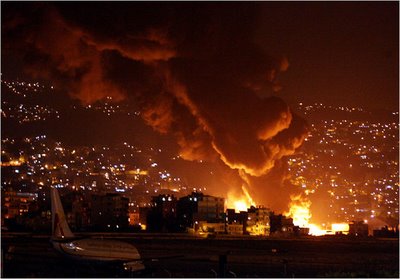
one of israel's first targets in lebanon (july 13 and again on july 15) was the power station in jiyyeh. jiyyeh is near sidon, the regional capital of the south, roughly halfway between beirut and tyre.

these attacks caused a 10,000-ton oil spill, but because lebanon's resources are being funneled towards the present internal refugee crisis, an additional 15,000 tons have spilled into the the mediterranean since then. the new york times reported this morning that oil reached the syrian coast yesterday as a result of the winds and the current.

the nighttime picture is my own -- a shot of beirut's southwestern coast during the second week of june. where the shore turns to sand is the location of the second picture, courtesy of a lebanese blogger.

according to the world peace herald, the material damage (infrastructure, buildings, etc.) from this conflict has amounted to over $2 billion. this does not include the approximately $200 million required to clean up this oil spill, or lost revenue from the closure of rafiq al-hariri international airport, failed businesses and the now bust summer tourist season, which was projected to bring 1.5 million visitors to a country of only 3.8 million people. adjusting for purchasing power parity, lebanon's gdp is $23.7 billion.

add usaid's most recent statistics -- 421 dead, 3,225 injured, 210,000 displaced to neighboring countries, and 500,000 displaced within lebanon -- and tell me how long you think reconstruction is going to take.

someone asked me a few days ago if i thought i would return to beirut and i couldn't answer the question. on a basic level, entry-points to the country are limited at the moment and will continue to be until a cease-fire comes into effect, money is raised or donated to lebanon, and then the airport runways, ports, and border crossings are repaired. more than that, though, this war has irreversably changed the city, both physically and emotionally. i received an email last week from the coordinator of international students at the american university of beirut. "the beirut you came to know," she told me, "no longer exists."

July 27, 2006

Why Is This Not News?


Try not to kill people wearing this


Apparently yesterday* Israel took a break from shelling/murdering Lebanese innocents to shell/murder four UN peacekeepers in a little booth. Here is a rough timetable of the incident:

1) Israel fires at, kills 4 people wearing UN hats in a UN bunker. There is no reason to assume these are Hezbollah guys or anything. Even though they have a lot of missiles, and the guys are only in a little booth, it takes them about 6 hours to kill all the people. Meanwhile, the four guys are apparently calling the UN up on the phone, telling them that they're being shot at and to maybe see if they can call off the guys shooting at them.
2) After the people are dead, somebody tells Kofi Annan that the whole thing smells a little fishy, and Kofi rushes out of a tremendously important comped dinner with Condoleezza and some other people to tell everybody about it.
3) Kofi changes his mind about the intentionality of the attack. Everybody agrees to "conduct an investigation," which doesn't sound much like "hold Israel responsible for the possibly-negligent-or-maybe-not homicide of 4 UN members." Noted jackass John Bolton, meanwhile, is caught cajoling the Chinese into dropping the "possibly-deliberate" rhetoric from their own shit.

Please somebody explain to me why
1) Israel expects us to believe that they really didn't know those guys were UN guys for six hours after repeated phone calls. Maybe the lines were tied up in NYC? Maybe the Israeli military, poor and destitute as it is, couldn't afford satellite phones? Who knows?
2) The probably deliberate murder of 4 UN peacekeepers by a whacko racist aggressor state is not front-page, headline news? I guess washingtonpost.com was busy running that picture of Nelly, and nytimes.com has that sweet Prey story. Portal technology sure is awesome!

Even the washingtonpost "World" section doesn't have it on the frontpage, but they sure as fuck have "Europe sweats through July," which is surely news to anybody who doesn't know that July is usually hot.


*(or something, I'm in Japan, it might have been 2 days to you people, or whatever look it was like 48 hours)

July 24, 2006

The Bush Administration & Civil Rights

This Boston Globe article is long, but it is an absolutely damning look at how the Bush administration has turned the Justice Department's Civil Rights division into a complete joke:
In an acknowledgment of the department's special need to be politically neutral, hiring for career jobs in the Civil Rights Division under all recent administrations, Democratic and Republican, had been handled by civil servants -- not political appointees.

But in the fall of 2002, then-attorney general John Ashcroft changed the procedures. The Civil Rights Division disbanded the hiring committees made up of veteran career lawyers...

The profile of the lawyers being hired has since changed dramatically, according to the resumes of successful applicants to the voting rights, employment litigation, and appellate sections... Hires with traditional civil rights backgrounds -- either civil rights litigators or members of civil rights groups -- have plunged. Only 19 of the 45 lawyers hired since 2003 in those three sections were experienced in civil rights law, and of those, nine gained their experience either by defending employers against discrimination lawsuits or by fighting against race-conscious policies... Meanwhile, conservative credentials have risen sharply [details follow]...

At the same time, the kinds of cases the Civil Rights Division is bringing have undergone a shift. The division is bringing fewer voting rights and employment cases involving systematic discrimination against African-Americans, and more alleging reverse discrimination against whites and religious discrimination against Christians.
Sometimes you just have to be astounded by how callously nepotistic this administration really is.

You know, I don't like attributing malice where stupidity can be more easily attributed to an action or a policy. But this isn't stupid. It's evil, and I mean that in a very direct way. It is evil to take a bureau designed to protect the rights of those Americans who most need protecting from infringements of those rights and handing it over to one's hack friends and supporters. I would say that I'm kind of bowled over by how transparent the Bush Admin is in their disdain for the rights and well-being of minorities, but then again, why should I be at this point?

PS. Unfortunately, you can only read the first three pages before you have to register. But those first three pages lay things out pretty well.

July 17, 2006

A little more about Lebanon

I was in Lebanon about a month ago visiting a friend. Everyone I met there was extremely kind, generous, and hospitable. The terrain was beautiful, full of towering mountains, seaside havens, and lush forests. It was heaven.

Beirut itself was teeming with life during my stay. The nights were full of raucous celebrations, especially when Lebanon's adopted team for the World Cup, Brazil, scored. Strangers smiled as I passed by during the day. And the call to prayer was stunning. It would always put a smile to my face.

What is happening now is a tragedy.

To be clear, I am not endorsing either side. I am not sure what other response Israel could have taken. But perhaps I am not creative enough.

Sometimes we see statistics scroll along the bottoms of our televisions and don't really understand what they mean. Sure, fifteen people died during such-and-such bombing. And then we forget about it. But how does it affect those who are closest to it? Most importantly, how will this affect the younger generation of Lebanese? They will be the doctors, teachers, lawyers, and statesmen who will shape the Middle East in the years to come. And few media outlets have reported their reactions.

The friend I visited (who is thankfully back in the United States) has posted some of her own thoughts as well as the thoughts of her Lebanese friends about what is happening now. I believe more information is almost always better, and I hope you will take a moment to read it. I would encourage anyone with similar stories (whether Israeli or Lebanese) to leave a comment linking to them.

The Link

July 14, 2006

Proportional Response


Today's Cup of Joe:

This is honestly what Joe Malchow wrote today. I am not making this up.
There should be a large stone statue of John Bolton somewhere, soon — at least before it becomes taboo to depict the human form. At a meeting of the United Nations Security Council, where every freedom-loving nation, hating Islamism, showed themselves too fearful to say so, Bolton cast the single no vote, blocking a proposition which would condemn Israel’s self-defense and, now, its freely-offered contribution to the War on Terror... To well-brook [wtf??] being so hated is a real talent that Mr. Bolton has.
Honestly, I'm not posting this just to be a jerk. I really feel that, if Joe is going to be the face of Dartmouth blogging (as he most definitely is), somebody should really call him out when his posts go this far off the deep end.

Joe Malchow: Now Entering Malkin Territory.

July 2, 2006

Catching up on the Alumni Constitution Battle

I've honestly not been following the recent coverage--in the Times, in the D, on the blogs--of the "long and tedious havoc," to borrow a line from Milton, that has been continuing to unfold over the past two or three weeks. I'll do a little catching up now, maybe some later.

Sara del Nido wrote "A Political Microcosm" for the D, in which she characterizes the defense of the constitution pretty accurately, I think:
Supporters of the constitution reply that the proposition is not a response to the particular claims of the three recently-elected trustees, but rather that it is a long-planned effort to, in the words of chairman William Neukom '64, create "a more democratic, more participatory form of alumni self-governance."
The latter part of this (everything after "not a response to the particular claims of the three recently-elected trustees") is quite true.

But more participation, even more democracy, does not mean more fairness. Peter Robinson made an egregiously hyperbolic comparison to Stalin, voting, and Eastern Europe sometime recently, but one need not be that dramatic to realize that the constitution can both successfully involve more people in the process of governance and also just as successfully constrict the way that participation functions. The board giveth, and the board taketh away.

What the constitution gives is a static, idle democracy that seems focused entirely on collecting inputs, without much thought given to how some outputs might be gotten out, or even what those outputs might be. Sure, the Constitution would likely introduce a broader level of participation in alumni governance, but I cannot help but think that breadth in this case precludes the addition of depth as well. I mean, I'd like to think that the new structure(s) introduced in the Constitution will allow a significantly larger number of people the chance to be creative agents in the process of alumni governance, but I'm not entirely convinced that will happen, and I'm not sure it's even intended to do so.

The presidential power arc (going from vice president to president-elect to president to past president) really bothers me because it is, quite simply, the most blatant sign that there is a massive distrust among the drafters of this constitution of the dynamics of personal choice. This complete lack of faith in the alumni body of Dartmouth College is what this structure, or any structure so ordered, reveals. The presidential power arc takes the elected candidate and just, well, sort of holds him/her for consideration for awhile, until s/he is either changed or at least influenced by those further up on the presidential ladder, or until his/her campaign platform has become less relevant or less important. It's a cooling method, and while insulation from the passions of an inflamed public can be a great thing in government, the iciness of this particular measure is, I think, a little out of proportion to the danger of the situation.

This all is essentially my response to Josiah Stevenson's defense of the Constitution, which can be found here. Stevenson states, "The proposed constitution significantly improves the democratic processes of electing alumni trustees and creates a vastly stronger alumni organization." I have before outlined why the second predicate bothers me, but the first predicate is the key here.

To reiterate: Yes, the Constitution does have measures in it that will increase democratic participation. But yes, it does have measures that are both unfair and pretty obviously designed to be so. To put it bluntly, this is democracy with a fudge factor.

But I am not at all of the opinion that this fudge factor is meant to advance a specific agenda—this is a defensive strategy, I feel, not an attempt at setting up a junta or an effort to carry Dartmouth to new heights/depths of imitating Harvard. I am sick of the conservative insurgents vs. liberal insiders rhetoric, and I'm sick of the conspiratorial accusations coming from both sides. I feel that this whole issue is just one big petty pity party, though not for people who really have any coherent vision of what they want Dartmouth to be, but rather for people who have one of two visions of what they desperately want Dartmouth not to be. If it were the former—two groups of people who had actual, positive, albeit conflicting, visions of Dartmouth—I think we might actually get somewhere. But instead we have two competing Dartmouth Dystopias repelling people into two camps whose only internal cohesion comes from the fear and repugnance of a common bugbear.

C'mon Dartmouth, we can do better than that.

This is just too funny not to post about

Joe:
The Right Brothers — Back Again

Brian with The Right Brothers was kind enough to send along the band’s newest release, “Remember: A Military Appreciation Project.” The new album was released on June 13 (and is available for purchase here). It is a collection of old and new songs from the heterodox rock group which a year ago made millions of bookmark lists with the addictive music video “Bush Was Right”.

The “Remember” disc is certainly more somber than previous albums—there are no tinkling, rhyming explications of trickle-down economics, for example—since it focuses on, primarily, the war in Iraq and the marital pain the war is causing. My favorite track from the disc, one which may be specially apt as Independence Day approaches, is “Native Son,” a soldier’s anthem. Unlike “Trickle Down” and “Bush Was Right,” this song does not lay out any line of argumentation. It is a little piece of atmosphere—of, as the song says, “man-made hell.” I include the first minute and a half of the song below.
You know, I'd really like to believe that Joe has his tongue firmly installed in his cheek here, but I'm kind of, well, skeptical.

But, anyway, count on conservatives to gain from and commodify patriotic angst--every time.

June 25, 2006

The World Cup

I have a few moments to update, so I'll talk about something that I absolutely love, the World Cup. The World Cup is greater in my mind, than any other sports event because, even more than the Olympics, the world is drawn together with an intensity of passion unequalled by anything else. It makes possible the feeling of being connected in jubilation or dejection with literally tens of millions instantaneously, a feat of such enormous humanism and humaneness that I truly cannot understand how anyone could possibly dislike or even ignore such an incredible experience.

But every Cup year, it seems, a favorite activity resurfaces--explaining America's lack of interest in soccer. There are a few common answers, and I'll try to give some of them here:

1) America is ADD. They can't take the sort of concentration needed for watching soccer.

Interestingly enough, though, this objection conflicts with the next:

2) Soccer doesn't have enough real action to keep the attention of an average American. [This also goes under the name of "not enough scoring"]

If soccer truly doesn't have enough action to keep our attention, then it should fit in perfectly with the ADD tendencies we have of letting our concentration shift from the game to something else, then to another thing, and then after awhile, back to the game, where we'll find that likely nothing has changed.

3) Americans don't like watching sports that their country isn't good at. Or, to put a finer point on it, Americans don't like watching a sport that other, smaller, Third World countries are better at than America is.

Are you saying that America is xenophobic and nationalistic to the point of hollow jingoism? O, well then, I agree. And for a good example of this genuinely silly attitude toward sport, check out Joe Malchow: "I think there are some very basic explanations, like the fact that soccer is necessarily an international sport, which makes very much sense for Europe. But the United States, vasty in its land and in its people, and separated by a sea, can sustain its three chief sports by competing within itself. This quantity and quality of competition—-in which the rest of the world doesn’t seem to want to take part anyway, and that’s just fine—-satisfies." Nevermind the fact that Great Britain has its own very successful Premiership league, or Japan its own baseball league, or even that both baseball and basketball in America can no longer really be called "satisfied" by "competing within itself," given that they are now and increasingly will be dominated by non-American players. No! American sports are not globalized, and sports in other countries are never localized! That would violate our national character!

Joe also points to a different post, which is actually worse than his own commentary, and which states,
Goals are indeed a rare commodity in soccer, so much so that soccer is, essentially, a zero sum game. The “pie” of goals not only is meager, it never grows. So it is fought over with an intensity that is almost never found in American sports. This isn’t boring, but it is deeply unsatisfying to Americans.

My theory is that Americans have neither the belief system nor the temperment for such a sisyphean sport as soccer. We are a society of doers, achievers, and builders. Our country is dynamic, constantly growing, and becoming ever bigger, richer, and stronger. We do not subscribe to a “zero sum” mentality. We do not labor for the sake of laboring. And we like our sports teams to score. Scoring is a tangible accomplishment that can be identified, quantified, tabulated, compared, analyzed, and, above all else, increased.
This is stupid, because it mischaracterizes soccer as a zero-sum game when it is nothing of the sort. It is a game of incrementalist strategy, and it is America's inability to think in the terms of incrementalist strategy—a character trait which I find to be often a deficiency and only sometimes a benefit—that helps kill soccer's popularity in America. Soccer is Risk, and America wants to play Sorry! Soccer isn't sisyphean, it's martial, but unfortunately, even that metaphor doesn't work, since most Americans think of war less tactically than heroically, less about field maps and broad strategies than about monument-ready moments of glory and triumph.

Americans don't like soccer because the victories on the field--at the end of the game or in it--are subtle and not really about individuals. They're small, and they don't coalesce very quickly or regularly. ESPN's slogan for the World Cup is "One game changes everything." I'm not even sure I'd go that far in my claims about the dynamics of soccer, but I would bet that Americans think even that claim is too dull--"One game changes everything? What about one swing, one pass, one shot? That's what sports are about!"

What vulgar puerility.

Secondarily, I think most Americans cannot understand the division which takes place in most fans between the watching of the game and the playing of it. As this blogger that Joe quotes from says, "We do not labor for the sake of laboring." Soccer players don't labor for the sake of laboring; that's a totally ludicrous claim and shows an absolute lack of experience playing. Rather, what this illustrates is the automatic identification with the players of a game that Americans do reflexively and that American sports depends upon for their popularity. You are "in the game" as a fan of American sport, but I don't think you are as a soccer fan. You can totally watch a game literally as a work of art, truly disinterested in whether the ball goes in the net or not.

The best game of the tournament so far was the Argentina/Mexico game--not because of the high drama of going into extra time or anything of that sort, but because it was played in a beautiful way--openly, with a controlled yet frenetic quality, featuring outrageous feats of ball handling and constant, perpetual dashes and runs--the Latin American way, in other words. If the game had been 8-7, it couldn't have been any better--the goals didn't matter, except for the fact that each one was utterly, unbelievably gorgeous in its execution.

But that's the way the spectator feels--it doesn't matter what the score is, as long as the ball moves around beautifully. For the players, beauty is only a means to an end. The score is what matters for them. The fans simply chose to do, to react, to observe, with different criteria in mind, and that, in my mind, is why Americans can't appreciate soccer--because they can't chose to have criteria of beauty in mind other than the beauty of the bottom line. Again, vulgar puerility.

June 21, 2006

Blogging will be virtually non-existent

Tomorrow I leave for Amherst, MA, where I will be working at a Great Books Summer Program. That may surprise some of you, given my distaste for core curricula and other such things, but I'm personally a big fan of the Great Books. I feel like I've blogged enough before on the topic, so I won't wear you out with another post about compulsory canons, etc. Instead, I leave you with another recommendation:


Watch Veronica Mars.

No, seriously. Watch Veronica Mars.

And if you're bored, check out Pitchfork's 100 Greatest Music Videos. I read Pitchfork rather lackadaisically, but this feature is actually really outstanding. However, to balance things out, also check out a Dartmouth alum's list of the Top Twenty-Five Music Videos.

June 20, 2006

Polar Bears: Humanity's Last Line of Defense

Norway is building an underground bunker somewhere above the Arctic Circle (in Svalbard, a name which should make any Philip Pullman fan smile) which will house an enormous variety of seeds for all kinds of plants, just in case we all nuke each other and all the plants die or global warming kills off the plants first.

The really awesome part about this whole thing is this, though:
While the facility will be fenced in and guarded, Svalbard's free-roaming polar bears, known for their ferocity, could also act as natural guardians, according to the Global Diversity Trust.
These polar bears will also be fitted with shoulder-mounted anti-aircraft missiles and will be trained in judo. That is all.

O, one other thing: check out this blog, a frequently updated site detailing and keeping track of all World Cup related deaths across the globe. At this moment, there have been 18. However, there has been one resurrection that we can chalk up to La Copa Mundial as well:
A 94-year-old declared dead suddenly sprang up and asked when Germany were next playing in the World Cup.

When told she had been declared dead by doctors, Maria Mueller replied: "Not likely, not until I see if Germany wins the World Cup.

"There's still life in these old bones yet, and I certainly couldn't miss the football."

Mrs Mueller had been found slumped over in her chair by son Bernhard Mueller, 66, at their home in Luegde. Neither Bernhard nor a local doctor could find a pulse.

June 19, 2006

Summer Reading Recommendation


Nikolai Gogol for the 21st Century. And if that doesn't sound exciting, you're probably not cool enough for this book.

June 16, 2006

Happy Bloomsday, Everyone!


The action

The text

I cannot believe in a God who wants to be witnessed for all the time.

I have no idea why there has of late been a resurgence of interest in Noah Riner (did he go talk to a home schooler conference or something?) but Little Green Blog and the Dartmouth Free Press website have been getting numerous comments the past few days to posts/articles that I wrote last fall. Since those comments are functionally hidden from you, my readers, due to their place deep within the LGB archives, I'll just throw up a link to the original post (this one too) and excerpt some of the comments now:

From the DFP website: "I don't understand your fear of all things Christian. What is so frightening about encouraging students to look at themselves critically and thoughtfully? Why does the name of "Jesus" strike fear in your heart?" [Ok, how about this. You recognize that faith, religion, and all your little biblical stories are legitimate subjects for unfettered secular academic inquiry, and we'll stop getting pissed off if kids tell us he's the only route to personal improvement. How about that?]

From Julie: If Jesus Christ truly did exist and if he lived a perfect life, would he not be worth mentioning in a convocation speech? Furthermore, if Christ actually died on a cross for the sins of mankind and resurrected after three days in order that we might be saved, then don't you think it was a good thing that Noah spoke of him? And so I challenge you to research the facts, the evidence; if you find that there is no real evidence for everything I listed above, then you're right in admonishing Noah for saying what he said. [Facts? Evidence? Madam, would you possibly be referring to The Bible? I believe we like to call that "begging the question."]

From Shaundra: There is a christian comic who just wrote a book called "out of the Closet Christianity" I am not sure if this is a quote from the book, but it talks about how homosexuals are coming out of the closet and christians are going in. That is a very scary thought. [A scarier thought is that there are actually Christian comics. Aren't bad attempts at popular music enough?]

From Mei-Shen Gregory: Noone understands God, we have all turned away from God, and we are stubbornly resistent to repent before God. Why are many people reluctant to ascribe God as both Father and Judge? [Uhhhhh... Maybe because some people feel that He doesn't exist.] Most importantly, the sacrificial act of Jesus is a symbol of the depravity of our condition? [That's what I was wondering.] ...in this postmodern culture, our reasoning has become clowded [sic] by too much generous orthodoxy and not enough absolute truth [like orthography]... Riner's message at a prestigious and secular IV [My land, we've gone intravenous--O, that insidious President Wright] league school such as Dartmouth was quite impressive [actually, I hear it was quite underwhelming to anyone who actually heard the speech]

From Anonymous: You see now, a person can blame his crimes on "bad genes" or a poor upbringing, instead of on the fallen sin nature. [Because "Satan made me do it" is such an improvement on the insanity plea.] ...true love is putting the well-being of another before one's own well being. I thank God for witnesses like Mr. Riner.I will keep you in my prayers. May God bless you all... [See, this is exactly it--Riner, and his supporters, feel that the best way they can show us "true love" is by ministering to us. We're saying no thanks, no sale, goodbye and brush the dust from your sandals on the way out.]