Finally, we are never immune from accusations of bias. It goes without saying that there is nothing more sensitive than matters of life and death, and the BBC's audience response has been massively supportive and understanding about the dilemmas we face in reporting terror. There have been two main exceptions. From a smattering of radical websites comes the argument that we are being hypocritical in mourning the dead of London when we allegedly gloried in civilian deaths in Iraq.
This utterly misrepresents the BBC's reporting of Iraq, where we have always sought to portray the whole picture of events in that country. The second exception is principally Fox News in the United States. A contributor to Fox said after the London bombings that "the BBC almost operates as a foreign registered agent of Hezbollah and some of the other jihadist groups". On the Fox website today there is an opinion piece, "How Jane Fonda and the BBC put you in danger". I am writing this in a building which was bombed by Irish terrorists. My colleagues and I are living in a city recovering from the wounds inflicted last week. If I may leave our customary impartiality aside for a moment, the comments made on Fox News are beneath contempt.

July 13, 2005
Reflecting on real journalism
Roger Mosey, head of BBC Television News, has a piece in today's Guardian (free registration required) discussing what it's been like to be the definitive source for reporting on the tragic London bombings. Coming from the director of one of the world's best news organizations, the brief article is an understated affirmation of what TV journalism should aspire to be: accurate, responsible, thoughtful. And I'm glad Mosey addresses one egregious example of everything TV news should not be. If you still watch Fox News, you should know you're an asshole, and a poorly informed one at that:


July 12, 2005
Setting the record straight about Rove's leak
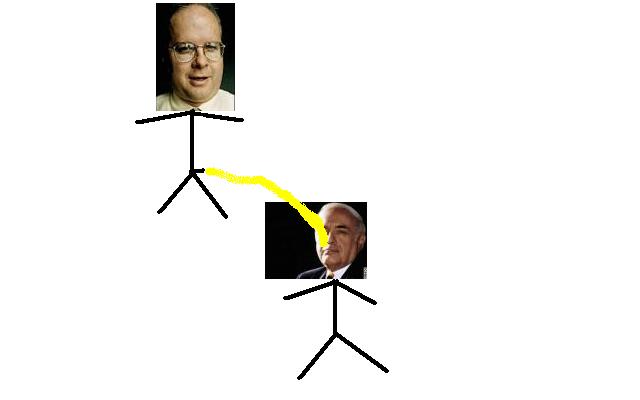
I've been following the Plame leak case for a few weeks now—and this is a story years in the making—but I thought this article from Salon was particularly good at getting the facts straight and analyzing the possible implications. It gives a brief history of the whole affair and then explains to what extent Rove might or might not be culpable, all in very clear terms.
I suspect Rove was fully cognizant of what he was doing, and what he's done is despicable. He should be fired without question (go tell the White House you think so, too). Also, it was encouraging to see the press finally do its job and hammer Scott McClellan yesterday and today. If the stakes of this case, occurring right around the whole Deepthroat/Mark Felt revelation, don't inspire mainstream journalists to dig deep and take some risks to find out the whole truth, I don't know what would.
While we're at it, how about another caption contest for the above illustration (done by yours truly)?
Photos courtesy of Google Image Search
On London
A friend alerted me to this little piece in The Nation's blog section, in John Nichol's blog.
This speech is pretty amazing, and I'll post the full text in the comments section.
This speech is pretty amazing, and I'll post the full text in the comments section.
"For instance, U.S. media pretty much missed the one truly Churchillian response to the attacks -- that of London Mayor Ken Livingstone, a committed socialist and anti-war activist, who issued the following statement on the day of the attacks:
I have no doubt whatsoever that this is a terrorist attack. We did hope in the first few minutes after hearing about the events on the Underground that it might simply be a maintenance tragedy. That was not the case. I have been able to stay in touch through the very excellent communications that were established for the eventuality that I might be out of the city at the time of a terrorist attack and they have worked with remarkable effectiveness. I will be in continual contact until I am back in London.
I want to say one thing specifically to the world today. This was not a terrorist attack against the mighty and the powerful. It was not aimed at presidents or prime ministers. It was aimed at ordinary, working-class Londoners, black and white, Muslim and Christian, Hindu and Jew, young and old. It was an indiscriminate attempt to slaughter, irrespective of any considerations for age, for class, for religion, or whatever....
(cont in comments)
July 10, 2005
Tracking the Rhetoric
When this war began, or in the march leading up to it, the case for war was completely predicated on securing Saddam's WMDs. Everything else was just icing on the cake. This little gem, from the 2003 State of the
"Before September the 11th, many in the world believed that Saddam Hussein could be contained. But chemical agents, lethal viruses and shadowy terrorist networks are not easily contained. Imagine those 19 hijackers with other weapons and other plans -- this time armed by Saddam Hussein. It would take one vial, one canister, one crate slipped into this country to bring a day of horror like none we have ever known. "
Now, depending where you lie on the political spectrum, this statement was either deceitful BS, or a well-intentioned if irresponsible overstatement. But regardless, the statement is indefensible. Report after report has shown no solid Al-Qaeda connection (just some vague and weak circumstantial evidence at best), and certainly no WMDs. The terrible dictator? Well, we’re all glad he's gone. But let’s be honest here, that was never the point of this war. In fact, our track record in
So they shifted gears. This became about spreading democracy and freedom, and liberation, a humanitarian campaign with greater ramifications for the entire
"We also hear doubts that democracy is a realistic goal for the greater
Well, that got kind of tough to back up too. Humanitarian conditions? The civilian casualties (obfuscating and micro-analyzing of the Lancet report aside) are astronomical, and the infrastructure is in complete shambles. In the Sunni triangle, things are hardly secure or safe. Democracy? Maybe. The government is just now cutting deals to include Sunni's in the government after their election boycott. We all know it won't happen any time soon, but hey, I've got hope for the future at least. What about the global war on terrorism? Reports that said the number of terrorist incidents around the world decreased turned out to be completely wrong. The insurgency is more violent than ever and more US (and Coalition) troops are dying than during the pre-Mission Accomplished era. So what became the new talking point?
We're fighting the terrorists over there so we don’t have to fight them over here.
(This comes paraphrased I guess, out of the June 28th


Maybe I'm making an obvious point here, but
"The war on terror goes on.... Their resolve is as strong as my resolve. And that is we will not yield to these people, will not yield to the terrorists."
July 6, 2005
An illusory victory, and all the better for it
David Horowitz, our favorite critic of academia, has made a name for himself by going on a crusade to badger governments and private colleges until they start teaching the conservative side of everything along side the “liberal” ideas (i.e. those commonly-held to be true and effective) or something.
Horowitz has been pushing his Academic Bill of Rights around like a cart of rotten mangos for a good while now (Horowitz plagued—I mean—visited Dartmouth in April 2004 to present his opinions), but apparently now he’s getting somewhere. Or so he thinks.
The American Council of Education released a rather brief document designed to outline “some central, overarching principles that are widely shared within the academic community [and that] deserve to be stated affirmatively as a basis for discussion of these issues on campuses and elsewhere.”
Though Horowitz claims this is a “major victory,” he’s really gotten nowhere. The standards outlined in the ACE release simply reaffirm the individual institution’s right to establish curricula (and consequentially the rejection of government intervention/regulation), as well as the idea that disagreement isn’t a bad thing, the (well-understood) notion that profs should grade impartially, and the assumption that some ideas are better than others. Really, no ground has been given, and it shouldn’t be.
Horowitz is trying to turn the same logic that has led to policies like affirmative action and the creation of departments like African-American Studies and WGST against the liberal academics who support and perpetuate them. The truism he is co-opting is “Discrimination is bad.” Horowitz’s Academic Bill of Rights uses the (very American) philosophy that it is always wrong to exclude people that differ from the socially dominant position and twists it to extend to ideas—it is always wrong, he suggests, to exclude an idea that differs from the mainstream (i.e. liberal) academic position.
For Horowitz, it is wrong to fail to balance a panel discussion, even if that will lead to inviting intellectually discredited figures. It is wrong to select readings for a curriculum without regarding all the alternatives to the mainline academic understanding of the issues at hand. It is wrong to grade an argument based on its speaker’s political beliefs without regard to its academic merit.
Well, one of these three is right (the third in case you couldn't figure it out on your own), but then again, it is unlike the others. The reasons for this difference can be summed up in one sentence:
Unlike with people, equality of opportunity is not a good thing for ideas.
The third case is a case of discrimination against the person, not the idea. The idea's merit does not enter into the reasons for its rejection--therefore, it is not a subject of discrimination. In the other two cases, it is the ideas are not given an equal opportunity, not the people behind the ideas because the situations involved are focused around the exchange of ideas, not the evaluation of people.
Without even touching on the pedagogical problems such a doctrine would create, the simple fact is that Horowitz does not understand the academic mission, which is to identify and disseminate truths. It is not in the business of presenting all sides of the issue; it is in the business of teaching which side works (the best). If it can be shown that another method or idea functions more effectively in explaining, ordering, or fixing a problem, then it should replace the old method or opinion.
To bring in speakers solely to achieve an ideological balance will only corrupt the debate; to present opinions or methods that do nothing other than offer an alternative view (but don’t improve on the mainstream position) will only bog down the class and the discourse with junk. It is this commitment to identifying and disseminating truths that was affirmed in the ACE release, not some nebulous quest for balance.
The only victory for Horowitz is that he can now say that someone has actually taken the time to try to get him to shut up rather than just sitting quietly and hoping he’d go away.
Congratulations, Davy.
[Caveat: I am not under the impression that libs have all the right answers for all academic problems, but, like it or not, that’s the way it stands in a great many fields—-liberal ideas solve or answer the questions that are being asked. Until this changes, it is unreasonable to ask for the presentation of answers or solutions that do not resolve those questions. While it is not the case that the best ideas are always the mainstream academic positions, it is the case that the business of academia is to self-correct, not to balance itself ideologically. Those are not mutually exclusive, but can certainly be at odds, and are within Mr. Horowitz’s Bill of Rights.]
Who's the real activist?
Paul Gewirtz and Chad Golder have a study in today's Times that attempts to quantify judicial activism by the Supreme Court since 1994. Their measure is simple, if a little primitive: find the number of Congressional laws each justice has struck down as a percentage of his or her total number of decisions on Congressional laws. Here's what they found:
Thomas 65.63 %
Kennedy 64.06 %
Scalia 56.25 %
Rehnquist 46.88 %
O’Connor 46.77 %
Souter 42.19 %
Stevens 39.34 %
Ginsburg 39.06 %
Breyer 28.13 %
Surprise! The cons are the activists!
The obvious methodological complication would seem to be that the study doesn't characterize or quantify the Congressional laws being deliberated by the Court. Were they passed by a Democratic or Republican Congress? And when were they passed? For laws passed long ago the whole Democratic/Republican value wouldn't mean much, since the parties shifted so much in the 60s and 70s. Basically, data with the distribution of the laws across the Congressional sessions in which they were passed and the Democratic/Republican composition of each session would make the study more precise.
But, as is, the findings still suggest the conage of "(liberal) judicial activists" to be as meaningless and misleading as most of their Orwellian bullshit.
"A Pat on the Back"
Sarah Vowell has a refreshing op-ed in the New York Times today. I saw Vowell, best known for NPR's This American Life, speak like two weeks ago at the Columbia Publishing Course where I'm at about the books she's written, Assassination Vacation and The Cloudy Patriot. She's an incredibly funny person, and the op-ed is good for quite a few laughs as well as a decent point or two. Basically, the message is: give credit where it's due, and pick your battles. Vowell is able to praise Pat Robertson for his efforts to end poverty and AIDS in Africa (he even supports the use of condoms there!?) while also arguing that we Democrats should fight like hell for this Supreme Court seat:
On Monday, anticipating an epic dust-up regarding his new nominee for the Supreme Court, President Bush said he hoped that special-interest groups on both sides would "tone down the heated rhetoric." They shouldn't, though.
This is about the lifetime appointment of a person who will be making life and death decisions for millions of people for decades to come, not about some petty time waster like - come on, again? - flag burning. It's so important that we should agree to melt together on the slopes of a Kilauea of issue-ad spew.
July 1, 2005
Now you know the rest of the story...
Paul Harvey, whom I grew up listening to in the mornings, recently made some unspeakably atrocious comments on his radio show.
The gist of it was, America has gotten where it is because we have crawled through the mud and the blood of those we've killed, enslaved, or blown up on our way to the top, and we shouldn't be worried about trying to stand up and walk like decent human beings now, with our nation's fate in the balance.
Here is one choice quote:
This man is one of the most widely respected commentators in the business, inspiring the same kind of trust that newsmen of older days like Cronkite or Kuralt carried. According to his website, "Paul Harvey News is the largest one-man network in the world, consisting of over 1200 radio stations, 400 Armed Forces Network stations that broadcast around the world, and 300 newspapers." It is estimated that his shows reach 18 million listeners. He also just signed a 10-year contract with ABC-Disney for 100 million dollars.
If this is the current voice of America, will someone please turn the station?
The gist of it was, America has gotten where it is because we have crawled through the mud and the blood of those we've killed, enslaved, or blown up on our way to the top, and we shouldn't be worried about trying to stand up and walk like decent human beings now, with our nation's fate in the balance.
Here is one choice quote:
We didn't come this far because we're made of sugar candy. Once upon a time, we elbowed our way onto and across this continent by giving smallpox-infected blankets to Native Americans. That was biological warfare. And we used every other weapon we could get our hands on to grab this land from whomever.
And we grew prosperous. And yes, we greased the skids with the sweat of slaves. So it goes with most great nation-states, which--feeling guilty about their savage pasts--eventually civilize themselves out of business and wind up invaded and ultimately dominated by the lean, hungry up-and-coming who are not made of sugar candy.
This man is one of the most widely respected commentators in the business, inspiring the same kind of trust that newsmen of older days like Cronkite or Kuralt carried. According to his website, "Paul Harvey News is the largest one-man network in the world, consisting of over 1200 radio stations, 400 Armed Forces Network stations that broadcast around the world, and 300 newspapers." It is estimated that his shows reach 18 million listeners. He also just signed a 10-year contract with ABC-Disney for 100 million dollars.
If this is the current voice of America, will someone please turn the station?
June 29, 2005
Dartmouth's reputation
We once predicted that Dartmouth would be known as the "laughing stock of academia" after vociferous conservatives Peter Robinson and Todd Zywicki were elected to the Board of Trustees in May.
So take the following for what it's worth: in light of the trustee election and the recent lift of the moratorium on new Greek houses, Inside Higher Ed yesterday published an article called "Dartmouth Shifts -- to the Right?"
Good or bad press? You decide.
June 28, 2005
Village Voice strike?
Damn gay-loving commie propagandists. Rumor on Gawker has it the Village Voice might be going on strike to protest benefit cuts proposed by their management. Just when I get to New York.
June 27, 2005
Obligatory Supreme Court Post--Someone had to do it
With the slew of cases decided by the Supreme Court today, a lot of blogging has been devoted to commentary about those decisions and the possibility that some of our beloved justices will be hanging up their robes relatively soon.
Not wanting LGB to be left out, I'll add a critique of Malchow's post about O'Connor, in which he frets about the possibility that, in the interest of maintaining minority representation on SCOTUS, when Sandra D. retires, it will seem necessary to fill that slot with another woman, or at least a "non-white, non-male replacement," a prospect Malchow could do without.
Jingoistic Joe says:
I, of course, disagree.
I disagree that some notion of minority representation on the Supreme Court is unimportant. The reason why we have nine justices instead of one person whom we deem to be supremely knowledgeable in the law is to achieve a certain amount of balance. Granted, when the Supreme Court was instituted, balance meant that not all the justices should be lawyers from plantations in Virginia who part their hair on the left. Now, however, it does--and should--mean finding eminently qualified jurists who come at the law from different perspectives, perspectives that come from a much broader range of life experiences. One way to achieve this balance is by appointing justices that are minorities.
While I believe that an unqualified candidate should never be given an appointment simply by virtue of minority status, there are more than enough highly qualified minority jurists in the nation that it wouldn't be a miscarriage of justice in the slightest to narrow the pool.
Not wanting LGB to be left out, I'll add a critique of Malchow's post about O'Connor, in which he frets about the possibility that, in the interest of maintaining minority representation on SCOTUS, when Sandra D. retires, it will seem necessary to fill that slot with another woman, or at least a "non-white, non-male replacement," a prospect Malchow could do without.
Jingoistic Joe says:
There is no room for "representation" of 400 million people in a nine-person body. Let's find some sharp people, forget about sex and non-whiteness, and call it a day.
I, of course, disagree.
I disagree that some notion of minority representation on the Supreme Court is unimportant. The reason why we have nine justices instead of one person whom we deem to be supremely knowledgeable in the law is to achieve a certain amount of balance. Granted, when the Supreme Court was instituted, balance meant that not all the justices should be lawyers from plantations in Virginia who part their hair on the left. Now, however, it does--and should--mean finding eminently qualified jurists who come at the law from different perspectives, perspectives that come from a much broader range of life experiences. One way to achieve this balance is by appointing justices that are minorities.
While I believe that an unqualified candidate should never be given an appointment simply by virtue of minority status, there are more than enough highly qualified minority jurists in the nation that it wouldn't be a miscarriage of justice in the slightest to narrow the pool.
June 26, 2005
Hagel fears Iraq might become another Vietnam
A reader of ours commented last month,
nothing about Vietnam remotely resembles Iraq. Not the people, the terrain, the tactics, the world situation and particularly not the results. To tuck your tail and run after losing 56,000 lives does not compare to freeing two countries from tyranny despite the loss of 1,600 so far.Chuck Hagel, Republican senator from Nebraska and twice-wounded Vietnam veteran, disagrees. Jake Thompson of the Omaha World-Herald reports,
Sen. Chuck Hagel addresses more than 200 Nebraska American Legion members in Grand Island on Saturday.
It took 20 minutes, but it boiled down to this:
The Bush team sent in too few troops to fight the war leading to today's chaos and rising deaths of Americans and Iraqis. Terrorists are "pouring in" to Iraq.
Basic living standards are worse than a year ago in Iraq. Civil war is perilously close to erupting there. Allies aren't helping much. The American public is losing its trust in President Bush's handling of the conflict.
And Hagel's deep fear is that it will all plunge into another Vietnam debacle, prompting Congress to force another abrupt pullout as it did in 1975.
"What we don't want to happen is for this to end up another Vietnam," Hagel told the legionnaires, "because the consequences would be catastrophic."
It would be far worse than Vietnam, says Hagel, a twice-wounded veteran of that conflict, which killed 58,000 Americans.
Rex multum loquitur
“Satire is a sort of glass wherein beholders do generally discover everybody's face but their own." – Jonathan Swift
"King of the Hill" is a great show. I've always enjoyed watching it as a satire of good ole' heartland America. But, not that surprisingly, a lot of other people—those comprising heartland America and other reddish counties, not to mention friends of mine from back in Tennessee—watch it and relate to the embattled conservatism of Hank and his buddies, perhaps seeing the influx of liberal multicuralism into the fictional town of Arlen as the real target of the show's humor. Believe it or not, such ambiguity existed well before the Age of Irony, being a common characteristic of good, subtle satire.
An article in today's New York Times Magazine, "'King of the Hill' Democrats," describes, a little belatedly, some of the cultural import of this TV show, telling how North Carolina's two-term Democratic governor actually consults it regularly for political guidance. According to the article:
The composition of the audience for ''King of the Hill'' is telling. You might expect that a spoof of a small-town propane salesman and his beer-drinking buddies would attract mostly urban intellectuals, with their highly developed sense of irony. In fact, as Governor Easley long ago realized, the show's primary viewer looks a lot like Hank Hill. According to Nielsen Media Research, the largest group of ''King of the Hill'' viewers is made up of men between the ages of 18 and 49, and almost a quarter of those men own pickup trucks.The article's worth reading, doing better than your average attempt by the NY Times to comprehend the mythical beast of the red-state Other. Howard Dean might do well to take note.
June 25, 2005
About time
Apparently the United States has finally admitted to torturing inmates at Guantanamo, though the document including the admission has not been made public yet. Story at Forbes.com.
June 24, 2005
State of the Union, world: troubling
Edit: Link fixed
The New York Review of Books has a long, must-read article on how U.S. foreign policy under Bush is failing us and the world, called "The New World Order."
I know what you might be thinking: what could the effete intellectuals at the NY Review of Books, a source we have actually never used on this blog, possibly know about the War on Terror? Well, the article is actually a review of several publications, including books by David Rieff, a reporter who once believed U.S. responsibility in international affairs boiled down to a choice between "imperalism and barbarism" for the world but who now sees the Iraq war as a disaster, and by Andrew J. Bacevich, West Point grad, Vietnam vet, and conservative Catholic who directs the study of international relations at Boston University. The author of the review is Tony Judt, director of the Remarque Institute at NYU.
Supported by Rieff and Bacevich, Judt accurately paints a picture of America under the Bush adminstration as a military state dangerously bordering on imperalism. He also describes the state of the U.N. and the desparate need for international cooperation instead of U.S. unilateralism.
The article is sizeable at 18 pages but all the better for its historical and textual detail, including informative footnotes as per NYRB standard.
Anyone who, say, supports John Bolton or votes Republican I especially encourage to read it, for it should really give you pause.
"Weakonomics"
Ariel, our economist in training, is a pretty big fan of the hit book Freakonomics. I read half of the book one day and I appreciated it as quirky, fascinating, powerful microeconomics done well. That said, I had similar qualms with it as I have with a great deal of more classically-oriented economics: the axioms about human nature on which it's based. That basically all human beings are the same, that they share some innate rationality, that we as agents use this mystical rationality to optimize our happiness, and that, to some extent, we're all made happy by similar things. I understand that this kind of economics leaves room for differing individual conceptions of happiness, so that people will take different paths towards optimizing their well-being, but in the worldview of someone like Steven Levitt the difference is more a variegation than a real variety, with all human beings essentially pursuing certain well-defined, and highly normative, types of happiness.
For me, the problem is a pretty serious epistemological one about the nature and domain of economics as a discipline. It occupies shifty ground as a science whose subject is human behavior. Although it shares with psychology an empirical method, it's more like mathematics in its underpinnings because it starts with such well-defined axioms and definitions about human behavior, namely all that facile assignation of "agency" and "rationality" to human beings, on which all its empirical explanations rest. Or so it seems to me, who cannot at all claim to know much economics but who am interested in the philosophies of mathematics, of science, etc. I'd be curious to know about any really serious treatments of the philosophy of economics which might address what I'm talking about.
I understand that not all economics works on such narrow premises, and that a lot of really great and innovative work has expanded economists' concepts of costs, benefits, and rationality. But I was also dismayed when I asked Ariel whether she knew of any economics studying decidedly non-capitalist economies such as many of the old Native American ones and those of smaller, isolated, tribal or communal societies, where ideas of agency, costs, and benefits were or are often alien. She said no she had not studied any such work and did not know of any.
How would economics describe these equally functional economies? It is certainly possible that the concepts of costs, benefits, and incentives--concepts proven to have great explanatory power--would rise to the challenge, be adapted and revised, and make sense of these systems without a massive overhaul of all economics. I would like to hear about some work in economics challenging itself to describe systems both existent and potential of social arrangements different from the capitalist one we know so well. It might be enlightening for everyone, and might even help us improve on our own capitalist society.
But getting back to Freakonomics, I offer you a provocative critique of the book on grounds similar to mine. The magazine is called N+1, the author one Meghan Falvey, and the article "Weakonomics." If you haven't read the book the article's still worth reading. Here's an excerpt from the conclusion, which suggests some immediate political consequences to this whole debate:
In this the Freakonomist is only a symptom of a pervasive metaphorical creep that has been underway for some time now. The trend toward understanding human beings as maximizers of gain and avoiders of loss has a longer history than Freakonomics'’ eight-week residency on the Times'’ bestseller list. Indeed, it is difficult to think otherwise of ourselves these days. How naturally we grasp ourselves as rational navigators of various markets: markets for friends and lovers, for career advancement, for our weekend leisure time, our political commitments. We budget and invest our time, our effort, our sympathies and pleasures. It's true that this perspective is substantially inflected with that other popular theory of self, Freudianism. But since the explosion of market exchange, seeing ourselves and others as market players has become irresistibly, sensibly alluring.
+ + +
Why does this matter? Metaphors abound. But this metaphor matters because it underpins political transformations making them seem either more palatable; or, when it runs unopposed, natural and inevitable. Our description of the rational self supports the real-world conditions under which some futures seem more attainable than others. It coaxes us into wholehearted, personally felt participation with capitalist regulation.
Levitt's calculating individual is the ideal subject of contemporary neoliberal economic reform, in particular the expansion of the market into all possible areas of life. Blair's "“stakeholder society"” and Bush's "“ownership society"” are based in just such a fictitious understanding of the individual as Levitt offers. Bush and Blair naturally take their slogans from shareholder prospectuses. Their programs involve predictable amendments to federal pension plans and tax codes. And both initiatives hail an entrepreneurial subject who is willing to negotiate various markets in the course of providing for their needs and wants. If Bush promises to make it easier for you to own a home, then what does it matter if you or anyone else has a right to shelter?
June 23, 2005
Screw the public, screw the children
Doesn't this capture nicely the Republican platform? It's been coming for a while now, but the cons' effort to destroy public broadcasting is coming to a head. The House of Representatives is considering a measure today that would cut funding for public broadcasting in half. A heartwarming detail from The Los Angeles Times:
The measure before the House today would strip more than $200 million, including money for Ready to Learn, an initiative that helps finance children's shows such as "Reading Rainbow."
And here's a New York Times article on the matter.
You can sign a petition to save public broadcasting here at MoveOn.org. They started with a goal of 500,000 signatures and are now past 1 million. This really is important. NPR and PBS are full of excellent, educational information and entertainment, which, by virtue of being public in a free society--not beholden to private, corporate interests--represent some of the last remaining independent broadcasting.
June 21, 2005

Funny competition
So I know George has submitted an entry to The New Yorker's new weekly cartoon Caption Contest. As an avid reader of the magazine for over five years now, I have been curious to know just how many people have been participating and how the feature has been working out for The New Yorker.
Well, the answer is more than 50,000 people since April, or between 7,000 and 12,000 each week.
I for one think the feature is great, and I am continually amazed at how clever some of the winning captions are.
The article from Newsday is actually pretty interesting for a few other tidbits about the contest process, such as how the editor in charge has developed a computer program to sift through entries and how the submissions are often in sync with the cartoonists' original caption:
In the May 9 issue, "First, you must gain their trust," was a finalist for a cartoon depicting a lab researcher wearing a mouse suit while taking notes on a group of caged mice. Cartoonist Mike Twohy's caption was, "First, you must earn their trust." Close enough.
Genetic politics
From The New York Times:
a team of political scientists is arguing that people's gut-level reaction to issues like the death penalty, taxes and abortion is strongly influenced by genetic inheritance. The new research builds on a series of studies that indicate that people's general approach to social issues - more conservative or more progressive - is influenced by genes.
If cons hate science so much, maybe we liberals should be focusing our efforts on genetic engineering. Who said communism was antithetical to human nature?
Subscribe to:
Posts (Atom)