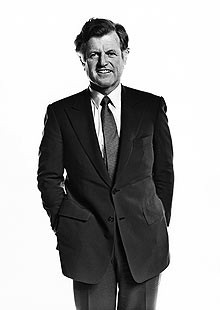
Ted Kennedy made his last stop at the U.S. Senate yesterday before being taken to Arlington National Cemetery to be buried among his brothers. The late Massachusetts Senator's funeral was held in Boston earlier in the day and attended by President Obama, Former Presidents Clinton, Bush (43), and Carter, Vice President Biden, Former Vice Presidents Gore and Quayle, and Secretary of State Clinton, among others. Awaiting his body on the Capitol steps were around 500 mostly former staffers, many of whom had attended Sen. Kennedy's 75th birthday party and now reconvened here under less happy circumstances. The casket was not originally planned to stop at the Capitol (as evidenced by the complete lack of crowd barriers), but seeing as that was where Ted had spent the majority of his life, it seemed only fitting that it should. The public was not given much notice, but from the DC news I read, I learned that the casket would arrive sometime after 4PM. Since I lived only two blocks away, I ventured out at the appointed hour to see it.
 Leaving my apartment and nearing the Senate, I saw waves of people converging there, drawn if by magnetism. Residents and tourists. Children and parents. The young. The elderly. A spectrum of all colors. They collectively felt that this was a historic moment and maybe for Teddy or maybe for themselves they wanted to be a part of it. I found myself next to a kindly looking older man with a powder blue Obama hat and holding what appeared to be the only sign in the entire crowd. In felt marker it read "Hail to the Hero of Healthcare" and he quietly held it to his chest as we awaited the hearse.
 Just then, a lady wearing a teal blazer and some neck badge I've never seen before came through the crowd and approached the man. She identified herself as a Kennedy staffer, told the man that his sign was disrespecting the funeral, ans asked him to take it down. The kindly man said that he would be unable to honor that request and held it up again. The fact that a congressional staffer asked a man to censor himself hear the capitol deeply troubled me. He wasn't shouting anything or disturbing those around him. The sign he held merely honored Kennedy's championing of health care, and did not directly advocate for anything. What's more, he was holding the sign in a secluded part of a 5,000+ crowd, not on Kennedy's funeral alter or anything. I patted him on the shoulder and we exchanged nods.
 "Maybe she's against healthcare," he said to me. The pasty man in front of him turned to him and matter-of-factly said that she's a loyal staffer and was merely enforcing the Kennedys' reasonable request that the event not be politicized. We asked this other staffer what about the sign he found to be partisan and why, given the fact that Kennedy himself said that the pursuit of universal health care was "the cause of my life," it disrespected the event. We reminded him that earlier at Kennedy's funeral, his own grandson, in the church and on live television, said, "that every American will have decent quality health care as a fundamental right and not a privileged, we pray to the lord [lord hear our prayer]." The man seemed to realize that he was not going to look good in this discussion, the way officials arguing with citizens never do. He said something about avoiding the political backlash caused at the Paul Wellstone funeral, and we asked again how a funeral for a lifetime politician can be anything less than political. If Democrats want to turn off voters, they should continue to hire self-righteous staffers like these.
 About that time, the 22-year-old woman directly in front of me collapsed. She and her similarly young and attractive husband had been waiting with their 1-year-old baby when heatstroke or dehydration must have got the better of her. Earlier they were frustrated they couldn't get any of the water for their baby that staffers were passing out, and I told them the obvious fact that if they say they have a child, everyone will bend over backwards to give them anything they want. "I have a baby," the father said. Presto: free water.
They had seemed pretty clueless when it came to being in crowds, I had to give them some more advice. "If she's not feeling well, you should shout the word 'medic'." Within 30 seconds the group of middle aged civilian paramedics who had come to her aid were relieved by a platoon of well-dressed Capitol doctors who gave her a full diagnostic and whisked her away. The kindly man turned again to me. "That's government run health care for you." Free and socialized, I thought. And no bureaucrat standing in the way. Within a few minutes, another woman fell, and then another. It became a game watching the young doctors and police man rush from place to place.
Standing in the heat of the Sun, occasionally relieved by a passing cloud, the crowd waited more than two hours, swelling in number all the while. Even the babies remained remarkably calm. The lady next to me remarked that things would have been better if the staffers passed out more water instead of American flags. I told her, "It's certainly not for lack of patriotism that everyone is passing out."
 The crowd broke out into sustained applause when the sickly 91-year-old Senator Robert Byrd (D-WV) appeared in his wheelchair on the steps, and then again 15 minutes later when the hearse arrived. After some words by a religious official and a representative of the family, a choir led the crowd in America the Beautiful. As the family returned to their cars, the crowd broke into impromptu recessionals of patriotic songs sung in muted and reverent tones. From what I heard there, the singing began with the staffers on the steps and slowly spread like a faint wind onto the gathered crowd so that it too was fully involved by each song's first chorus.
 The caravan consisted of a half dozen black sedans, a few black short-buses, and no less than five full-sized Peter Pan tour buses. After a while I started to wonder exactly how many Kennedys there really were. And then they all finally left, the sun setting behind the Lincoln Monument far in the distance, motorcycle engines competing for volume over the din of the cicadas: the Last the Senate ever saw of Ted Kennedy.