Showing posts with label Books. Show all posts

March 1, 2011

Review: Snuff- Where the reader gets screwed.

Reading Chuck Palahniuk's novels have convinced me of one simple fact: that ever since Fight Club, ol' Chuck is coasting.

Snuff tells the story of a come-back-seeking porno actress trying to break the world group-sex record, as told by the 600 men waiting off-camera to screw her. Now Fight Club was and remains one of the most brilliant books I've ever read, but the disjointed narrative style, repetition, disaffected characters, and aggressive violence that served that book so well have frankly flopped in his other work. Instead we are left with a gross and simple little story. Gross in the childish way where the point is to shock the reader but too immature to be effective or engaging. Group sex is naughty. Peeing on a floor where people walk on bare feet is gross. Guzzling ranch dip, scooping it up with the same chip every time, is something mommy would never let us do.

August 28, 2010

REVIEW: Linchpin is simple, weak on meaning, and poorly written

Imagine the worst motivational speech ever given. That's Seth Godin's Linchpin.

Now the premise of the book is an admirable and important topic to cover: how can you make yourself indispensable at work? Godin correctly summarizes the situation we now live in-- If you are just a gear in a machine, if you do what you're told and nothing more, if you want to be paid just for showing up, if you want a profession that does not require you to be creative-- then sucks to be you. Those kinds of jobs are rightly being shipped away overseas to be done by equally qualified people at a fraction of the price. What are left are jobs that require creativity, problem solving, and original thinking, and there begins Godin's advice.

The gaping, cavernous-sized flaw with Godin's book is that the vision he offers is one that precludes regular work environments. He wants people to devote themselves entirely to creating "art" but never reconciles this noble pursuit of self-actualization with employment realities. The 'artist' Godin describes cannot work for a boss or really fit into a team. Instead they are merely creative people who when given the possibilty to expand beyond their job descriptions are able to usher in a new corporate ideology or system for doing things that improves the company. If it's news that people should be doing that, they you should take Godin's book and smack yourself in the face.

August 18, 2010

REVIEW: Sedaris's Flames shine bright

David Sedaris has to be one of the greatest writers who ever lived. I say this because while other best-selling writers teach you compelling lessons (David McCullough), encourage your inner conspirator (Dan Brown), show you new and scary worlds (Michael Crichton), or take you off into fantasy (J.K. Rowling), Sedaris writes about the mundane and somehow makes it fascinating. Each of the many stories in his books are like literary candy: short, sweet, and easily digestible. That is not to say that he is entirely frivolous, though the books are far from serious, as at each turn Sedaris is able to make quick incisive quips about the absurd and awkward world he tries in vain to live in.


July 11, 2010

REVIEW: Nightlight: A Parody

The Harvard Lampoon lives up to its narcissistic self-promotion in this laugh-out-loud hilarious parody of that ultimate tween literary decay, Stephenie Meyer's Twilight series. I can't tell if it's the pure absurdity of the basis books (and the magnitude of their popularity) or if the kids at Harvard really are that funny, but Nightlight had me in stitches to the bemusement of the other passengers on the NYC subway.

Basically the book is written as if a girl as insane, spacey, and self-obsessed as Bella 'Goose' were actually the narrator and 'Edwart' were not a vampire but rather a highly odd, slightly-hypochondriac, overachieving dweebish high school student. Knowing more than just a few Dartmouth students who, like Bella, seem to live in their own little worlds where their suffocating underachievement and complete awkwardness is remaped in their brain as evidence of insightfullness, attractiveness, and being interesting, Nightlight was a lampoon for me on many levels.

June 4, 2010

REVIEW: Theodor SEUSS Geisel (Lives and Legacies)

Dr. Suess is one of Dartmouth's favorite sons, and yet few of us know much about Theodor Seuss Geisel, the D'25 son of a brewer who drew naughty cartoons for the Jack-O and made war movies for the military. In his book, Theodor SEUSS Geisel Dartmouth Professor and MALS director Donald Pease shows us the flesh-and-blood man behind the most celebrated children's books in America. We see how Geisel's shame and ostracism due to his German ancestry in WWI America inspired him to take refuge in satire. We learn how he adopted his now famous pen-name to circumvent the administration's suspension of his extracurricular activities after H-Po caught him drinking during prohibition. We see the development he experiences, from a war-cartoonist and political satirist to an author/illustrator primarily for children, and we take note of the tragedies that befall him, notably the suicide of his first wife.

June 1, 2010

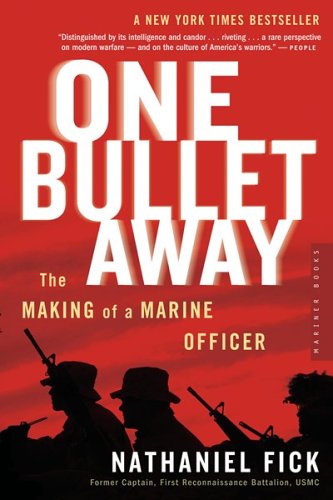
REVIEW: One Bullet Away

Nate Fick (D'99) divides his life into three sections: "peace", "war", and "afterward". By page count, "war" is by far the longest.

After completing Officer Candidate School and his A.B. in Classics from Dartmouth, Fick was commissioned a Second Lieutenant in the U.S. Marines and commanded the auxiliary platoon of the 1st Battalion, 1st Marines in the 15th Marine Expeditionary Unit during the first stages of the War in Afghanistan. As the kind of guy who gets perfect scores on the Marine physical exam, Fick thought he wasn't challenged enough with that assignment and passed rigorous training to be a platoon commander of the Marine's elite 1st Reconnaissance Battalion on the front-most lines in the 2003 invasion of Iraq.

Thanks to embedded Rolling Stone journalist Evan Wright, Fick's story was published as an article series in that magazine and later turned into a book, movie, and TV show all entitled Generation Kill. The publicity made Fick a Marine celebrity, rocketing his career as a Washington expert on the war and eventually as CEO of the Center for a New American Security.

REVIEW: Naked Economics

Where was Charlie Wheelan (D '88) when I took Econ 01?

In the foreword to Wheelan's acclaimed 2002 pop-economics book Naked Economics, Princeton University professor Burton Malkiel sums up the author best: “Charles Wheelan is the man with the anti-Midas touch... If he touched gold he would turn it to life.”

For casual observers of 'the dismal science', Naked Economics takes your hand and walks you through a basic understanding of market-theory frameworks, all in a light and conversational tone. Wheelan explains why everyone should love government (as a necessary correcting and regulating force in the market) and outlines which uses of it would be most efficient. He explains why it is that Bill Gates makes more money than you or I and uses that example to bolster later conversations about value and scarcity. He detailed the differences between fiscal and monetary policy and shows you why and when governments would use each.

April 12, 2010

REVIEW: Lone Survivor

Lone Survivor: The Eyewitness Account of Operation Redwing and the Lost Heroes of Seal Team 10 follows ex-Navy SEAL Marcus Luttrell through his Texan upbringing, Seal School, deployment to Afghanistan, and eventual rescue from the most disastrous Special Operations engagement in U.S. History.

First, the good: Lone Survivor offers a rare glimpse at not only the training and operations that SEALs go through, but also a play-by-play look at the thinking of one SEAL during the most dangerous and traumatic operation of his life. We see how advanced SEAL training prepares its members to be effective, resourceful, and tenacious killing machines, even when faced with insurmountable odds and overwhelming force. These men take only the most dangerous missions and accept only the most daring, strong, and pain-tolerant among them. Marcus Luttrell and his ghost writer convey all this in a very approachable style any aspiring SEAL can appreciate, and it will doubtlessly be turned into a movie one day.

Now, the bad (and there is a lot of it): First, this book might better be called "Glenn Beck goes to War". As Luttrell and his men are scoping-out a terrorist stronghold, he would have us believe that while he fears neither Al-Quaeda nor the Taliban nor death itself, the one thing that haunts his dreams and raises the hair on his neck is... the American "liberal" media. Specifically, he believes that the media would vilify him for killing terrorists and somehow whip-up criminal charges against him. When a bunch of unarmed goat-herders happen upon Luttrell's position (possibly revealing them to the Taliban below), Luttrell quickly suggests (and proudly recounts his suggestion) that kill them (a War Crime). Only for 'fear of what the Liberals might say' does their commander decide instead to let them go (possibly leading to the Taliban discovering the SEALs a short while later). Luttrell immediately regrets the decision, lamenting "I felt like such a Liberal."

The irony of the situation is completely lost on Luttrell when he finds himself at the mercy of Pashtun tribesmen, who have to choose between defending him (thereby risking reprisal attacks from the Taliban against them) or turn him over to be killed. If the tribesman made the "pure military decision" Luttrell himself demanded of the goat herders, they would have surely killed him. But being responsible citizens, as well as moral people, they choose not to and instead risked everything by actually defending him, theoretically "to the last man".

At every turn, Luttrell demonstrates a fervent hatred for all things liberal and an almost willful misunderstanding of the reasoning behind and proper execution of rules of engagement. He also generously peppers in Muslim bigotry (calling them towel-heads), machismo, god-is-on-my-side bravado, and an unholy amount of pride for his native state of Texas. As someone aspiring to be a Naval Intelligence Officer, I find men like Luttrell dangerous to the overall U.S. mission in Afghanistan-- trying to win the locals' hearts and minds, when he'd rather put a bullet through each. In terms of style, Luttrell is something between Huck Finn and Yosemite Sam, which might be endearing to some, but torturous to me.

Luttrell and his comrades have honorably served their country, and as a tribute to his fallen brothers, this book is deserving of respect. But for all the vitriol and hate contained herein, it offers a very narrow strip of understanding and can only be taken so seriously. Much of what went wrong about the operation can be chalked up to poor planning and mistakes on the ground, which (besides the decision not to kill the goat herders) is not really discussed. Given that Luttrell's role in the Hindu Kush was one of a "blunt instrument" (to quote M from James Bond) not much more could really be expected of him, and in this book, nothing more is given.

Buy it
Skim it
Toss it

April 7, 2010

REVIEW: In Defense of Food

Everything you know about food is wrong. Not only that, everything the people making your food know is probably wrong too.

Michael Pollan's In Defense of Food illustrates how poorly understood the field of food science is and ignorance corrupts our eating habits. Scientists try to reduce everything down to soil to their essential few components and then build "nutrients" -- not "food" -- accordingly. Soil is reduced to just potassium, phosphorous and nitrogen. The plants that soil produces suffer from a lack of nutritional diversity, and then the meat animals that eat those plants do as well. To compensate, scientists sprinkle on top whatever nutrients are popular at the moments and market it as "healthy" "food".

The big problem, Pollan shows, is that a lot of the benefits in food exist in the synergy between many food elements coming together, rather than in the right combination of five or so ingredients. To function properly, the human body needs an astonishing amount of different compounds, the spectrum of which are available in common food has been severely limited by the industrialization of production. Whereas in previous generations, many varieties of crops were planted and consumed, now industrialization has led to convergence. The dominant crops were selected for their ability to produce, not nutritional value, and the fact that they are always in season means that the usual shifts in diets are stabilized to a few homogeneous crops.

The most alarming part of what Pollan shows is how much of the supermarket is now filled with imitation food -- colorful concoctions of chemicals, additives, food colouring, and sugar that generations-past would not even recognize as being edible. After seeing Food Inc. (which shows how almost the entire supermarket consists of corn mascaraing as everything from cereal to pancake syrup) and reading this book, I felt like I could see into the Matrix. Everyone around me was eating-- but they weren't eating food. It was all an illusion. What they thought as a proper meal was really fried red meat (non-grass fed), with bread (robbed of its nutrients), fried potatoes, and a corn syrup-filled artificial drink.

What's the way forward? Pollan says that we should read the ingredients lists and if we see corn syrup, a word we can't pronounce, or more than 10 ingredients, we should leave it on the shelf. Certifications labeling food as "healthy" are all to be treated as suspect due to the fact that research studies into the nutritional value of food are paid for and influenced by the companies that commission them. If you want to eat healthy, follow Pollan's advice: "Eat food (not 'nutrients' or 'imitation food'). Not too much. Mostly plants. And nothing your great-grand parents wouldn't recognize as food.

As someone who admires the work of Norman Borlaug in vastly increasing the yield and strength of crops in order to feed the world's hungry poor, I tended to view the organic movement as hippie misadventure. But reading this book has changed my thinking. If you have the money, buy organic. Go to the farmer's market. Prepare your own food. If you don't, at least avoid the things things that don't look natural. The food we have may keep us from starving to death, but that doesn't mean that it isn't killing us.

Read it
Skim it
Toss it

REVIEW: The Big Short

In his latest book, The Big Short, ex-investment banker Michael Lewis exposes all that I suspected about the financial industry: that it is essentially a bunch of vastly over-paid, type-A 20/30-year-olds greedily gambling away the public's money on bets they don't understand in ways that are not socially productive, safe in the knowledge that should they fail, they will be furnished with a lavish golden parachute and a government bailout. I find something intrinsically parasitic about people who go into a finance career hoping to make names for themselves betting other peoples' money and collecting salaries exponentially greater than the worth of their labors.

The form of the book is a drifting narrative following various real, but unknown players in the financial collapse, illustrating what went wrong and who saw it coming. As the fodder for an eventual movie, it's pretty compelling (see: The Blind Side); and it's a nice and breezy read. As an academic look at the crisis, why it went wrong, and what should be done, Lewis is all platitudes. Missing this key component in a discussion of the financial system leaves an empty story and the reader wanting.

Read it
Skim it
Toss it

March 30, 2010

REVIEW: Me Talk Pretty One Day

Arguably the most famous work in the canon of David Sedaris, Me Talk Pretty One Day has the kind of stories Sedaris fans will love, and Sedaris-virgins will love to discover. Since reading Naked and Dress Your Family in Corduroy and Denim, I've been amazed by Sedaris's talent for turning mundane life into fascinating explorations of the human experience, and have made it a passive goal of mine to read all his six books. With stories centering around family members or childhood figures (each with the kind of clear, constant voice you can effortlessly hear inside your head as you read), Sedaris must have an incredible memory, detailed diary, or convincing imagination. While those expecting to hear heartthrob stories of excitement and adventure will be disappointed by the National Public Radio-ready prose of Sedaris's books, everyone will be able to appreciate the mastery of his writing and brevity.

Some of the stories contained in Me Talk Pretty will be familiar to listeners of NPR's This American Life, which I believe speaks more to their strength than their redundancy. The book contains quite a bit on his experiences in France (touched upon in other works), and has a bit too much Andy Rooney-esque nostalgia at times, but Me Talk Pretty is Sedaris at his best.

Read it

Skim it
Skip it

March 28, 2010

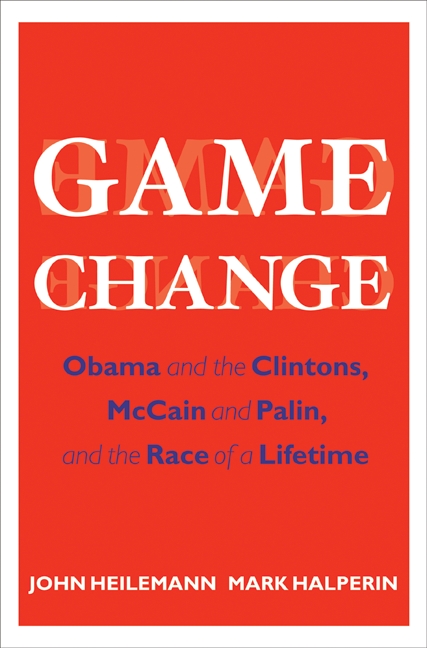
REVIEW: Game Change


A blow-by-blow tactical recap of the 2008 primary and general presidential elections, Game Change is a mind-blowing and eye-opening look behind the curtain in American Presidential Politics. What Otto Van Bismark said about laws and sausages (it's best not to watch them being made) can be equally applied to the minting of candidates; readers of this book will be startled at how impulsive, random, and junior-varsity the process is to crown the leader of the free world.

A few observations on the primary characters:

Hillary: Clearly the person best-suited and most deserving of being President. Foiled and propelled at times by her husband and drama-prone staff, Hillary fell victim to the resistance of her party's leadership to Clinton-Family Domination and the Media's infatuation of the hail-Mary narrative of Obama.

Obama: The coolest candidate in both senses of the world. Always confident, always in control, perhaps to the point of arrogance or megalomania. While his rhetoric has always been praised, Game Change reinforces the view that Obama has been weak on substance. Very weak. In spite of poor debate performances and long-shot odds (even though the establishment Democratic Party backed him), Obama was able tap into the right message, lift the right spirits, and win the impossible victory.

McCain: RISK LOVING... but what can you expect from a pilot? Curses like a sailor, but then again he was in the Navy. What you see is what you get, and as a regular good ol' guy, it's probably best he's not in the White House

Palin
: Eager if extremely, extremely naive. An undereducated Alaskan mom who really had little business outside of her state and certainly not in politics. She was catapulted onto the national stage by sheer, dumb, cosmic chance caused by the impulsiveness of McCain's VEEP decision (one that that needed to be a "game changer") and the complete lack of vetting. Fast and loose with the truth, though I'm not sure if she's a liar or if she just doesn't get it. Even McCain's staff twisted with regret when they learned exactly how completely unfit she is to be President

The Media: A violin to be played by the most talented maestro. Dutifully broadcasted any faux-outrage put out by the usually quite rational and understanding candidates. Completely ineffective as a vehicle for vetting and testing candidates as social narrative always dominates. Clearly the most embarrassed party in Game Change.

Read it
Skim it
Skip it

March 16, 2010

REVIEW: Brave New World

Aldous Huxley's 1932 novel Brave New World presents a vision of consumerism and mechanization, where social strata are bred into the biology of factory-produced twins, and stuporous stability is the highest government ideal. I found myself captivated by the book's system of society, its veneration of Henry Ford, and culture of instant gratification. If Orwell's vision was pure fascism, this is pure capitalism.

On the downside, Brave New World is nowhere as intellectually deep as 1984. The plot and characters are underdeveloped and inconsequential. Huxley makes the joy of reading solely in its exploration of his (brave new) world, but that can only carry the book so far. Throw in a compelling plot, differentiated tone of story-telling, and dynamic characters and it might have been perfect.

Read it

Skim it
Toss it

December 15, 2009

Review: The Tipping Point

The Tipping Point is a commercially accessible examination of how trends start and flourish, which is much like pandemics. Gladwell has a talent for explaining large concepts in succinct, clear writing, expounded upon by numerous examples and weaved together through engaging tales. I found Tipping Point more cerebral than Blink, but still a bit too 'accessible' for the educated reader. Also, much of the analysis of the book appeared to be retro-justifications of particular trends, generalizing most of the contributing factors into Gladwell's construction, muting the others, and ignoring trends that may have run completely counter. I would have liked to see a prediction made based on the theories presented to test them and provide falsifiability, but that would have been above and beyond the call of duty.

Read it.
Skim it.
Toss it.

December 9, 2009

Review: Queer London

A dry, technical, and academic look at queer subculture in London between 1918 and 1957. Interesting in that it reduces to a science the rather inexpressible notions and progressions of gay life. There is certainly a parallel to be found between the passive->excluded->marginalized->subculture->pride progression of gays and other social movements. Houlbrook tries to weave in personal stories that humanize the concepts presented, and while he does a good job in those parts, the people reading such a book are in no need of convincing; the parts serve only to make the technical bits endurable. A great book, I'm sure, for academics, but not for pleasure reading.

Read it
Skim it
Toss it

December 5, 2009

Review: Bach, Beethoven, and the Boys

Billed as "music history as it ought to be taught," Bach, Beethoven, and the Boys offers a sarcastic, familiar, whirlwind tour of the greats from music history. As pleasure reading, the book offers a number of great details and funny stories from the way-side of history. As a textbook, the details about most musicians are trivial, the important stuff, forgettable, and the prose, too sarcastic to tell genuine from jest. In all, a rather frivolous read that music lovers would enjoy and everyone else would likely fail to appreciate.

Read it
Skim it
Toss it