Umm, that's weird, but it's just one of the (reported) nicknames Dubya has bestowed upon a variety of Washington/international personalities.
Some of the best:
Vladimir Putin: Pootie-Poot
Karen Hughes: Hurrican Karen
Alberto Gonzales: Fredo (as in the brother Michael Corleone kisses and sends to sleep with the fishes? that's a bit creepy)
Maureen Dowd: Cobra
(Hat tip: Village Voice)
Edit: This registry is actually part of a larger effort, the NNDB, which purports to keep track of all noteworthy people. Kind of like IMDb, but for people that matter.

October 11, 2005


October 10, 2005
Speaking of new blogs
Check out The Agenda Gap, run by two 07s--Adam Shpeen and Michael Herman.
The Agenda Gap is "intent on reporting, addressing, and examining salient political issues from a critical point of view. Instead of the common demagoguery found on internet blogs, The Agenda Gap seeks to provide refuge for politically aware individuals tired of destructive ideological labels and agenda-driven opinion makers."
It's a very good blog already, with some extraordinarily insightful commentary about Congressional races, Washington whispers, etc. Check it out.
The Agenda Gap is "intent on reporting, addressing, and examining salient political issues from a critical point of view. Instead of the common demagoguery found on internet blogs, The Agenda Gap seeks to provide refuge for politically aware individuals tired of destructive ideological labels and agenda-driven opinion makers."
It's a very good blog already, with some extraordinarily insightful commentary about Congressional races, Washington whispers, etc. Check it out.
The Review Reviewed
I have now started a blog that will be a place I'll post some of my longer and more thoughtful entries, Vox in Sox.
I've posted a few times now, but the most recent entry is a retort to the new issue of the Review. If you'd like to see it systematically taken apart and reduced to shreds, check it out.
[I'll still post here, of course, but mainly links without much commentary]
I've posted a few times now, but the most recent entry is a retort to the new issue of the Review. If you'd like to see it systematically taken apart and reduced to shreds, check it out.
[I'll still post here, of course, but mainly links without much commentary]
Off Center -- On Target?
Someone please read this book for me and tell me everything about it?
This book Off Center says it explains how and why asymmetrical polarization--Republicans have polarized more than Dems--without a concomitant, significant shift of the center has been able to bring about new governmental programs, policies, and philosophies that are out of line with moderate expectations or desires.
If their thesis--that moderates aren't really all that happy about the new conservatism, but haven't found a way to express (or have been prevented from expressing) themselves--is correct, that means a lot in terms of what a strongly led group of young, outsider Democrats can do in 2006, especially if Miers gives some far-righters a reason to stay at home (or vote for a third party).
Being in Glasgow, it might be difficult to get a book on American politics without having it shipped over, so I encourage y'all to read it and tell me what you think.
This book Off Center says it explains how and why asymmetrical polarization--Republicans have polarized more than Dems--without a concomitant, significant shift of the center has been able to bring about new governmental programs, policies, and philosophies that are out of line with moderate expectations or desires.
If their thesis--that moderates aren't really all that happy about the new conservatism, but haven't found a way to express (or have been prevented from expressing) themselves--is correct, that means a lot in terms of what a strongly led group of young, outsider Democrats can do in 2006, especially if Miers gives some far-righters a reason to stay at home (or vote for a third party).
Being in Glasgow, it might be difficult to get a book on American politics without having it shipped over, so I encourage y'all to read it and tell me what you think.
October 9, 2005
If you haven't seen this
Barack Obama's Dailykos entry of last Friday is a must-read. This could be the manifesto we--or at least I--have been waiting for (and that I tried to write for the DFP over the summer).
Here is the key quote:
This man is for real.
Here is the key quote:
The bottom line is that our job is harder than the conservatives' job. After all, it's easy to articulate a belligerent foreign policy based solely on unilateral military action, a policy that sounds tough and acts dumb; it's harder to craft a foreign policy that's tough and smart. It's easy to dismantle government safety nets; it's harder to transform those safety nets so that they work for people and can be paid for. It's easy to embrace a theological absolutism; it's harder to find the right balance between the legitimate role of faith in our lives and the demands of our civic religion. But that's our job. And I firmly believe that whenever we exaggerate or demonize, or oversimplify or overstate our case, we lose. Whenever we dumb down the political debate, we lose. A polarized electorate that is turned off of politics, and easily dismisses both parties because of the nasty, dishonest tone of the debate, works perfectly well for those who seek to chip away at the very idea of government because, in the end, a cynical electorate is a selfish electorate.
This man is for real.
October 6, 2005
Oh, Thank God
White House denies claims that Bush told Palestinians that he was on a mission from God.
Bush is supposed to have said, "I'm driven with a mission from God. God would tell me, George, go and fight those terrorists in Afghanistan. And I did, and then God would tell me, George, go and end the tyranny in Iraq... And I did.
"And now, again, I feel God's words coming to me, Go get the Palestinians their state and get the Israelis their security, and get peace in the Middle East. And by God I'm gonna do it."
God similarly denies claims that he told Bush anything of the sort.
He also denies claims that he had anything to do with last night's Red Sox loss. "That Graffanino fucker botched that all on his own," he said.
Bush is supposed to have said, "I'm driven with a mission from God. God would tell me, George, go and fight those terrorists in Afghanistan. And I did, and then God would tell me, George, go and end the tyranny in Iraq... And I did.
"And now, again, I feel God's words coming to me, Go get the Palestinians their state and get the Israelis their security, and get peace in the Middle East. And by God I'm gonna do it."
God similarly denies claims that he told Bush anything of the sort.
He also denies claims that he had anything to do with last night's Red Sox loss. "That Graffanino fucker botched that all on his own," he said.
Taliban controlled?
The download page for Dartmouth's VPN client lists a number of countries that are restricted from using said client.
They are:
Has this just not been updated, or does Dartmouth know something about Afghanistan the rest of us don't?
Also, what's wrong with Montenegro?
They are:
Afghanistan (Taliban controlled), Cuba, Iran, Iraq, Kosovo (Serbian controlled), Libya, Montenegro, North Korea, Serbia, Sudan, and Syria.
Has this just not been updated, or does Dartmouth know something about Afghanistan the rest of us don't?
Also, what's wrong with Montenegro?
He said the word!
(Bill) Clinton calls Iraq a "quagmire".
If I remember correctly, Clinton has drawn some criticism for not strongly speaking out against the Iraq War--could this be the start of something new or merely a meek acknowledgement of what everyone already knows?
If I remember correctly, Clinton has drawn some criticism for not strongly speaking out against the Iraq War--could this be the start of something new or merely a meek acknowledgement of what everyone already knows?
Programming Board--Still Sucking
Joe Malchow is rightly confused about the Programming Board's latest failure to bring a halfway decent act to Dartmouth. (I think the answer to his question is Norah Jones.)
I have previously written two articles (here and here) for the DFP defaming Programming Board's musical selections, but I thought Vanessa Carlton needed no such diatribe.
Apparently, I was right, given that no one went.
I have previously written two articles (here and here) for the DFP defaming Programming Board's musical selections, but I thought Vanessa Carlton needed no such diatribe.
Apparently, I was right, given that no one went.
Roe--'Dead to Rights?'
Uh-oh?
Or maybe not. I don't really think The Huffington Post should be relied on here.
But at least Dr. Dobson is on the case. He'll tell us pretty soon what God says about Miers.
Or maybe not. I don't really think The Huffington Post should be relied on here.
But at least Dr. Dobson is on the case. He'll tell us pretty soon what God says about Miers.
October 5, 2005
The Review finds a friend
A Harvard student wrote a moving op-ed criticizing the diffusion of the Crimson Core Curriculum.
I think the conceit he uses--an address to the Core Curriculum itself--is fairly stilted, but the message--how does one "know thyself" if the Core Curriculum has no identity of its own?--is solid.
However, to reiterate arguments I have made earlier, a core curriculum is no longer commensurate with either the breadth or the depth of our knowledge or our know-how--as a human race, as an American nation, or as individuals. I believe that the wide-open GenEd requirements this Harvard author describes are pretty bad and likely do very little to helping students prepare for anything, but I believe the solution to this problem is not to junk any class that doesn't focus on Western culture/history/philosophy, but to have more faith in authors, in ideas, and in cultures that are not dead, white, and male.
As a person who is two of the above adjectives, perhaps I should recuse myself from this sort of judgment, but I think that if we get serious about teaching and studying other cultures, we will find them easily as wondrously complex and, more importantly, as useful as Western "civilization." I think the problem is, simply, that the efforts to include non-Western traditions in GenEd requirements have been half-hearted and lukewarm. This leads to half-hearted and lukewarm students. If people are taking a WGST or AAAS course because it is easy, this is a problem. But there is a difference between the course being easy and the subject being easy. If taught well, it won't be, students will stop taking it as a soft option, and may return, after all, to the Classics Department. Or they may find something intriguing, vital, and troubling in another culture and use it to work out things about the world that they inhabit.
But a Core Curriculum, especially along the lines of the one the Review proposed, will be incapable of covering such a broad area of study--literally, the world. What will be needed in navigating this field is better advising that helps students find good classes, an administration that understands the value of non-Western culture, and a campus of open minds.
I think the conceit he uses--an address to the Core Curriculum itself--is fairly stilted, but the message--how does one "know thyself" if the Core Curriculum has no identity of its own?--is solid.
However, to reiterate arguments I have made earlier, a core curriculum is no longer commensurate with either the breadth or the depth of our knowledge or our know-how--as a human race, as an American nation, or as individuals. I believe that the wide-open GenEd requirements this Harvard author describes are pretty bad and likely do very little to helping students prepare for anything, but I believe the solution to this problem is not to junk any class that doesn't focus on Western culture/history/philosophy, but to have more faith in authors, in ideas, and in cultures that are not dead, white, and male.
As a person who is two of the above adjectives, perhaps I should recuse myself from this sort of judgment, but I think that if we get serious about teaching and studying other cultures, we will find them easily as wondrously complex and, more importantly, as useful as Western "civilization." I think the problem is, simply, that the efforts to include non-Western traditions in GenEd requirements have been half-hearted and lukewarm. This leads to half-hearted and lukewarm students. If people are taking a WGST or AAAS course because it is easy, this is a problem. But there is a difference between the course being easy and the subject being easy. If taught well, it won't be, students will stop taking it as a soft option, and may return, after all, to the Classics Department. Or they may find something intriguing, vital, and troubling in another culture and use it to work out things about the world that they inhabit.
But a Core Curriculum, especially along the lines of the one the Review proposed, will be incapable of covering such a broad area of study--literally, the world. What will be needed in navigating this field is better advising that helps students find good classes, an administration that understands the value of non-Western culture, and a campus of open minds.
Harriet the Spy
The defections begin.
Or threaten to.
Update: Lott not impressed either.
This is really confusing me. Bush did such a good job in threading the needle in choosing John Roberts, that I'm a little baffled by the apparent idiocy of choosing Harriet Miers.
Any choice that was not explicitly anti-choice (not just pro-life, which leaves open the possibility of calling Roe 'settled law') is a possible Souter to the religious right, who have been convinced that this was what they were voting for--the chance to end abortion.
To avoid this, Bush must convince them that he has nominated a candidate they can trust, but, because of her total lack of a stated judicial philosophy or judicial experience, means that, essentially, they must trust Bush.
All of which only exacerbates the charges of cronyism, which, coupled with the dissatisfaction with Bush's attempt to play identity politics (which itself is amplified by the obviously unqualified nature of the candidate) pisses off a whole different batch of people (and pisses off some of the first group more).
If Bush overplays the hand of "I know her, she's just like me" that only fuels the fires of cronyism; if he concentrates on her "respect for the law," he pisses off abortion activists. He can't concentrate on her strengths, for she has none.
I think there's only one move for Dems--confirm her, and by supporting her make her look more mainstream, which alienates the far right. I wouldn't venture any hopes that she actually is a Souter in the making, but she could be a Kennedy rather than a Scalia/Thomas.
But that's not really the point, is it? The Court is, unfortunately, secondary here. I think this is going to be about the 2006 and 2008 elections. If this confirmation battle does sufficiently tear the Republican Senators into two groups, a lot of them are going to have to decide which side of the fence they're on, which will seriously affect their Presidential chances.
Now if that Roy Moore guy can just run for President (instead of Governor of Alabama) on a third party ticket...
Addendum: In addition, doesn't the fact that the White House Counsel is now going to be sitting in front of a panel of people who just might be interested in some of the White House's backroom deals not worry Bush/Cheney/Rove a little bit? I mean, Schumer can't exactly ask, "So how involved was Karl Rove in the Plame affair?" but it would be awfully stupid not to go fishing a bit.
Or threaten to.
Update: Lott not impressed either.
This is really confusing me. Bush did such a good job in threading the needle in choosing John Roberts, that I'm a little baffled by the apparent idiocy of choosing Harriet Miers.
Any choice that was not explicitly anti-choice (not just pro-life, which leaves open the possibility of calling Roe 'settled law') is a possible Souter to the religious right, who have been convinced that this was what they were voting for--the chance to end abortion.
To avoid this, Bush must convince them that he has nominated a candidate they can trust, but, because of her total lack of a stated judicial philosophy or judicial experience, means that, essentially, they must trust Bush.
All of which only exacerbates the charges of cronyism, which, coupled with the dissatisfaction with Bush's attempt to play identity politics (which itself is amplified by the obviously unqualified nature of the candidate) pisses off a whole different batch of people (and pisses off some of the first group more).
If Bush overplays the hand of "I know her, she's just like me" that only fuels the fires of cronyism; if he concentrates on her "respect for the law," he pisses off abortion activists. He can't concentrate on her strengths, for she has none.
I think there's only one move for Dems--confirm her, and by supporting her make her look more mainstream, which alienates the far right. I wouldn't venture any hopes that she actually is a Souter in the making, but she could be a Kennedy rather than a Scalia/Thomas.
But that's not really the point, is it? The Court is, unfortunately, secondary here. I think this is going to be about the 2006 and 2008 elections. If this confirmation battle does sufficiently tear the Republican Senators into two groups, a lot of them are going to have to decide which side of the fence they're on, which will seriously affect their Presidential chances.
Now if that Roy Moore guy can just run for President (instead of Governor of Alabama) on a third party ticket...
Addendum: In addition, doesn't the fact that the White House Counsel is now going to be sitting in front of a panel of people who just might be interested in some of the White House's backroom deals not worry Bush/Cheney/Rove a little bit? I mean, Schumer can't exactly ask, "So how involved was Karl Rove in the Plame affair?" but it would be awfully stupid not to go fishing a bit.
October 4, 2005
More on Riner
The Convocation Agitation gets a mention in the libertarian online mag Reason.
In a larger article about the church/state wall, author Cathy Young says:
In a larger article about the church/state wall, author Cathy Young says:
Meanwhile, bogus charges of "religious intolerance" are swirling over a controversy at Dartmouth College. Late in September at Convocation, which marks the start of the school's academic year, senior Noah Riner, president of the College's Student Assembly, gave a speech on character that turned into a sermon about Jesus as the only solution to character flaws: "He gave His life for our sin so that we wouldn't have to bear the penalty of the law; so we could see love. The problem is me; the solution is God's love: Jesus on the cross, for us." And more in that vein.
Riner came in for harsh criticism. The student paper, The Dartmouth, accused him of "preaching his faith from a commandeered pulpit"; Student Assembly vice president Kaelin Goulet resigned to protest his "abuse of power."
Some conservatives, such as Peter Robinson on the website of National Review magazine, see the brouhaha as liberal intolerance. Yet Riner didn't simply talk about his own faith; he spoke for "us," delivering to the entire student body a message that excluded non-Christians. Since Dartmouth is a private institution, this is not a legal problem. But at a school with a religiously diverse student body, it is certainly a moral one.
October 3, 2005
Affirmative Action? That's a Negatory
So states Ward Connerly in this article in which he argues that the recently amplified attempt to attract black voters to the Republican Party is a bad idea, that "any effort to attract blacks or any other ethnic group to the Republican party, based on explicit or implicit appeals to race or ethnic identity, are not only a waste of time and resources, but are also misguided and potentially quite damaging to the nation."
Here's a choice quote:
I don't think a comment is needed.
Here's a choice quote:
What more could America, often led by Republicans, have done to demonstrate its irrevocable commitment to the principle of equality regardless of race? What greater evidence of good faith in eradicating every vestige of discrimination could have been exhibited than decades of preferential treatment ("affirmative action") in education, employment, and contracting? How can a nation expect continued success when a significant segment of its population suffers from such racial paranoia and a false sense of exclusion? How can any nation run at maximum speed in a global race with a broken leg that comes in the form of an emotionally hobbled portion of its population? [emphasis mine]
I don't think a comment is needed.
All the Politics That's Fit to Grow
The Times Magazine ran a really incredible essay yesterday that outlines New York's central position in the growth of multiple strands of American politics--liberal and conservative.
Having only been to NY once (I know, I know), it's difficult for me to really relate to many of the author's observations of NY's history and character, but the historical analysis of the roots of political movements is very astute and makes a lot of sense.
Basically, the point is that NY is big and diverse (which we already knew), but its specific history (which depends on its bigness and its diversity) has given America some rather unobvious legacies.
Having only been to NY once (I know, I know), it's difficult for me to really relate to many of the author's observations of NY's history and character, but the historical analysis of the roots of political movements is very astute and makes a lot of sense.
New York is [...] historically, the fertile soil from which some of the richest ideas and policies have been harvested, ideas and policies that have defined the relationship between the American people and their government.
Basically, the point is that NY is big and diverse (which we already knew), but its specific history (which depends on its bigness and its diversity) has given America some rather unobvious legacies.
Miers
Harriet Miers, a Bush insider, has been selected as the candidate for O'Connor's spot.
Miers has no experience adjudicating; other than being White House Counsel, her big claim to fame or expertise is administrating the Texas Lottery.
Interestingly enough, the Bush administration's rampant cronyism is finally getting through to at least some conservatives, and others are worried about her pro-lifeness. Even PowerLine doesn't have anything nice to say about her.
No, honestly, I'm not smiling. Okay, maybe I am.
Update: Volokh rounds up more conservative wailing and gnashing of teeth.
In other news, Wolf Parade is awesome.
Miers has no experience adjudicating; other than being White House Counsel, her big claim to fame or expertise is administrating the Texas Lottery.
Interestingly enough, the Bush administration's rampant cronyism is finally getting through to at least some conservatives, and others are worried about her pro-lifeness. Even PowerLine doesn't have anything nice to say about her.
No, honestly, I'm not smiling. Okay, maybe I am.
Update: Volokh rounds up more conservative wailing and gnashing of teeth.
In other news, Wolf Parade is awesome.
October 2, 2005
Nature and Nurture
A new British study, the most extensive yet of its kind, reveals that babies do best with their own mother.
Not exactly shocking, but how much fuel does this give to anti-gay marriage groups or groups that demand women stay at home to mother their children? If this is broadly published and substantiated (perhaps with a twin study in the US), what kind of effect might this have on these national debates about parenting?
Also, "definitely less good?" Is that like "plus ungood," a la Orwell?
According to Penelope Leach, a leading British childcare expert and one of the study's authors, the social and emotional development of children cared for by someone other than their mother 'is definitely less good'.
Not exactly shocking, but how much fuel does this give to anti-gay marriage groups or groups that demand women stay at home to mother their children? If this is broadly published and substantiated (perhaps with a twin study in the US), what kind of effect might this have on these national debates about parenting?
Also, "definitely less good?" Is that like "plus ungood," a la Orwell?
File Under "Racists Suck"
As you have likely heard, Bill Bennett, in remarks on his radio show, trotted forth the idea that, "if you wanted to reduce crime, you could -- if that were your sole purpose -- you could abort every black baby in this country, and your crime rate would go down."
Rapidly tacking on a caveat that such a measure would be "an impossible, ridiculous and morally reprehensible thing to do," Bennett probably hoped to avoid a national shitstorm landing atop his head. (Courtesy WaPo)
Not so fast, there, Bill. Bill was under the impression that Steven Levitt, the author of Freakonomics, in his now famous bit about abortion rates and crime rates, saw race as a major contributing factor to the crime rate. He did not.
In remarks on Slate.com, Levitt argued that,
Bennett is clearly using a not entirely accepted intellectual theory to back up his own race-based prejudice. If he had actually read the book, or read it without his racializing blinders, he would not have said what he did, targeting specifically black children.
The point is, Bennett made clear that he thinks 'poor' is equivalent to 'black,' without any attempt at qualifying that over-generalization. In an argument supposedly about an academic matter, precision is key. Bennett's imprecision displays a tendency to racialize such matters at the expense of truth. That is what racism essentially is.
And if you need confirmation of his general assholic behavior, read this.
Rapidly tacking on a caveat that such a measure would be "an impossible, ridiculous and morally reprehensible thing to do," Bennett probably hoped to avoid a national shitstorm landing atop his head. (Courtesy WaPo)
Not so fast, there, Bill. Bill was under the impression that Steven Levitt, the author of Freakonomics, in his now famous bit about abortion rates and crime rates, saw race as a major contributing factor to the crime rate. He did not.
In remarks on Slate.com, Levitt argued that,
As an aside, it has been both fascinating and disturbing to me how the media have insisted on reporting this as a study about race, when race really is not an integral part of the story. The link between abortion and unwantedness, and also between unwantedness and later criminality, have been shown most clearly in Scandinavian data. Abortion rates among African-Americans are higher, but overall, far more abortions are done by whites. None of our analysis is race-based because the crime data by race is generally not deemed reliable. (Courtesy mediamatters)
Bennett is clearly using a not entirely accepted intellectual theory to back up his own race-based prejudice. If he had actually read the book, or read it without his racializing blinders, he would not have said what he did, targeting specifically black children.
The point is, Bennett made clear that he thinks 'poor' is equivalent to 'black,' without any attempt at qualifying that over-generalization. In an argument supposedly about an academic matter, precision is key. Bennett's imprecision displays a tendency to racialize such matters at the expense of truth. That is what racism essentially is.
And if you need confirmation of his general assholic behavior, read this.
September 30, 2005
Jail Finally Throws Out NYT Reporter
Well, not quite, but Judith Miller finally left jail, promising to testify before a grand jury in regards to the Plame case.
Given that the source she was supposedly protecting, Scooter Libby, Dick Cheney's COS, gave her the go ahead to testify awhile ago, many are skeptical of her motives for staying in the clink.
WaPo suggests she was doing so to salvage her journalistic reputation (seriously damaged after her inaccurate reporting on Iraq) by becoming a martyr for journalistic freedom. Joe Malchow concurs, quoting GB Shaw in support. Josh Marshall, usually the pick to click for catching all the little nuances of tricky and confusing situations like this one, is unusually silent. (However, his blogging about DeLay is really good--if you'd like to track the decline and fall of the Texan rep, follow it there.)
But doesn't it stand to reason that if all Miller wanted to do was impale herself on the sword of journalistic freedom, she could have left a long time ago? Getting jailed was enough--it's not like people have been eagerly following her 'plight' since. I am inclined to believe the nasty WaPo column is more about sour competition between papers than about the real issue, but there is still a lot to explain.
However, I'll go ahead and solve it for you:
Judith Miller just wanted to take advantage of the free exercise room at the jail. NY gym membership fees are a bitch.
Given that the source she was supposedly protecting, Scooter Libby, Dick Cheney's COS, gave her the go ahead to testify awhile ago, many are skeptical of her motives for staying in the clink.
WaPo suggests she was doing so to salvage her journalistic reputation (seriously damaged after her inaccurate reporting on Iraq) by becoming a martyr for journalistic freedom. Joe Malchow concurs, quoting GB Shaw in support. Josh Marshall, usually the pick to click for catching all the little nuances of tricky and confusing situations like this one, is unusually silent. (However, his blogging about DeLay is really good--if you'd like to track the decline and fall of the Texan rep, follow it there.)
But doesn't it stand to reason that if all Miller wanted to do was impale herself on the sword of journalistic freedom, she could have left a long time ago? Getting jailed was enough--it's not like people have been eagerly following her 'plight' since. I am inclined to believe the nasty WaPo column is more about sour competition between papers than about the real issue, but there is still a lot to explain.
However, I'll go ahead and solve it for you:
Judith Miller just wanted to take advantage of the free exercise room at the jail. NY gym membership fees are a bitch.
September 29, 2005
Dr. Dobson, I'm ready for my close-up...
The NY Times lays bare the new rampant conservatism in Hollywood.
DWLS now has a blog
The Dartmouth College Legal Society has started a blog. So far, nothing of note, but I suppose it's always good to see more Dartmouth students joining the blogosphere (God, I hate that word).
I'm Sorry Dave, I Can't Do That
Google begins its takeover of NASA
"We already have Google Earth. We'd like to have Google Mars and Google Moon," crowed Peter Norvig, director of search quality at Google.
"We already have Google Earth. We'd like to have Google Mars and Google Moon," crowed Peter Norvig, director of search quality at Google.
All Great Artists are Right Wing(ish)
Or so says Ann Althouse in a post about the Bob Dylan doc "No Direction Home." (the claim is found in her comment at 12:33). She argues that the guy who sang "Masters of War" secretly has a very right wing personality.
But before you start chucking your copy of "Highway 61 Revisited" into the nearest rubbish bin, check out how Althouse defines being "right wing."
My inclination is still to say very clearly and loudly "Bullshit," but it does give me pause--are true liberals really so concerned with communal values that they can't be powerful individuals?
In the sense of Mill's liberalism, yeah, probably so. The idea is to maximize happiness for the greatest number of people, so that essentially precludes the type of individualism practiced by "great artists." (Hello, Ayn Rand)
But this comment (later on Althouse's post) rocks her shit totally (I can't do better, so I'll just post it):
It is awfully nice, though, of Althouse to expose the right wing as a bunch of narcissistic, politically unengaged, selfish solipsists.
In other news, all things not specifically focused on group goals and communal values, like pot-smoking, pornography, and watching Seinfeld re-runs have been labelled "right wing."
But before you start chucking your copy of "Highway 61 Revisited" into the nearest rubbish bin, check out how Althouse defines being "right wing."
I'm not saying that the great artist adopts a right wing political ideology. If [sic] fact, [...] the great artist needs to separate himself [sic] from politics and certainly to get it out of his [sic] art. I'm saying there's something right wing about doing that... [I]t was not possible [for a great artist] to do what was needed to be a good lefty, which would require a strong focus on group goals and communal values[...]
I'm calling that right wing. It's certainly antithetical to left wing politics, which requires you to remain engaged and would require the artist to include politics in his art. The great artist sees that those requirements will drag him down.
My inclination is still to say very clearly and loudly "Bullshit," but it does give me pause--are true liberals really so concerned with communal values that they can't be powerful individuals?
In the sense of Mill's liberalism, yeah, probably so. The idea is to maximize happiness for the greatest number of people, so that essentially precludes the type of individualism practiced by "great artists." (Hello, Ayn Rand)
But this comment (later on Althouse's post) rocks her shit totally (I can't do better, so I'll just post it):
Conflating individualism with right-wing politics immediately leads to embarrassing rah-rah non sequiters [sic] like this. It's another link in a long chain of National Review-style "everyone I like is on my political side, whether they know it or not" arguments. Don't your musings imply something like this:
"To be a soldier is inherently left wing. A soldier may have some superficial, naive, righty things to say, but underneath, where it counts, a person who will put aside his personal preferences and goals to obey orders, even laying down his life for his fellow man, shows a powerful recognition of the greater good."
It is awfully nice, though, of Althouse to expose the right wing as a bunch of narcissistic, politically unengaged, selfish solipsists.
In other news, all things not specifically focused on group goals and communal values, like pot-smoking, pornography, and watching Seinfeld re-runs have been labelled "right wing."
September 28, 2005
Another Con Bites the Dust
In early May of last year, as the revelation that Jack Abramoff would be serving some jailtime jostled Tom DeLay from his special-legislative-session vigil for the Schiavo woman, I wrote this in the Free Press
"I expect to see it any day now. Tom DeLay is going to invoke morality and values in another one of his ego-driven, sanctimonious press conferences, and then it’s going to happen. He’s just asking to get smote. A bolt of lightning is going to shoot out of sky and reduce the man to a pile of ash, expediting his soul’s descent into hell, or at the very least, branding the phrase “unethical hypocrite” across his forehead"
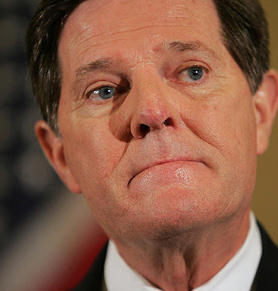
Well, close enough. Tom DeLay has been indicted. He was already losing in the polls, but now that he has been forced to step down as Majority Leader, his defeat is pretty much clinched. DeLay was also a powerful fundraiser for the GOP, and an outspoken and prominent member, so his corrupt image will undoubtedly reflect on the party as a whole. While DeLay claims he's done nothing unlawful, everyone on the hill except for his own staff knows its going to be tough to dodge a conviction. DeLay claims not to have even violated a rule of the House when, at the very least, he's already violated custom. We all remember the ethics committee finagling that helped DeLay resist resigning his seat a few months back. While the prospect of DeLay serving jailtime is uncertain, his political career has been dealt a fatal blow.

Well, close enough. Tom DeLay has been indicted. He was already losing in the polls, but now that he has been forced to step down as Majority Leader, his defeat is pretty much clinched. DeLay was also a powerful fundraiser for the GOP, and an outspoken and prominent member, so his corrupt image will undoubtedly reflect on the party as a whole. While DeLay claims he's done nothing unlawful, everyone on the hill except for his own staff knows its going to be tough to dodge a conviction. DeLay claims not to have even violated a rule of the House when, at the very least, he's already violated custom. We all remember the ethics committee finagling that helped DeLay resist resigning his seat a few months back. While the prospect of DeLay serving jailtime is uncertain, his political career has been dealt a fatal blow.
If the Corporation is a Person...
What kind of person is it?
If you ask John Mackey, self-described "free market libertarian" and CEO of Whole Foods, the Corporation is generally a small, egocentric child.
These days, we are seeing more and more debate about the role of corporations, either negatively, in the aftermath of Enron-like catastrophes, or in the more hopeful sphere of socially responsible investment.
In this Reason article, Mackey debates the merits of his business and its "stakeholder" capitalism with renowned economist Milton Friedman and Dartmouth's (Board of Trustees) own hardass libertarian Thurman J. Rodgers '70 .
Essentially, Mackey discusses all the great things that Whole Foods does for its stakeholders, like its employees, the local community, and the environment, and the great things it does for its stockholders, like being the Fortune 500's leading food retailer in terms of returns on invested capital.
Friedman, who believes corporate philanthropy to be theft from shareholders, says that Mackey isn't really being a stakeholder capitalist. Instead, Friedman argues that Whole Foods makes these donations and policies for three reasons: 1) Helping the community is long-term profit maximization for the store, not altruism; 2) The non-evil-corporation is a successful marketing strategy, not actual altruism; 3) Donations make for nifty tax breaks.
Rodgers calls Mackey a communist and then pleasures himeslf to the notion of the nobility of laissez-faire capitalism, while ignoring the fact that his company can barely turn a profit.
The question that comes to my mind is that, whether Whole Foods is intentionally altruistic or not, if the company is doing good, who cares. The very idea that a large segment of the population finds non-evil corporate activity appealing is a step in the right direction. If the general public comes to reject corporations that maximize profit at the expense of community, or at the very least, exercise a preference where possible towards more stakeholder-concerned corporations, the market will begin to favor non-evil corporations. That's a good thing, because everybody, shareholders included, wins, or at least, the people who typically get screwed will get screwed less. I do believe that part of being a rational and informed consumer means exercising ethical judgement of a company, and that this will influence American capitalism. I guess I'm an optimist.
If you ask John Mackey, self-described "free market libertarian" and CEO of Whole Foods, the Corporation is generally a small, egocentric child.
These days, we are seeing more and more debate about the role of corporations, either negatively, in the aftermath of Enron-like catastrophes, or in the more hopeful sphere of socially responsible investment.
In this Reason article, Mackey debates the merits of his business and its "stakeholder" capitalism with renowned economist Milton Friedman and Dartmouth's (Board of Trustees) own hardass libertarian Thurman J. Rodgers '70 .
Essentially, Mackey discusses all the great things that Whole Foods does for its stakeholders, like its employees, the local community, and the environment, and the great things it does for its stockholders, like being the Fortune 500's leading food retailer in terms of returns on invested capital.
Friedman, who believes corporate philanthropy to be theft from shareholders, says that Mackey isn't really being a stakeholder capitalist. Instead, Friedman argues that Whole Foods makes these donations and policies for three reasons: 1) Helping the community is long-term profit maximization for the store, not altruism; 2) The non-evil-corporation is a successful marketing strategy, not actual altruism; 3) Donations make for nifty tax breaks.
Rodgers calls Mackey a communist and then pleasures himeslf to the notion of the nobility of laissez-faire capitalism, while ignoring the fact that his company can barely turn a profit.
The question that comes to my mind is that, whether Whole Foods is intentionally altruistic or not, if the company is doing good, who cares. The very idea that a large segment of the population finds non-evil corporate activity appealing is a step in the right direction. If the general public comes to reject corporations that maximize profit at the expense of community, or at the very least, exercise a preference where possible towards more stakeholder-concerned corporations, the market will begin to favor non-evil corporations. That's a good thing, because everybody, shareholders included, wins, or at least, the people who typically get screwed will get screwed less. I do believe that part of being a rational and informed consumer means exercising ethical judgement of a company, and that this will influence American capitalism. I guess I'm an optimist.
September 27, 2005
this can't possibly be true
I just received a blitz from the Programming Board advertising the sale of tickets for a Vanessa Carlton show at Dartmouth.
Please, someone tell me that they're joking. Please.
Please, someone tell me that they're joking. Please.
Open Letter to Noah Riner
Noah:
I would like to correct a misunderstanding I think you may have in regards to ‘character.’ You seem to believe it is about the moral or ethical courage to stand alone and sacrifice, as Christ did in the Garden of Gethsemane; it is more than that. It is propriety. Propriety is the quality of doing the right thing at the right time. Propriety may not be glamorous or romantic, may not get you headlines or convince anyone of your views, but it is the very soul of character, of moral and ethical strength. After all, if one is unable or unwilling to do the right thing in the right moment, but rather insists on doing a right thing at a wrong time (or worse, a wrong thing at a wrong time), how can that person truly be said to possess moral or ethical strength, which encompasses far more than courage, but also discipline and discretion?
You define character as “sacrifice, laying our personal interests down for something bigger” yet you have belied that very definition by your actions and words at the recent Convocation. You have chosen to put your personal interests in spreading the message of Christ before the “something bigger” on whose behalf you were acting—namely, the Dartmouth student body.
I am certain you believe that the “something bigger” you were working for was Christ Himself, but I believe that you in fact neglected entirely what should have been your primary responsibility—your role as Student Assembly President and thus representative of the student body. The duty you owe to our student body is one of representing—or doing your very best to—all voices while silencing or estranging none. This may mean that while you are acting in this capacity, you cannot fulfill your duties to God in the same manner you might otherwise do.
I realize that many Christians believe that no duty comes before their duty to Christ, but I also believe that Christ, at least in the Gospels, was pragmatic. He realized clearly that there are days and times for proselytizing and there are days and times for more worldly matters. Christ was comfortable with allotting to the world what is owed to the world; he was comfortable with fulfilling secular and material obligations when they needed fulfilled.
I assume you know your Bible well enough to substantiate this claim, but Matthew 22:21 is always a good place to start: “Render therefore unto Caesar the things which are Caesar's; and unto God the things that are God's.” I Peter 2:13-17 also works well:
I am sure that the outcry against you must now seem like “the ignorance of foolish men,” but I think it is more important that you realize that you should not “us[e] your liberty [of speech] for a cloak of maliciousness”—which in this case, I hope, amounts to insensitivity. Insensitivity to the fact that the day, time, and place you chose to speak was not one that was dedicated to Christ, nor need it have been. It was a time to challenge students, sure, but not to do so in a manner that had at least the potential of alienating some of them.
Some have suggested that this small impropriety of yours has been blown out of proportion, that if you had used an innocuous figure from popular culture, then this whole thing would have not been an issue. What that sort of argument ignores is the very fact that you tried to make clear in your speech—exactly how important a position the figure of Jesus Christ is in society.
If all you were doing is dropping his name, you show tremendous ignorance of the kind of impact a mention of Christ has on many students who do not share your faith. It is ironic that you can put Christ at the center of your life but fail utterly to see the tenor and shape of his relation to people other than yourself or Christians like you. Christ is simply not a positive figure in many people’s lives. This may be an unfortunate fact in your opinion, but it is not and will not be solved by thrusting His Cross into a Convocation speech.
Sincerely,
Andrew Seal
I would like to correct a misunderstanding I think you may have in regards to ‘character.’ You seem to believe it is about the moral or ethical courage to stand alone and sacrifice, as Christ did in the Garden of Gethsemane; it is more than that. It is propriety. Propriety is the quality of doing the right thing at the right time. Propriety may not be glamorous or romantic, may not get you headlines or convince anyone of your views, but it is the very soul of character, of moral and ethical strength. After all, if one is unable or unwilling to do the right thing in the right moment, but rather insists on doing a right thing at a wrong time (or worse, a wrong thing at a wrong time), how can that person truly be said to possess moral or ethical strength, which encompasses far more than courage, but also discipline and discretion?
You define character as “sacrifice, laying our personal interests down for something bigger” yet you have belied that very definition by your actions and words at the recent Convocation. You have chosen to put your personal interests in spreading the message of Christ before the “something bigger” on whose behalf you were acting—namely, the Dartmouth student body.
I am certain you believe that the “something bigger” you were working for was Christ Himself, but I believe that you in fact neglected entirely what should have been your primary responsibility—your role as Student Assembly President and thus representative of the student body. The duty you owe to our student body is one of representing—or doing your very best to—all voices while silencing or estranging none. This may mean that while you are acting in this capacity, you cannot fulfill your duties to God in the same manner you might otherwise do.
I realize that many Christians believe that no duty comes before their duty to Christ, but I also believe that Christ, at least in the Gospels, was pragmatic. He realized clearly that there are days and times for proselytizing and there are days and times for more worldly matters. Christ was comfortable with allotting to the world what is owed to the world; he was comfortable with fulfilling secular and material obligations when they needed fulfilled.
I assume you know your Bible well enough to substantiate this claim, but Matthew 22:21 is always a good place to start: “Render therefore unto Caesar the things which are Caesar's; and unto God the things that are God's.” I Peter 2:13-17 also works well:
Submit yourselves to every ordinance of man for the Lord's sake: whether it be to the king, as supreme; Or unto governors, as unto them that are sent by him for the punishment of evildoers, and for the praise of them that do well. For so is the will of God, that with well doing ye may put to silence the ignorance of foolish men: As free, and not using your liberty for a cloak of maliciousness, but as the servants of God. Honour all men. Love the brotherhood. Fear God. Honour the king.
I am sure that the outcry against you must now seem like “the ignorance of foolish men,” but I think it is more important that you realize that you should not “us[e] your liberty [of speech] for a cloak of maliciousness”—which in this case, I hope, amounts to insensitivity. Insensitivity to the fact that the day, time, and place you chose to speak was not one that was dedicated to Christ, nor need it have been. It was a time to challenge students, sure, but not to do so in a manner that had at least the potential of alienating some of them.
Some have suggested that this small impropriety of yours has been blown out of proportion, that if you had used an innocuous figure from popular culture, then this whole thing would have not been an issue. What that sort of argument ignores is the very fact that you tried to make clear in your speech—exactly how important a position the figure of Jesus Christ is in society.
If all you were doing is dropping his name, you show tremendous ignorance of the kind of impact a mention of Christ has on many students who do not share your faith. It is ironic that you can put Christ at the center of your life but fail utterly to see the tenor and shape of his relation to people other than yourself or Christians like you. Christ is simply not a positive figure in many people’s lives. This may be an unfortunate fact in your opinion, but it is not and will not be solved by thrusting His Cross into a Convocation speech.
Sincerely,
Andrew Seal
September 25, 2005
Our very own cowboy president

[T]he differences are in degree. We [Dartmouth students] have the same flaws as the individuals who pillaged New Orleans. Ours haven't been given such free range, but they exist and are part of us all the same.
Jesus is a good example of character, but He's also much more than that. He is the solution to flawed people like corrupt Dartmouth alums, looters, and me. [emphasis mine]
Premise 1: Dartmouth students are all flawed people.
Premise 2: Jesus is the solution to flawed people.
Conclusion: Jesus is the solution for Dartmouth students.
It's not very difficult. Seriously. Noah Riner's statements at the Convocation for the Class of 2009 do not equivocate in their message: Jesus is the way for Dartmouth students to build character.
If you still believe, as Joe over at Dartblog does, that Riner's comments were "[h]ardly inflammatory...universally apt and eminently peaceful," try this on for size:
Jesus' message of redemption is simple. People are imperfect, and there are consequences for our actions. He gave His life for our sin so that we wouldn't have to bear the penalty of the law; so we could see love. The problem is me; the solution is God's love: Jesus on the cross, for us.
The last sentence is what I'd like to focus on. Riner simply makes bare that he equates "me" with "us"--the pronouns slip entirely--"us" replaces "me"--grammatically, the sentence should be "The problem is me; the solution is God's love: Jesus on the cross, for me."
This is not a case of a personal profession of faith. Riner makes no distinction between himself and the rest of us, between what he believes is the route to his salvation and the path for everyone else to follow.
One thing that is even more disturbing: Riner does not stop at saying something equivalent to 'Surrendering to God's love is the optimal or best way to obtain character.' By providing no further examples of character and by using the exclusive article 'the' without any attempt at moderation, Riner makes it explicit that Christ is, according to him, the only Way, Truth, and Life.
I am not surprised that he holds this belief nor am I arguing that he does not have a right to hold it privately. But Riner does not just hold it; he does presume that we also hold such a belief if we are to have or do have character. In speaking for all others on campus who would like to think of themselves as persons of character without asking for or receiving their consent, Riner does abuse his position as a public speaker and as Student Assembly President.
One further note: Joe and others try to make the case that Riner's comments were no more (or no less) a violation of his office than a professor espousing or recommending political opinions (and therefore anyone who complains about Riner but lets professors off the hook is a hypocrite).
However, a speech by an elected representative is a far different matter from a professor voicing his or her opinions on gay marriage or Bush's penchant for prevaricating. Simplistically, Professors are not elected to represent our voices to anyone else; Riner clearly was. As such, Riner's acts usurp our own voices without our consent; a professor speaks only for him or herself.
September 20, 2005
Just when I thought I had found my drug of choice
Apparently, coffee is actually pretty good for you.
Meanwhile, Whitney Houston is still trying to fund research that will say that crack is rich in Vitamin A and riboflavin.
Meanwhile, Whitney Houston is still trying to fund research that will say that crack is rich in Vitamin A and riboflavin.
September 15, 2005
CONfirmation hearings
I'm growing increasingly frustrated with the Roberts hearings--both with Roberts's flinty refusal to talk about anything that might matter and with the Democrats' ridiculous questions. (Slate has a pretty good piece that writhes with disgust.)
But most of all, I'm frustrated with what these confirmation hearings make all too clear--the Democrats' increasing propensity to play for small potatoes.
Seriously, what is the point of these hearings--what is Schumer & Co.'s goal in their questioning? To uncover or make explicit Roberts's conservative side? To somehow get him to align himself with the wrong end of a highly divisive issue? Merely to discredit him?
To discredit Roberts will be very difficult in these hearings and, as I have said before, counterproductive--we need a respected judiciary, not a slate of nine robes who people think are partisan stiffs.
To force Roberts to come out against a right to die or eminent domain or something similar or to "uncover" his conservative side--both are merely attempts at discrediting him. It is unlikely that such attempts--even if successful--will result in his being rejected by the Senate.
So what are Schumer, Feingold, Brownback, et al. really playing for? I don't know if they know, but it's not the least bit strategic or even very bright. It's bush league, and I don't intend a pun.
What do we (liberals) really need to know about Roberts? Not how conservative he really may be--we need to know what are his strengths--understood not as what he is good at, but what he is good for us at. Can we count on him to insulate the judiciary from the influence and intimidation of Congress, the President, and extreme interest groups? (One word here--just because Roberts's politics may be conservative does not mean he is in "their" pocket--but that is a topic certainly to be pursued--how much allegiance does he feel he owes to the executive and legislative branches, etc.)
Also, why don't they ask him a bit more about how he sees his duties specifically as Chief Justice? How will he assign the writing of opinions, how will he handle 7 fellow Justices who are much more experienced than he, etc. His answers to these sort of questions--much like his "umpire answer"--will reveal far more about his philosophy of law (and will consequently be far more valuable) than trying to get him to talk about abortion.
Are we playing a prevent defense--just trying to locate the cases and precedents he might strike down so we can marshal our forces now? As Schumer said, "What we need to know are the kinds of things that are coming before the court now." No, honestly, we don't.
Are these hearings to confirm him as a Chief Justice or to try to confirm our worst suspicions about him? There's an old lawyer's saying that you never ask a question of a witness that you don't already know the answer to--that's certainly the way the Senators are acting.
(Caveat: I honestly have not been watching the hearings--no TV here in Scotland--but I've been reading about them and nowhere have I found coverage of questioning like I propose. Feingold had a few questions along this line, but they were mostly of the sort that result merely in yes/no answers, not in insights.)
But most of all, I'm frustrated with what these confirmation hearings make all too clear--the Democrats' increasing propensity to play for small potatoes.
Seriously, what is the point of these hearings--what is Schumer & Co.'s goal in their questioning? To uncover or make explicit Roberts's conservative side? To somehow get him to align himself with the wrong end of a highly divisive issue? Merely to discredit him?
To discredit Roberts will be very difficult in these hearings and, as I have said before, counterproductive--we need a respected judiciary, not a slate of nine robes who people think are partisan stiffs.
To force Roberts to come out against a right to die or eminent domain or something similar or to "uncover" his conservative side--both are merely attempts at discrediting him. It is unlikely that such attempts--even if successful--will result in his being rejected by the Senate.
So what are Schumer, Feingold, Brownback, et al. really playing for? I don't know if they know, but it's not the least bit strategic or even very bright. It's bush league, and I don't intend a pun.
What do we (liberals) really need to know about Roberts? Not how conservative he really may be--we need to know what are his strengths--understood not as what he is good at, but what he is good for us at. Can we count on him to insulate the judiciary from the influence and intimidation of Congress, the President, and extreme interest groups? (One word here--just because Roberts's politics may be conservative does not mean he is in "their" pocket--but that is a topic certainly to be pursued--how much allegiance does he feel he owes to the executive and legislative branches, etc.)
Also, why don't they ask him a bit more about how he sees his duties specifically as Chief Justice? How will he assign the writing of opinions, how will he handle 7 fellow Justices who are much more experienced than he, etc. His answers to these sort of questions--much like his "umpire answer"--will reveal far more about his philosophy of law (and will consequently be far more valuable) than trying to get him to talk about abortion.
Are we playing a prevent defense--just trying to locate the cases and precedents he might strike down so we can marshal our forces now? As Schumer said, "What we need to know are the kinds of things that are coming before the court now." No, honestly, we don't.
Are these hearings to confirm him as a Chief Justice or to try to confirm our worst suspicions about him? There's an old lawyer's saying that you never ask a question of a witness that you don't already know the answer to--that's certainly the way the Senators are acting.
(Caveat: I honestly have not been watching the hearings--no TV here in Scotland--but I've been reading about them and nowhere have I found coverage of questioning like I propose. Feingold had a few questions along this line, but they were mostly of the sort that result merely in yes/no answers, not in insights.)
September 6, 2005
September 5, 2005
Racism in the Respone to Katrina
Joe Malchow in a recent post suggested that natural disasters are equal opportunity destroyers, and that there is no racism involved with Federal Government's appalingly slow response. While I watch various political and non-political (cough - Kanye West) figures weigh in on the issue, I'm somewhat pleased just to see the issue of race being addressed here, and some recognition of the reality that mostly black people are suffering. It serves as a great counterweight to all the footage of African-Americans looting stores and shooting at people. So far, however, the only clear example of racism has been one man (I think this was in a U.S. News report, but I can't find it right now) who was not backed by the government, using not-so-PC language in explaining his choice not to rescue any black people.
But its not that simple. Black people are suffering disproportionately, not because of their race (at least, not directly), but because of their socio-economic status. Poor white people I'm sure are suffering quite badly as well. In the coming months as people feebly try to weed out who deserves blame for what in this disaster, I hope the government addresses the pervasive problems of poverty than make these people so vulnerable. Because it's not so simple as saying President Bush hates black people. It's not that he hates them, he just doesn't care about them, or any other poor people for that matter.
Unfortunately, few natural disasters actually are equal-opportunity destroyers. Right now, the only big exception that comes to mind is wildfires that tear through suburbs.
The problem isn't so much that black people get hit badly, but that poor people get hit badly, and as we all know, a lot of poor people are black people. Poor people suffer disproportionately because they live in more densely populated areas, in housing of sub-standard quality, and a lack of information and resources to enable fleeing the impending disaster. People often joke that tornados steer themselves towards trailer parks. Well, not quite. But a tiny little aluminum box will come out of the storm in far worse shape than a newly built house in the suburbs. When you consider how tightly clustered a trailer park is compared to a normal housing development, you can see once again why poor people suffer disproportionately. Finally, they are the least likely to be able to leave everything behind, jump in their cars, and book a hotel room somewhere out of harm's way. Now that I think of it, the process of recovering afterwards is probably tougher when you are completely broke, and your now destroyed former employment was the only thing keeping food on the table.
This isn't an issue of race so much as it is an issue of neglecting the poor and neglecting the inner cities. Where I don't dispute the cries of racism is here: The inner cities are easier to ignore because they are poor and black. The American public doesn't hear from them, and is less likely in general to sympathize with their plight.
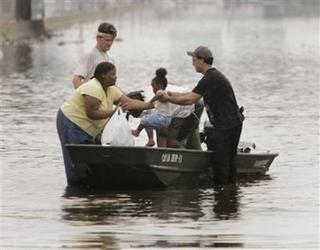
The slow response isn't motivated by racism, but its enabled by a long-standing neglect of such areas and the people that are affected. One can only wonder whether the same violence would've broken out if, during the peak of the crack epidemic, if there was a comprehensive effort at providing drug counseling and rehabilitation services in addition to increased police pressure. With better housing assistance, would as many people be stuck in homes so easily damaged by the high winds and water? With better healthcare, would there have been so many people on the brink of death, unable to withstand a week without adequate food and water?
The media focus on looting and destruction, as opposed to struggling and separated families helps reinforce the fear America has of urban black people, but still, we can all see through to the main point. Human beings are suffering, and they shouldn't be. As we prepare to prevent this from ever happening again, we should focus on the succeptibility of the poor as much as we concentrate on the weakness of the levees.
But its not that simple. Black people are suffering disproportionately, not because of their race (at least, not directly), but because of their socio-economic status. Poor white people I'm sure are suffering quite badly as well. In the coming months as people feebly try to weed out who deserves blame for what in this disaster, I hope the government addresses the pervasive problems of poverty than make these people so vulnerable. Because it's not so simple as saying President Bush hates black people. It's not that he hates them, he just doesn't care about them, or any other poor people for that matter.
Unfortunately, few natural disasters actually are equal-opportunity destroyers. Right now, the only big exception that comes to mind is wildfires that tear through suburbs.
The problem isn't so much that black people get hit badly, but that poor people get hit badly, and as we all know, a lot of poor people are black people. Poor people suffer disproportionately because they live in more densely populated areas, in housing of sub-standard quality, and a lack of information and resources to enable fleeing the impending disaster. People often joke that tornados steer themselves towards trailer parks. Well, not quite. But a tiny little aluminum box will come out of the storm in far worse shape than a newly built house in the suburbs. When you consider how tightly clustered a trailer park is compared to a normal housing development, you can see once again why poor people suffer disproportionately. Finally, they are the least likely to be able to leave everything behind, jump in their cars, and book a hotel room somewhere out of harm's way. Now that I think of it, the process of recovering afterwards is probably tougher when you are completely broke, and your now destroyed former employment was the only thing keeping food on the table.
This isn't an issue of race so much as it is an issue of neglecting the poor and neglecting the inner cities. Where I don't dispute the cries of racism is here: The inner cities are easier to ignore because they are poor and black. The American public doesn't hear from them, and is less likely in general to sympathize with their plight.

The slow response isn't motivated by racism, but its enabled by a long-standing neglect of such areas and the people that are affected. One can only wonder whether the same violence would've broken out if, during the peak of the crack epidemic, if there was a comprehensive effort at providing drug counseling and rehabilitation services in addition to increased police pressure. With better housing assistance, would as many people be stuck in homes so easily damaged by the high winds and water? With better healthcare, would there have been so many people on the brink of death, unable to withstand a week without adequate food and water?
The media focus on looting and destruction, as opposed to struggling and separated families helps reinforce the fear America has of urban black people, but still, we can all see through to the main point. Human beings are suffering, and they shouldn't be. As we prepare to prevent this from ever happening again, we should focus on the succeptibility of the poor as much as we concentrate on the weakness of the levees.
September 1, 2005
Latest DFP now online
Shameless self-promotion, the heart of journalism.
N.B. The cover picture on the website is different from the picture we actually published. We had a little mix-up with the Valley News. Don't be confused, though--it's the same issue.
N.B. The cover picture on the website is different from the picture we actually published. We had a little mix-up with the Valley News. Don't be confused, though--it's the same issue.
August 31, 2005
Damn Liberal Media
Yahoo! News Photos and Their Captions
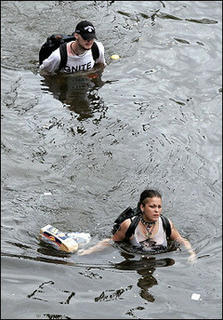
Two residents wade through chest-deep water after finding bread and soda from a local grocery store after Hurricane Katrina came through the area in New Orleans, Louisiana.(AFP/Getty Images/Chris Graythen)

A young man walks through chest deep flood water after looting a grocery store in New Orleans on Tuesday, Aug. 30, 2005. Flood waters continue to rise in New Orleans after Hurricane Katrina did extensive damage when it made landfall on Monday. (AP Photo/Dave Martin)
So, apparently, the white folk of New Orleans are hardy survivors, while the black folk are a bunch of opportunistic theiving bastards.
Links: Photo 1 and Photo 2

Two residents wade through chest-deep water after finding bread and soda from a local grocery store after Hurricane Katrina came through the area in New Orleans, Louisiana.(AFP/Getty Images/Chris Graythen)
vs.

A young man walks through chest deep flood water after looting a grocery store in New Orleans on Tuesday, Aug. 30, 2005. Flood waters continue to rise in New Orleans after Hurricane Katrina did extensive damage when it made landfall on Monday. (AP Photo/Dave Martin)
So, apparently, the white folk of New Orleans are hardy survivors, while the black folk are a bunch of opportunistic theiving bastards.
Links: Photo 1 and Photo 2
August 26, 2005
Washington Monthly gets in on the game
The Washington Monthly has just released its own list ranking American colleges and universities, seeking to complement and perhaps challenge the methodology and philosophy behind the infamous US News rankings. WM has changed the focus and the criteria for the list drastically:
Here's the list. As you can see, Dartmouth did not crack the top 30. I have been unable to look at an actual copy of the magazine yet, so I do not know what position Dartmouth actually came in at, but here:

Dartmouth does get a mention in the article, but in a very negative (though hardly fair) light:
The rest of the article can be found here.
The first question we asked was, what does America need from its universities? From this starting point, we came up with three central criteria: Universities should be engines of social mobility, they should produce the academic minds and scientific research that advance knowledge and drive economic growth, and they should inculcate and encourage an ethic of service. We designed our evaluation system accordingly.
Here's the list. As you can see, Dartmouth did not crack the top 30. I have been unable to look at an actual copy of the magazine yet, so I do not know what position Dartmouth actually came in at, but here:
Dartmouth does get a mention in the article, but in a very negative (though hardly fair) light:
Nine Nobelists are on faculty at UCSD (Dartmouth, by comparison, has none)...
The rest of the article can be found here.
August 15, 2005
Justice Sunday (II!)
The real battle yet begun (sunday, bloody sunday)
To claim the victory jesus won (sunday, bloody sunday)
On...
Sunday bloody sunday
Sunday bloody sunday...
Justice Sunday II was a smashing success. Broadcast nationally from my hometown of Nashville, TN, the program (fully titled Justice Sunday II— — God Save the United States and this Honorable Court) reached 79 million households in all 50 states, according to the Family Research Council.
Here are some highlights from The Tennessean:
Amen.
To claim the victory jesus won (sunday, bloody sunday)
On...
Sunday bloody sunday
Sunday bloody sunday...
Justice Sunday II was a smashing success. Broadcast nationally from my hometown of Nashville, TN, the program (fully titled Justice Sunday II— — God Save the United States and this Honorable Court) reached 79 million households in all 50 states, according to the Family Research Council.
Here are some highlights from The Tennessean:
House Majority Leader Tom DeLay's comments drew loud audience response, particularly when he said that "all wisdom does not reside in nine persons in black robes."
DeLay discussed his dismay with rulings that appeared to overturn long-standing tradition. He said he respects the judiciary "but our respect and admiration does not grant judges the powers many have assumed over the years"....
James Dobson, founder of Focus on the Family, said, "America's court system is tearing at the very fabric of this nation." He said an "unelected, unaccountable, and often arrogant" judiciary, is imposing "judicial tyranny" as judges legislate from the bench, being guided by Western Europe "that most liberal place on the planet"....
"Call, write, visit, e-mail, fax your senators, contact their local officers and then pray urgently that God's perfect will will be done. ... Future generations depend on us"....
Bishop Harry Jackson Jr., a Maryland pastor and author, spoke about the new sense of the black church to "team with the white evangelical church and the Catholic church to deal with moral issues."
"We are not just going to sit back and let America to go down this ramp of immorality alone"...
The last speaker...the Rev. Jerry Sutton—challenged church pastors nationwide to recognize that they have a place in this effort.
"You are the leaders," Sutton said. "You speak for God. We care about our country."
Sutton, first vice president of the Nashville-based Southern Baptist Convention, the nation's largest Protestant body, closed with five sentences: "It's a new day. Liberalism is dead. The majority of Americans are conservative. You can count on us for showing up and speaking out. And ... let the church rise."
Amen.
August 12, 2005
GTA: Grasping Toward Anything

This is a great analysis of the really bizarre move Hillary has made in attacking the Grand Theft Auto video game in order to take a pose of moral guardian for our children.
It also makes a fairly convincing argument against the received parenting wisdom that video games rot our minds and corrupt our souls.
But honestly, I feel that if Hillary wants to show that she means business about values, this is a really odd "vehicle" for her.
I mean, It Takes a Village was nice, but attacking GTA seems a little, ummmm... beside the point.
August 4, 2005
Where Iden Sinai goes far too far...
A curious opinion piece appeared in today’s D subtly titled “Where Feminism Went Too Far.” From what I can tell, the author Iden Sinai’s beef is that men are the principal objects of humiliating humor in entertainment today and that boys are not doing as well as girls in certain areas of the educational experience—boys are disciplined more often, held back more often, and drop out more often.
Sinai quotes a variety of statistics to show the ‘egregiously insidious effects of feminism’:
What he does not do is attempt to show any causal relationship between the feminist project of creating equal opportunity for men and women, boys and girls and the data he uses. In fact, except in one instance, he doesn’t even show conclusively that the data is even linked to the time period in which feminism has been a social force.
As far as we know, boys were disciplined far more often than girls before feminism, they were held back more often, boys committed suicide more often than girls, and girls decided at an earlier age what they wanted to do with their lives. (Though it must be said that early decision was an artifact of lack of career choice, to say that lack has been filled entirely is highly naïve.)
In addition, Sinai’s other statistic, which is very poorly expressed (actually the writing of the entire piece is rather murky and unclear) is that “the gap [in boy-girl reading scores] actually increases from the first year of the data in 1971 to the present across all three age groups as well.” What Sinai does not clarify is precisely how that gap has widened—has it widened because female scores have held steady but male scores have dropped? Or because male scores have dropped and female scores have risen? Or because male scores have stayed relatively steady while female scores have risen, suggesting a success in creating a better environment for girls? Neither does Sinai tell us how big the gap was and how big it is. A gap is simply not a smoking gun for brutalizing discrimination—there may be a great many more factors at play and almost certainly are.
As for the entertainment industry’s 'prejudice' against men, the archetypal stupid, fat, white man (what Sinai decries) was Jackie Gleason from the Honeymooners, a show that launched in 1955. Today’s Homer Simpson is not exactly a character that broke new ground for comedic ingenuity. And I think you have to be pretty ill-read to believe that men have not been ridiculed for being fat, dumb, and stupid as long as humor has existed.
Even if Mr. Sinai has actual data that proves a chronological coincidence of an increase in the above statistics with the period since women’s lib, all he has shown is some small correlation of the data, definitely not a causal effect. He relies on cheap prejudices still extant in the male population, prejudices which have no grounding—in the data as presented or in real life.
If he's going to make this argument, he needs to have some actual facts, not just a few isolated and decontextualized statistics. I personally believe he's not going to find them because they're not there, though apparently masquerading misogyny still is.
Sinai quotes a variety of statistics to show the ‘egregiously insidious effects of feminism’:
11 percent of males from 16 to 24 did not finish high school, as opposed to 8 percent of females for the same age group. More simply put, men make up 59 percent of high school dropouts, which is significantly disproportionate… For every girl who commits suicide, four boys do. For every girl suspended from school, three boys are. Girls are also twice as likely to indicate that they want to pursue a career as early as eighth grade.
What he does not do is attempt to show any causal relationship between the feminist project of creating equal opportunity for men and women, boys and girls and the data he uses. In fact, except in one instance, he doesn’t even show conclusively that the data is even linked to the time period in which feminism has been a social force.
As far as we know, boys were disciplined far more often than girls before feminism, they were held back more often, boys committed suicide more often than girls, and girls decided at an earlier age what they wanted to do with their lives. (Though it must be said that early decision was an artifact of lack of career choice, to say that lack has been filled entirely is highly naïve.)
In addition, Sinai’s other statistic, which is very poorly expressed (actually the writing of the entire piece is rather murky and unclear) is that “the gap [in boy-girl reading scores] actually increases from the first year of the data in 1971 to the present across all three age groups as well.” What Sinai does not clarify is precisely how that gap has widened—has it widened because female scores have held steady but male scores have dropped? Or because male scores have dropped and female scores have risen? Or because male scores have stayed relatively steady while female scores have risen, suggesting a success in creating a better environment for girls? Neither does Sinai tell us how big the gap was and how big it is. A gap is simply not a smoking gun for brutalizing discrimination—there may be a great many more factors at play and almost certainly are.
As for the entertainment industry’s 'prejudice' against men, the archetypal stupid, fat, white man (what Sinai decries) was Jackie Gleason from the Honeymooners, a show that launched in 1955. Today’s Homer Simpson is not exactly a character that broke new ground for comedic ingenuity. And I think you have to be pretty ill-read to believe that men have not been ridiculed for being fat, dumb, and stupid as long as humor has existed.
Even if Mr. Sinai has actual data that proves a chronological coincidence of an increase in the above statistics with the period since women’s lib, all he has shown is some small correlation of the data, definitely not a causal effect. He relies on cheap prejudices still extant in the male population, prejudices which have no grounding—in the data as presented or in real life.
If he's going to make this argument, he needs to have some actual facts, not just a few isolated and decontextualized statistics. I personally believe he's not going to find them because they're not there, though apparently masquerading misogyny still is.
August 3, 2005
The Un-Intelligence of Intelligent Design
This is not going to be about "the scientific merit of Intelligent Design vis-a-vis Evolution." I hate the word "vis-a-vis" and I think that argument has a pretty clear result.
I would like to address two points. First is the idea that, as Bush said yesterday "part of education is to expose people to different schools of thought." Second is the place of the God vs. Darwin debate in society and why it is so important to religious conservatives.
Bush's argument, which echoes what a lot of other conservatives are saying, that students "ought to be exposed to different ideas," is a bastardization of multicultural pluralist politics. It ignores the essential difference between what something like science does and what something like history or literature does. Science attempts to identify things that are invariably repeatable experimentally and empirically verifiable. History or literature does not and should not attempt to find laws that apply universally and invariably, mostly because those laws do not exist. Human beings make choices that render all-encompassing models impossible.
It is not simply a difference between objective and subjective--those are loaded terms and increasingly difficult to separate the more we ponder their meaning. It is a difference in goals, in methodology, and in purpose. The mission of science is to limit different perspectives to the perspective that works the best.
Science is in this way much like grammar. While I fully recognize the right of other people to speak how they would like, what should be taught is what works the best in our society--standard grammar. Science, like language, is primarily functional, not speculative. If the focus is function, one should use the best tools. ID is not a good tool to improve scientific understanding. ID is scientifically sterile--it does nothing to help us understand what may have happened or is happening or will happen in any way that can actually produce new physical or material benefits.
The importance of the ID vs. evolution debate is rather curious to me. Honestly, I'm not sure why Christians are so eager to make their stand in an arena (biology) where there is such overwhelming evidence contrary to their theory. Sure, not everything is fully understood about the mechanics of evolution, but those gaps fit in pretty nicely in the overall model and we pretty much know what kinds of things will go in those gaps.
What I think is the driving force behind the choice of evolution as a target is the ideological importance of establishing God as prior to and therefore immanent in the physical world. Having their creation story accepted gives validation to the entire way their world is oriented--it is not so much the first plank of their ideological platform as it is the keel of their ship--the center line and orienting principle.
There are other areas besides biology that have more effect on the actual process of everyday life--biology can be sort of ignored, but language, for instance, can't. It would seem if they really wanted to establish the presence of God in the world, they would advocate that our language be taught as intelligently designed, not our biology.
The point is, creation stories are over-privileged as central to the orientation of our various worldviews. If one de-centers the origin of life as the most important element of society, Christians would see that it really doesn't threaten their worldview or their way of life to teach only evolution in schools. They could teach that God's hand is behind evolution in the same manner and place as they may teach God's hand is behind ethics or behind our nation's history or whatever--in the privacy of their own homes.
Those religious conservatives who are arguing for ID, quite simply, are misusing the wrong arguments for their position and are focusing on the wrong thing. There are things that matter pragmatically far more than God's activities in the process of life. We're going to have an argument between the secularists and the religionists--let's at least make it count.
I would like to address two points. First is the idea that, as Bush said yesterday "part of education is to expose people to different schools of thought." Second is the place of the God vs. Darwin debate in society and why it is so important to religious conservatives.
Bush's argument, which echoes what a lot of other conservatives are saying, that students "ought to be exposed to different ideas," is a bastardization of multicultural pluralist politics. It ignores the essential difference between what something like science does and what something like history or literature does. Science attempts to identify things that are invariably repeatable experimentally and empirically verifiable. History or literature does not and should not attempt to find laws that apply universally and invariably, mostly because those laws do not exist. Human beings make choices that render all-encompassing models impossible.
It is not simply a difference between objective and subjective--those are loaded terms and increasingly difficult to separate the more we ponder their meaning. It is a difference in goals, in methodology, and in purpose. The mission of science is to limit different perspectives to the perspective that works the best.
Science is in this way much like grammar. While I fully recognize the right of other people to speak how they would like, what should be taught is what works the best in our society--standard grammar. Science, like language, is primarily functional, not speculative. If the focus is function, one should use the best tools. ID is not a good tool to improve scientific understanding. ID is scientifically sterile--it does nothing to help us understand what may have happened or is happening or will happen in any way that can actually produce new physical or material benefits.
The importance of the ID vs. evolution debate is rather curious to me. Honestly, I'm not sure why Christians are so eager to make their stand in an arena (biology) where there is such overwhelming evidence contrary to their theory. Sure, not everything is fully understood about the mechanics of evolution, but those gaps fit in pretty nicely in the overall model and we pretty much know what kinds of things will go in those gaps.
What I think is the driving force behind the choice of evolution as a target is the ideological importance of establishing God as prior to and therefore immanent in the physical world. Having their creation story accepted gives validation to the entire way their world is oriented--it is not so much the first plank of their ideological platform as it is the keel of their ship--the center line and orienting principle.
There are other areas besides biology that have more effect on the actual process of everyday life--biology can be sort of ignored, but language, for instance, can't. It would seem if they really wanted to establish the presence of God in the world, they would advocate that our language be taught as intelligently designed, not our biology.
The point is, creation stories are over-privileged as central to the orientation of our various worldviews. If one de-centers the origin of life as the most important element of society, Christians would see that it really doesn't threaten their worldview or their way of life to teach only evolution in schools. They could teach that God's hand is behind evolution in the same manner and place as they may teach God's hand is behind ethics or behind our nation's history or whatever--in the privacy of their own homes.
Those religious conservatives who are arguing for ID, quite simply, are misusing the wrong arguments for their position and are focusing on the wrong thing. There are things that matter pragmatically far more than God's activities in the process of life. We're going to have an argument between the secularists and the religionists--let's at least make it count.
August 2, 2005
That's Scientist James C. Dobson
The New York Times issued the following correction Monday:
An article on Saturday about Senator Bill Frist's support for expanding federal financing of human embryonic stem cell research misstated the title of James C. Dobson, founder of the evangelical group Focus on the Family. He is a psychologist with a doctorate in child development; he is not "the Rev."C'mon, New York Times—have some respect for science. What's next, a Faith section instead?
July 29, 2005
Ariel in New York Times (implicitly)
Today's op-ed by Paul Krugman in the New York Times, "French Family Values," discusses a study of international differences in working hours, by Alberto Alesina and Edward Glaeser at Harvard and Bruce Sacerdote at Dartmouth. Ariel was Professor Sacerdote's research assistant for the paper.
July 27, 2005
Confederates target of ethnic cleansing
The plight of the Confederates continues. From the Tennessean:
We're talking about erasing it from a building in which students live, not the proverbial history books, where slavery in fact continues to be a well-documented phenomenon. We've all seen this simplistic line of argument at Dartmouth before, regarding College symbols pertaining to Native Americans. Defenders of the Dartmouth Indian and Confederate Memorial Hall (the two symbols being quite different in their historical context but perhaps equally offensive to many in their function) invoke the sanctity of History when what's at stake is not history but the highly visible symbols in some public domain where people live and interact. It's a distinction that seems to evade many self-styled defenders of tradition. Preserve the pediment, but move it to a museum. Drop the Indian, but let its record persist elsewhere.

Confederate Memorial Hall
Group to fight effort to rename three 'Confederate' parksThis exact kind of battle gets played out every year or so in Tennessee, it seems. A three-year legal struggle over Confederate Memorial Hall at Vanderbilt University ended this month, with Vanderbilt losing to the United Daughters of the Confederacy and being forced to keep the pediment inscription of the dorm name. The moral justification?
The Sons of Confederate Veterans plans to donate at least $10,000 to be used in efforts to fight a proposal to change the names of three "Confederate" parks in downtown Memphis.
Nearly 1,000 SCV members approved the "emergency donation" at the group's annual convention, which concluded Saturday in Nashville, according to a statement released by the SCV.
The $10,000 represents the "first installment of cash" and will be used for "any and all purposes including litigation," the statement says.
"This outrageous affront to our Southern heritage will be met with every financial and legal means available to the Sons of
Confederate Veterans," said SCV Commander in Chief Denne Sweeney.
"The park renamings and monument removals are tantamount to an ethnic cleansing."
At issue are the names of Confederate, Jefferson Davis and Forrest parks.
"It's a victory for the entire South," [Deanna] Bryant, [president of the United Daughters of the Confederacy's Tennessee division,] who lives in Franklin, said of the decision to keep the inscription on the building. "Regardless, the War Between the States happened. Just because somebody doesn't like something, you can't erase it from the history books."
We're talking about erasing it from a building in which students live, not the proverbial history books, where slavery in fact continues to be a well-documented phenomenon. We've all seen this simplistic line of argument at Dartmouth before, regarding College symbols pertaining to Native Americans. Defenders of the Dartmouth Indian and Confederate Memorial Hall (the two symbols being quite different in their historical context but perhaps equally offensive to many in their function) invoke the sanctity of History when what's at stake is not history but the highly visible symbols in some public domain where people live and interact. It's a distinction that seems to evade many self-styled defenders of tradition. Preserve the pediment, but move it to a museum. Drop the Indian, but let its record persist elsewhere.
Confederate Memorial Hall
July 26, 2005
"Gay marriage -- who the hell cares?"

Iraq war vet Paul Hackett is taking on chicken-hawk Republicans in Ohio by running for Congress on an anti-Iraq war, socially liberal, fiscally conservative platform. Good to see this man standing up to the bullshit:
[GOP candidate Jean] Schmidt commends Hackett for his service, but believes Hackett should "stand with the president" by "supporting the Iraqi war effort and our troops that are over there," her campaign manager Joe Braun said. (Through Braun, Schmidt declined to speak with Salon.) When asked to answer that charge, Hackett is blunt: "The only way I know how to support the troops is by going over there." He doesn't hesitate to criticize Schmidt's support of the war: "All the chicken hawks back here who said, 'Oh, Iraq is talking bad about us. They're going to threaten us' -- look, if you really believe that, you leave your wife and three kids and go sign up for the Army or Marines and go over there and fight. Otherwise, shut your mouth."I'll be keeping an eye on this race, which is in its last week.
July 24, 2005
Chimp Haven

It's really nice to see this as the front-page New York Times Magazine article. I have a weak spot for chimpanzees, so I found the article really moving. I even donated to Chimp Haven, the permanent home for chimpanzees retired from biomedical research, entertainment, or no longer wanted as pets. The movie on the web site is worth watching. Chimps are totally sweet.
July 21, 2005
Who'd a thunk?
Karl Rove might have lied in his grand jury testimony!
Daily Kos puts it in context and revels in the potential consequences.
Daily Kos puts it in context and revels in the potential consequences.
July 20, 2005
July 19, 2005
A faithful nominee
At least we know John Roberts would "faithfully apply the Constitution." This has to be one of my favorite conages, uttered by Bush on hundreds of occasions. Thing is, I bet it's pretty effective. I imagine it aroused 9 out of 10 religious wackos and 6/10 uninformed moderates in focus groups.
You now have less than 7 hours of wild speculation...
Any guesses?
My pick to win is Joe Malchow.
I base this guess on the empirical data that Bush tends to pick nominees with a highly disproportionate ratio of ego to actual insight/intelligence(e.g. Bolton, Ashcroft, Wolfowitz...).
Update: Apparently, it's this guy.
My pick to win is Joe Malchow.
I base this guess on the empirical data that Bush tends to pick nominees with a highly disproportionate ratio of ego to actual insight/intelligence(e.g. Bolton, Ashcroft, Wolfowitz...).
Update: Apparently, it's this guy.
July 18, 2005
Framing is a force that gives us meaning
The long article in Sunday's New York Times Magazine is about Democrats' new consciousness of and use of framing. Framing has to do with the way in which information is presented. It is a concept developed by the cognitive linguist and, now, political strategist George Lakoff. Lakoff's research argues that when the human brain processes ideas and language, it does not treat and evaluate each as an isolated piece of data on its own merit, but it views them through frames, i.e. biases and preconceptions that are hardwired into the neural networks of the brain (certainly by information previously encountered, likely also by genetics). If a piece of information is presented to a person in a way agreeable to their neural framework, the person is likely to accept the information. If it's presented in a way that conflicts with their previous experience (of what's good, profitable, right), the person will likely reject it. But presentation is key, and an idea presented in different ways may have very different results.
I posted before about Lakoff months ago, after I read "Don't Think of an Elephant!", his primer on framing in politics. Matt Bai's article does a good job tracing Lakoff's meteoric rise on Capitol Hill and treating the belief in framing as panacea for Democratic woes with a healthy dose of skepticism. The possibility the article considers is that Democrats' problems run deeper than language, and that their recent successes on social security and Terri Schiavo are due more to party discipline, not a common language.
Bai rightly points to Lakoff's own proposal for a 10-word summary of Democratic principles as a sign that Dems lack more than just the mots justs:
Bai's tendency throughout the article, however, is to put language and ideas in a stark dichotomy. This is where he goes wrong, I believe. The process of framing is not a matter of cloaking arbitrary concepts in deliberately chosen, appealing rhetoric. Framing is an active exercise that makes one think about what exactly the values and policies expressed in the language are. Lakoff himself says his 10-word party identity is just a suggested starting point, and that it will take years for Democrats to fully develop their approach. He believes Democrats badly need to launch new and comprehensive policy initiatives (a counterpart to the "Contract with America") to live up to the rhetoric. In Don't Think of an Elephant! he specifically champions the "New Apollo Program" of investing in alternative energy as Democrats' (and America's) great opportunity of the era.
My concern is not so much defending Lakoff as highlighting how potentially useful the idea of framing is. A huge part of Republicans' ascendancy in the past few decades has been their attentiveness to the power of language ("Tax relief," "Constitutional Option," "Death Tax") and the importance of coordinating ALL their communication around a single party line. It's kind of frightening, and the discipline becomes repetitive as hell, but it works. Science tells us so. Sound science. Plus, thinking about how to frame our ideas will help us refine our ideas. It's as simple as that.
So, anyone got a better 10-word summary for the Democratic Party? Cons, here's your chance to really shine.
I posted before about Lakoff months ago, after I read "Don't Think of an Elephant!", his primer on framing in politics. Matt Bai's article does a good job tracing Lakoff's meteoric rise on Capitol Hill and treating the belief in framing as panacea for Democratic woes with a healthy dose of skepticism. The possibility the article considers is that Democrats' problems run deeper than language, and that their recent successes on social security and Terri Schiavo are due more to party discipline, not a common language.
Bai rightly points to Lakoff's own proposal for a 10-word summary of Democratic principles as a sign that Dems lack more than just the mots justs:
Consider, too, George Lakoff's own answer to the Republican mantra. He sums up the Republican message as "strong defense, free markets, lower taxes, smaller government and family values," and in "Don't Think of an Elephant" he proposes some Democratic alternatives: ''Stronger America, broad prosperity, better future, effective government and mutual responsibility.'' Look at the differences between the two. The Republican version is an argument, a series of philosophical assertions that require voters to make concrete choices about the direction of the country. Should we spend more or less on the military? Should government regulate industry or leave it unfettered? Lakoff's formulation, on the other hand, amounts to a vague collection of the least objectionable ideas in American life. Who out there wants to make the case against prosperity and a better future? Who doesn't want an effective government?
What all these middling generalities suggest, perhaps, is that Democrats are still unwilling to put their more concrete convictions about the country into words, either because they don't know what those convictions are or because they lack confidence in the notion that voters can be persuaded to embrace them. Either way, this is where the power of language meets its outer limit. The right words can frame an argument, but they will never stand in its place.
Bai's tendency throughout the article, however, is to put language and ideas in a stark dichotomy. This is where he goes wrong, I believe. The process of framing is not a matter of cloaking arbitrary concepts in deliberately chosen, appealing rhetoric. Framing is an active exercise that makes one think about what exactly the values and policies expressed in the language are. Lakoff himself says his 10-word party identity is just a suggested starting point, and that it will take years for Democrats to fully develop their approach. He believes Democrats badly need to launch new and comprehensive policy initiatives (a counterpart to the "Contract with America") to live up to the rhetoric. In Don't Think of an Elephant! he specifically champions the "New Apollo Program" of investing in alternative energy as Democrats' (and America's) great opportunity of the era.
My concern is not so much defending Lakoff as highlighting how potentially useful the idea of framing is. A huge part of Republicans' ascendancy in the past few decades has been their attentiveness to the power of language ("Tax relief," "Constitutional Option," "Death Tax") and the importance of coordinating ALL their communication around a single party line. It's kind of frightening, and the discipline becomes repetitive as hell, but it works. Science tells us so. Sound science. Plus, thinking about how to frame our ideas will help us refine our ideas. It's as simple as that.
So, anyone got a better 10-word summary for the Democratic Party? Cons, here's your chance to really shine.
July 16, 2005
Prison in the Land of the Free
Naturally, I was reading MIM Notes—The Official Newsletter of the Maoist Internationalist Movement—today and I learned from their Facts on U$ imprisonment section that "the United $tates has been the world's leading prison-state per capita for the last 25 years, with a brief exception during Boris Yeltsin's declaration of a state of emergency." Furthermore, "To find a comparison with U$ imprisonment of Black people, there is no statistic in any country that compares including apartheid South Africa of the era before Mandela was president."
You may laugh at the source or the writing, and the data they use in this May 2005 issue are from 1994, but the reality is that this is the truth and the situation is only getting worse. According to a study by the UK Government, the United States had 1.96 million prisoners and the highest prison population rate in the world as of 2002, followed closely by the Cayman Islands and Russia. As of mid-2004 the US prison and jail population was a still greater 2,131,180, with the racial breakdown going:
4,919 black male inmates per 100,000 black males
1,717 Hispanic male inmates per 100,000 Hispanic males
717 white male inmates per 100,000 white males
(From the U.S. Department of Justice)
Our (domestic) penal system is a topic that has almost completely fallen out of mainstream political discourse. In the midst of wars abroad and culture wars here, we shouldn't forget it.
You may laugh at the source or the writing, and the data they use in this May 2005 issue are from 1994, but the reality is that this is the truth and the situation is only getting worse. According to a study by the UK Government, the United States had 1.96 million prisoners and the highest prison population rate in the world as of 2002, followed closely by the Cayman Islands and Russia. As of mid-2004 the US prison and jail population was a still greater 2,131,180, with the racial breakdown going:
4,919 black male inmates per 100,000 black males
1,717 Hispanic male inmates per 100,000 Hispanic males
717 white male inmates per 100,000 white males
(From the U.S. Department of Justice)
Our (domestic) penal system is a topic that has almost completely fallen out of mainstream political discourse. In the midst of wars abroad and culture wars here, we shouldn't forget it.
July 14, 2005
Makeover
I'm in the process of making some minor changes to the blog's appearance. So far, I'm pissed off because it's looking better in Internet Explorer. Any feedback is welcome.
July 13, 2005
Reflecting on real journalism
Roger Mosey, head of BBC Television News, has a piece in today's Guardian (free registration required) discussing what it's been like to be the definitive source for reporting on the tragic London bombings. Coming from the director of one of the world's best news organizations, the brief article is an understated affirmation of what TV journalism should aspire to be: accurate, responsible, thoughtful. And I'm glad Mosey addresses one egregious example of everything TV news should not be. If you still watch Fox News, you should know you're an asshole, and a poorly informed one at that:
Finally, we are never immune from accusations of bias. It goes without saying that there is nothing more sensitive than matters of life and death, and the BBC's audience response has been massively supportive and understanding about the dilemmas we face in reporting terror. There have been two main exceptions. From a smattering of radical websites comes the argument that we are being hypocritical in mourning the dead of London when we allegedly gloried in civilian deaths in Iraq.
This utterly misrepresents the BBC's reporting of Iraq, where we have always sought to portray the whole picture of events in that country. The second exception is principally Fox News in the United States. A contributor to Fox said after the London bombings that "the BBC almost operates as a foreign registered agent of Hezbollah and some of the other jihadist groups". On the Fox website today there is an opinion piece, "How Jane Fonda and the BBC put you in danger". I am writing this in a building which was bombed by Irish terrorists. My colleagues and I are living in a city recovering from the wounds inflicted last week. If I may leave our customary impartiality aside for a moment, the comments made on Fox News are beneath contempt.
July 12, 2005
Setting the record straight about Rove's leak
I've been following the Plame leak case for a few weeks now—and this is a story years in the making—but I thought this article from Salon was particularly good at getting the facts straight and analyzing the possible implications. It gives a brief history of the whole affair and then explains to what extent Rove might or might not be culpable, all in very clear terms.
I suspect Rove was fully cognizant of what he was doing, and what he's done is despicable. He should be fired without question (go tell the White House you think so, too). Also, it was encouraging to see the press finally do its job and hammer Scott McClellan yesterday and today. If the stakes of this case, occurring right around the whole Deepthroat/Mark Felt revelation, don't inspire mainstream journalists to dig deep and take some risks to find out the whole truth, I don't know what would.
While we're at it, how about another caption contest for the above illustration (done by yours truly)?
Photos courtesy of Google Image Search
On London
A friend alerted me to this little piece in The Nation's blog section, in John Nichol's blog.
This speech is pretty amazing, and I'll post the full text in the comments section.
This speech is pretty amazing, and I'll post the full text in the comments section.
"For instance, U.S. media pretty much missed the one truly Churchillian response to the attacks -- that of London Mayor Ken Livingstone, a committed socialist and anti-war activist, who issued the following statement on the day of the attacks:
I have no doubt whatsoever that this is a terrorist attack. We did hope in the first few minutes after hearing about the events on the Underground that it might simply be a maintenance tragedy. That was not the case. I have been able to stay in touch through the very excellent communications that were established for the eventuality that I might be out of the city at the time of a terrorist attack and they have worked with remarkable effectiveness. I will be in continual contact until I am back in London.
I want to say one thing specifically to the world today. This was not a terrorist attack against the mighty and the powerful. It was not aimed at presidents or prime ministers. It was aimed at ordinary, working-class Londoners, black and white, Muslim and Christian, Hindu and Jew, young and old. It was an indiscriminate attempt to slaughter, irrespective of any considerations for age, for class, for religion, or whatever....
(cont in comments)
July 10, 2005
Tracking the Rhetoric
When this war began, or in the march leading up to it, the case for war was completely predicated on securing Saddam's WMDs. Everything else was just icing on the cake. This little gem, from the 2003 State of the
"Before September the 11th, many in the world believed that Saddam Hussein could be contained. But chemical agents, lethal viruses and shadowy terrorist networks are not easily contained. Imagine those 19 hijackers with other weapons and other plans -- this time armed by Saddam Hussein. It would take one vial, one canister, one crate slipped into this country to bring a day of horror like none we have ever known. "
Now, depending where you lie on the political spectrum, this statement was either deceitful BS, or a well-intentioned if irresponsible overstatement. But regardless, the statement is indefensible. Report after report has shown no solid Al-Qaeda connection (just some vague and weak circumstantial evidence at best), and certainly no WMDs. The terrible dictator? Well, we’re all glad he's gone. But let’s be honest here, that was never the point of this war. In fact, our track record in
So they shifted gears. This became about spreading democracy and freedom, and liberation, a humanitarian campaign with greater ramifications for the entire
"We also hear doubts that democracy is a realistic goal for the greater
Well, that got kind of tough to back up too. Humanitarian conditions? The civilian casualties (obfuscating and micro-analyzing of the Lancet report aside) are astronomical, and the infrastructure is in complete shambles. In the Sunni triangle, things are hardly secure or safe. Democracy? Maybe. The government is just now cutting deals to include Sunni's in the government after their election boycott. We all know it won't happen any time soon, but hey, I've got hope for the future at least. What about the global war on terrorism? Reports that said the number of terrorist incidents around the world decreased turned out to be completely wrong. The insurgency is more violent than ever and more US (and Coalition) troops are dying than during the pre-Mission Accomplished era. So what became the new talking point?
We're fighting the terrorists over there so we don’t have to fight them over here.
(This comes paraphrased I guess, out of the June 28th


Maybe I'm making an obvious point here, but
"The war on terror goes on.... Their resolve is as strong as my resolve. And that is we will not yield to these people, will not yield to the terrorists."
July 6, 2005
An illusory victory, and all the better for it
David Horowitz, our favorite critic of academia, has made a name for himself by going on a crusade to badger governments and private colleges until they start teaching the conservative side of everything along side the “liberal” ideas (i.e. those commonly-held to be true and effective) or something.
Horowitz has been pushing his Academic Bill of Rights around like a cart of rotten mangos for a good while now (Horowitz plagued—I mean—visited Dartmouth in April 2004 to present his opinions), but apparently now he’s getting somewhere. Or so he thinks.
The American Council of Education released a rather brief document designed to outline “some central, overarching principles that are widely shared within the academic community [and that] deserve to be stated affirmatively as a basis for discussion of these issues on campuses and elsewhere.”
Though Horowitz claims this is a “major victory,” he’s really gotten nowhere. The standards outlined in the ACE release simply reaffirm the individual institution’s right to establish curricula (and consequentially the rejection of government intervention/regulation), as well as the idea that disagreement isn’t a bad thing, the (well-understood) notion that profs should grade impartially, and the assumption that some ideas are better than others. Really, no ground has been given, and it shouldn’t be.
Horowitz is trying to turn the same logic that has led to policies like affirmative action and the creation of departments like African-American Studies and WGST against the liberal academics who support and perpetuate them. The truism he is co-opting is “Discrimination is bad.” Horowitz’s Academic Bill of Rights uses the (very American) philosophy that it is always wrong to exclude people that differ from the socially dominant position and twists it to extend to ideas—it is always wrong, he suggests, to exclude an idea that differs from the mainstream (i.e. liberal) academic position.
For Horowitz, it is wrong to fail to balance a panel discussion, even if that will lead to inviting intellectually discredited figures. It is wrong to select readings for a curriculum without regarding all the alternatives to the mainline academic understanding of the issues at hand. It is wrong to grade an argument based on its speaker’s political beliefs without regard to its academic merit.
Well, one of these three is right (the third in case you couldn't figure it out on your own), but then again, it is unlike the others. The reasons for this difference can be summed up in one sentence:
Unlike with people, equality of opportunity is not a good thing for ideas.
The third case is a case of discrimination against the person, not the idea. The idea's merit does not enter into the reasons for its rejection--therefore, it is not a subject of discrimination. In the other two cases, it is the ideas are not given an equal opportunity, not the people behind the ideas because the situations involved are focused around the exchange of ideas, not the evaluation of people.
Without even touching on the pedagogical problems such a doctrine would create, the simple fact is that Horowitz does not understand the academic mission, which is to identify and disseminate truths. It is not in the business of presenting all sides of the issue; it is in the business of teaching which side works (the best). If it can be shown that another method or idea functions more effectively in explaining, ordering, or fixing a problem, then it should replace the old method or opinion.
To bring in speakers solely to achieve an ideological balance will only corrupt the debate; to present opinions or methods that do nothing other than offer an alternative view (but don’t improve on the mainstream position) will only bog down the class and the discourse with junk. It is this commitment to identifying and disseminating truths that was affirmed in the ACE release, not some nebulous quest for balance.
The only victory for Horowitz is that he can now say that someone has actually taken the time to try to get him to shut up rather than just sitting quietly and hoping he’d go away.
Congratulations, Davy.
[Caveat: I am not under the impression that libs have all the right answers for all academic problems, but, like it or not, that’s the way it stands in a great many fields—-liberal ideas solve or answer the questions that are being asked. Until this changes, it is unreasonable to ask for the presentation of answers or solutions that do not resolve those questions. While it is not the case that the best ideas are always the mainstream academic positions, it is the case that the business of academia is to self-correct, not to balance itself ideologically. Those are not mutually exclusive, but can certainly be at odds, and are within Mr. Horowitz’s Bill of Rights.]
Horowitz has been pushing his Academic Bill of Rights around like a cart of rotten mangos for a good while now (Horowitz plagued—I mean—visited Dartmouth in April 2004 to present his opinions), but apparently now he’s getting somewhere. Or so he thinks.
The American Council of Education released a rather brief document designed to outline “some central, overarching principles that are widely shared within the academic community [and that] deserve to be stated affirmatively as a basis for discussion of these issues on campuses and elsewhere.”
Though Horowitz claims this is a “major victory,” he’s really gotten nowhere. The standards outlined in the ACE release simply reaffirm the individual institution’s right to establish curricula (and consequentially the rejection of government intervention/regulation), as well as the idea that disagreement isn’t a bad thing, the (well-understood) notion that profs should grade impartially, and the assumption that some ideas are better than others. Really, no ground has been given, and it shouldn’t be.
Horowitz is trying to turn the same logic that has led to policies like affirmative action and the creation of departments like African-American Studies and WGST against the liberal academics who support and perpetuate them. The truism he is co-opting is “Discrimination is bad.” Horowitz’s Academic Bill of Rights uses the (very American) philosophy that it is always wrong to exclude people that differ from the socially dominant position and twists it to extend to ideas—it is always wrong, he suggests, to exclude an idea that differs from the mainstream (i.e. liberal) academic position.
For Horowitz, it is wrong to fail to balance a panel discussion, even if that will lead to inviting intellectually discredited figures. It is wrong to select readings for a curriculum without regarding all the alternatives to the mainline academic understanding of the issues at hand. It is wrong to grade an argument based on its speaker’s political beliefs without regard to its academic merit.
Well, one of these three is right (the third in case you couldn't figure it out on your own), but then again, it is unlike the others. The reasons for this difference can be summed up in one sentence:
Unlike with people, equality of opportunity is not a good thing for ideas.
The third case is a case of discrimination against the person, not the idea. The idea's merit does not enter into the reasons for its rejection--therefore, it is not a subject of discrimination. In the other two cases, it is the ideas are not given an equal opportunity, not the people behind the ideas because the situations involved are focused around the exchange of ideas, not the evaluation of people.
Without even touching on the pedagogical problems such a doctrine would create, the simple fact is that Horowitz does not understand the academic mission, which is to identify and disseminate truths. It is not in the business of presenting all sides of the issue; it is in the business of teaching which side works (the best). If it can be shown that another method or idea functions more effectively in explaining, ordering, or fixing a problem, then it should replace the old method or opinion.
To bring in speakers solely to achieve an ideological balance will only corrupt the debate; to present opinions or methods that do nothing other than offer an alternative view (but don’t improve on the mainstream position) will only bog down the class and the discourse with junk. It is this commitment to identifying and disseminating truths that was affirmed in the ACE release, not some nebulous quest for balance.
The only victory for Horowitz is that he can now say that someone has actually taken the time to try to get him to shut up rather than just sitting quietly and hoping he’d go away.
Congratulations, Davy.
[Caveat: I am not under the impression that libs have all the right answers for all academic problems, but, like it or not, that’s the way it stands in a great many fields—-liberal ideas solve or answer the questions that are being asked. Until this changes, it is unreasonable to ask for the presentation of answers or solutions that do not resolve those questions. While it is not the case that the best ideas are always the mainstream academic positions, it is the case that the business of academia is to self-correct, not to balance itself ideologically. Those are not mutually exclusive, but can certainly be at odds, and are within Mr. Horowitz’s Bill of Rights.]
Who's the real activist?
Paul Gewirtz and Chad Golder have a study in today's Times that attempts to quantify judicial activism by the Supreme Court since 1994. Their measure is simple, if a little primitive: find the number of Congressional laws each justice has struck down as a percentage of his or her total number of decisions on Congressional laws. Here's what they found:
Thomas 65.63 %
Kennedy 64.06 %
Scalia 56.25 %
Rehnquist 46.88 %
O’Connor 46.77 %
Souter 42.19 %
Stevens 39.34 %
Ginsburg 39.06 %
Breyer 28.13 %
Surprise! The cons are the activists!
The obvious methodological complication would seem to be that the study doesn't characterize or quantify the Congressional laws being deliberated by the Court. Were they passed by a Democratic or Republican Congress? And when were they passed? For laws passed long ago the whole Democratic/Republican value wouldn't mean much, since the parties shifted so much in the 60s and 70s. Basically, data with the distribution of the laws across the Congressional sessions in which they were passed and the Democratic/Republican composition of each session would make the study more precise.
But, as is, the findings still suggest the conage of "(liberal) judicial activists" to be as meaningless and misleading as most of their Orwellian bullshit.
Thomas 65.63 %
Kennedy 64.06 %
Scalia 56.25 %
Rehnquist 46.88 %
O’Connor 46.77 %
Souter 42.19 %
Stevens 39.34 %
Ginsburg 39.06 %
Breyer 28.13 %
Surprise! The cons are the activists!
The obvious methodological complication would seem to be that the study doesn't characterize or quantify the Congressional laws being deliberated by the Court. Were they passed by a Democratic or Republican Congress? And when were they passed? For laws passed long ago the whole Democratic/Republican value wouldn't mean much, since the parties shifted so much in the 60s and 70s. Basically, data with the distribution of the laws across the Congressional sessions in which they were passed and the Democratic/Republican composition of each session would make the study more precise.
But, as is, the findings still suggest the conage of "(liberal) judicial activists" to be as meaningless and misleading as most of their Orwellian bullshit.
"A Pat on the Back"
Sarah Vowell has a refreshing op-ed in the New York Times today. I saw Vowell, best known for NPR's This American Life, speak like two weeks ago at the Columbia Publishing Course where I'm at about the books she's written, Assassination Vacation and The Cloudy Patriot. She's an incredibly funny person, and the op-ed is good for quite a few laughs as well as a decent point or two. Basically, the message is: give credit where it's due, and pick your battles. Vowell is able to praise Pat Robertson for his efforts to end poverty and AIDS in Africa (he even supports the use of condoms there!?) while also arguing that we Democrats should fight like hell for this Supreme Court seat:
On Monday, anticipating an epic dust-up regarding his new nominee for the Supreme Court, President Bush said he hoped that special-interest groups on both sides would "tone down the heated rhetoric." They shouldn't, though.
This is about the lifetime appointment of a person who will be making life and death decisions for millions of people for decades to come, not about some petty time waster like - come on, again? - flag burning. It's so important that we should agree to melt together on the slopes of a Kilauea of issue-ad spew.
July 1, 2005
Now you know the rest of the story...
Paul Harvey, whom I grew up listening to in the mornings, recently made some unspeakably atrocious comments on his radio show.
The gist of it was, America has gotten where it is because we have crawled through the mud and the blood of those we've killed, enslaved, or blown up on our way to the top, and we shouldn't be worried about trying to stand up and walk like decent human beings now, with our nation's fate in the balance.
Here is one choice quote:
This man is one of the most widely respected commentators in the business, inspiring the same kind of trust that newsmen of older days like Cronkite or Kuralt carried. According to his website, "Paul Harvey News is the largest one-man network in the world, consisting of over 1200 radio stations, 400 Armed Forces Network stations that broadcast around the world, and 300 newspapers." It is estimated that his shows reach 18 million listeners. He also just signed a 10-year contract with ABC-Disney for 100 million dollars.
If this is the current voice of America, will someone please turn the station?
The gist of it was, America has gotten where it is because we have crawled through the mud and the blood of those we've killed, enslaved, or blown up on our way to the top, and we shouldn't be worried about trying to stand up and walk like decent human beings now, with our nation's fate in the balance.
Here is one choice quote:
We didn't come this far because we're made of sugar candy. Once upon a time, we elbowed our way onto and across this continent by giving smallpox-infected blankets to Native Americans. That was biological warfare. And we used every other weapon we could get our hands on to grab this land from whomever.
And we grew prosperous. And yes, we greased the skids with the sweat of slaves. So it goes with most great nation-states, which--feeling guilty about their savage pasts--eventually civilize themselves out of business and wind up invaded and ultimately dominated by the lean, hungry up-and-coming who are not made of sugar candy.
This man is one of the most widely respected commentators in the business, inspiring the same kind of trust that newsmen of older days like Cronkite or Kuralt carried. According to his website, "Paul Harvey News is the largest one-man network in the world, consisting of over 1200 radio stations, 400 Armed Forces Network stations that broadcast around the world, and 300 newspapers." It is estimated that his shows reach 18 million listeners. He also just signed a 10-year contract with ABC-Disney for 100 million dollars.
If this is the current voice of America, will someone please turn the station?
Subscribe to:
Posts (Atom)