April 17, 2010

Asch '79 Leaves Dartblog

Joe Asch, Class of 1979 and erstwhile petition candidate for the Dartmouth Board of Trustees, announced this morning that he is retiring from Dartblog, and pursuing interests beyond Dartmouth College.

After much reflection here in the quiet of our New Zealand valley, I have
decided that in the future I will be devoting my time and energy to things other
than Dartmouth College. To those of you who have spent time reading my posts on
Dartblog over the past eight and a half months, thank you so much for your
attention. I enjoyed writing my sincere perception of the truth for you.


Personally, I am quite disappointed to hear this news -- Dartblog was a part of my daily news and analysis rotation. We here at Little Green Blog will certainly miss Joe's insightful observations and commentary on all things Big Green. After a very intense election, however, we cannot hold against him the desire to take a well-deserved break from College politics.

Joe has served the College well, and has dutifully 'kept for her the old, undying faith.' He deserves our thanks, and our sincerest wishes of best luck. You have rendered great services to the school, Joe, and those won't be soon forgotten. Fare ye well.

April 16, 2010

Liveblogging Dr. Zeke Emanuel

Today the Rockefeller Center played host to Dr. Ezekiel "Zeke" Emanuel MD Ph.D, leading American bio-ethicist and elder brother of White House Chief-of-Staff/2nd most powerful man in America (and famous dirty-mouth) Rahm Emanuel. Dr. Emanuel came as part of the Nixon scholarship, awarded to scholars who intersect Jewish life and academic scholarship.

Zeke is more weathered and grayed than his younger brothers, but he is unmistakably their relation. He has that Emanuel restlessness (he was figiting in his platformed moccasins as he sat in front of me) and that same Chicagoian accent. He almost sounds like Christopher Walken, if he happened to be exceedingly over-educated. ("Sarry", "Prablem", "Aabout", "Nat", Absessed")

The form his lecture took is a series of "interactive" case studies examining various bioethical scenarios with the audience having to give consent or not. When he's done explaining, Zeke races up the stairs to talk with (and continuously interrupt) the speakers who venture their answers. Dr. Emanuel's time is valuable and he wants to get the answers out as fast as they can, a frustrating thing for him given that he speaks (and thinks) approximately three times as fast as everyone else. "What do you want to know?" "Why is that important?" "But we're just dealing with spit!" "I have a soft spot in my heart for government"

He tries to show that the IRB approach (jumping to "informed consent" as the default) is missing out on a long progression of ethical principles including informed consent, but occurring prior to it. As the event went on, the crowd continued to raise their hands, venturing their answers to the ethical dilemmas, but due to the constant interruptions, they did so with waning ferocity. This confused Dr. Emanuel, who wondered aloud "Do I bite!?" right after smacking his fists on the chalkboard (and smudging a few misspelled words)

His net point is that there are four principles we should use in treatment: (1) equality, (2) helping the worst off, (3) utility, and (4) social value. For equality, lotteries are fair, but the policy of first-come-first-served privileges the wealthy. How else did Steve Jobs get his liver so quickly? He put his name on many lists and could afford to traverse the country for treatment. Helping the worst off should favor the young, who are entitled to more life, but not the sickest as it would squander the good use of the organs. For utility, a person who needs both a liver and kidney deserves neither as two people could be saved with the same components that in him can only save one. The social value side of things refers to the benefit that continued life of the individual affords the community. This can be forward or backward looking. Forward looking policies would favor doctors, who would be needed to help save everyone else . To prevent a conflict of interest and the over-privileging of doctors, this should only be done in time of true pandemic catastrophe. On the backwards looking side, hospitals could privileged veterans or organ donors as a way to encourage such service in the future (though this should only be done if all other things are equal). It goes without saying that someone with drastic social benefit like the President should get priority.

The intensively interactive and challenging format of the lecture easily made Dr. Emanuel one of the most entertaining speakers I've seen as Rocky. It's a real achievement that the Nixon family were able to secure someone like him on their very first try.

Vox Populi in Deserto

This morning, The Dartmouth editorial board enjoined the community to consider changes to the structure of the Board of Trustees that the editors think are more fundamental than parity. The editorial’s ideas are flaccidly presented, but this could still serve as a good opening for a renewed discussion of Dartmouth governance.

As the editors point out, Dartmouth’s board woefully under-represents major constituencies at the College. Of the twenty-two trustees, only five are women and only four are non-white – one being Mr. Kim, who sits on the board ex officio. The election of Mort Kondracke ’60 and John Replogle ’88 – or, admittedly, the potential election of Joe Asch ’79 – do nothing to fix the situation.

So we should have more minorities and women on the board, correct? Absolutely. But the editors forget a component more fundamental than race and gender – intellectual diversity and independence. Trustees of whatever gender, color or creed should be independent and active fiduciaries instead of deferential wielders of the rubber stamp.

This is becoming more infrequent in American higher education. Despite the board’s technical role as ultimate governors of the College, much authority has been abdicated. As Jose A. Cabranes writes in the Fordham Law Review [Vol. 76, 2007] “the real power in any university is, for better or worse, the faculty.” Because trustees assume they know less about the College than the faculty, they defer to the faculty and the administration almost universally. To appear fiduciarily responsible, trustees hold hearings on proposed projects and, technically, have the final say on tenure. But these hearings are, according to Judge Cabranes – who has served as a trustee at Fordham, Colgate and Yale – nigh on “dog and pony shows” most of the time.

This pattern is very apparent at Dartmouth, and was a major factor in the alumni’s decision to elect four petition candidates in a row. (I would posit that, had the Dartmouth United and Hanover Institute folks not supported the Association of Alumni’s 2007 decision to sue the College, more trustees like Peter Robinson ‘79 and Stephen Smith ’88 would have been elected.) The alumni wanted to support the College fully, and believed that independent alumni elected to the board would be good for the long-term health of the institution. Not only that, but alumni elected two academics to the board who could provide other trustees with an independent voice and the capacity to critically regard faculty plans and programs.

By expanding the board only through the addition of charter trustees, the College’s board endorsed the prevailing attitude that trustees should be passive and deferential. I, on the other hand, side with Judge Cabranes in that we should seek to “strengthen the performance of basic fiduciary responsibilities of trustees.” I want to see trustees actively engaged – not micromanaging, but engaged – in the direction of the school beyond just playing bandwagon politics behind the College’s president.

What the Dartmouth’s editors do not understand, then, is that parity is a legitimate precondition for a diverse, active and engaged board. Elected trustees are now relegated to super-minority status, holding only thirty-three percent of trustee seats. If the Dartmouth’s editors truly want to achieve fundamental changes in board structure, focusing on the re-establishment of parity is a good place to start.


April 15, 2010

Two Campus Emails: Alcohol and Management Structure

#1: H-Po Changing its arrest policy for internal pocession
--- Forwarded Message from "Sylvia C. Spears" ---

>From: "Sylvia C. Spears"
>Date: Thu, 15 Apr 2010 19:15:22 EDT
>Subject: HPD change in alcohol procedure
>To: All Undergraduates:;

Dear Dartmouth Students,

Please be informed regarding changes to Hanover Police Alcohol Procedures.

Statement to Dartmouth Community from Acting Dean of the College Spears
April 15, 2010

The Hanover Police Department has recently made a procedural change in its
response to alcohol emergencies involving underage students in need of
immediate medical attention.

Responding Hanover officers will continue to assist the Hanover Fire Department
at the scene but will not issue the underage person a citation at that time. If
the underage person qualifies according to department guidelines for diversion,
the responding officer will leave a Hanover Alcohol Diversion Program brochure
with them and follow this up with an email notification reminding them of their
obligation to contact the diversion program coordinator within seven (7) days
in order to enroll in the program. A future record check at Hanover Police
Department would indicate that the person had been referred to diversion in
lieu of prosecution. Any person failing to contact the diversion coordinator
within the specified time period will be served a summons and referred to
court.

I view this as a very positive procedural change that enhances our efforts
toward harm reduction. This new change in procedure is not to be taken as a
license to engage in the reckless and dangerous use of alcohol. It is
imperative that we continue our efforts to reduce excessive consumption of
alcohol on campus. The responsibility is now on our community to foster a
positive social atmosphere that sets new norms around the safe consumption of
alcohol.

The work of the Student and Presidential Alcohol Harm Reduction Committee
(SPAHRC) is critical in the identification and implementation of best practices
for the safe management of alcohol on campus. We will continue to work with
Hanover Police and the Town to address common concerns regarding alcohol.
Hanover Police have graciously agreed to suspend compliance checks at this
time. However, the onus is on our community to show progress in reducing unsafe
drinking at Dartmouth.

As I have said on many occasions, my worst fear is that I will have to call the
family of a student and tell them that their son or daughter has died as a
result of the excess consumption of alcohol. Every student on our campus must
play an active role in addressing this urgent call to action.

Taking care of each other is a hallmark tradition of the Dartmouth student
community and we are hopeful that this change will only strengthen that
tradition.


#2: Management Reorganization
--- Forwarded Message from "President Jim Yong Kim" ---

>From: "President Jim Yong Kim"
>Date: Thu, 15 Apr 2010 20:56:30 EDT
>Subject: Senior Administration Reorganization
>To: All:;

Dear Colleagues,

I've received a lot of valuable advice since I joined the Dartmouth community
10 months ago as President. I truly appreciate the contributions that so many
have made in this demanding and intense period for everyone employed at
Dartmouth. Through your combined efforts, I am proud to say that we have been
able to successfully address many of the challenges we have been facing.

To ensure that we maintain focus on our priorities, in full support of our
academic mission, I have decided to introduce a more integrated senior
management structure. Following consultations with the Board of Trustees and
senior officers, I am introducing a new organizational structure
http://www.dartmouth.edu/~president/announcements/images/senior_administration.pdf
to better serve Dartmouth.

The changes are in three main areas: Finance and Administration, Advancement,
and the President's Office. The changes will be effective June 1, 2010.

Finance and Administration: Steve Kadish will become Executive Vice President
and Chief Financial Officer. Steve, as you know, with Acting Provost and Dean
of Faculty Carol Folt, has been co-leader of our ongoing Strategic Budget
Reduction and Investment projects. Since coming to Dartmouth last July, Steve
has served as Senior Vice President and Senior Advisor.

Steve will oversee Finance and Administration as well as a number of critical
operating areas. Steve's direct reports will include Traci Nordberg, Chief
Human Resources Officer and Vice President, who will have a dual report to the
President. Traci also will take on new responsibility for oversight of the
Dartmouth College Child Care Center and for the Student Employment Office (for
job placements, not financial aid). Ellen Waite-Franzen, Chief Information
Officer and Vice President, will have a dual report to the Provost and to the
Executive Vice President to ensure that Information Technology fully supports
our academic mission and our overall operations. We have opened a search for a
Vice President for Finance, who also will report to Steve.

Advancement: To enhance the way we present Dartmouth's strengths to the
world, we are creating a new Advancement division, which combines Alumni
Relations, Development, and Public Affairs. Carrie Pelzel, currently the Vice
President for Development, will become Senior Vice President for Advancement.

Carrie's direct reports will include Patsy Fisher '81, Director of Alumni
Leadership, who has agreed to serve as Acting Vice President for Alumni
Relations while a search is in progress to fill the position left open by David
Spalding's move to the position of Chief of Staff for the President,
described below. Diana Pearson, Vice President for Communications, will have a
dual report to the Senior Vice President and the President.

Until a search is launched for a new Vice President for Development, Ann Root
Keith and Tom Herbert, Associate Vice Presidents in Development, and Sylvia
Racca, Executive Director of the Dartmouth College Fund, will continue to
report to Carrie.

The President's Office: To strengthen the coordination of our response to
critical issues, David Spalding will become Chief of Staff. David will take on
new responsibility for key initiatives. David has considerable knowledge of
Dartmouth, not only as a member of the first coeducational Class of 1976, but
also as Vice President for Alumni Relations since 2005. He came to Dartmouth
after a successful career in New York in financial services and non-profit
management. I am grateful to David for the valuable advice he has provided
through the transition.

I would like to thank Carrie, David, Steve and Traci for taking on additional
responsibilities. As we move forward, we are continuing to strengthen our
management team. A number of key positions remain open on our organizational
chart. Searches are currently under way for the positions of Provost and for
Dean of the Dartmouth Medical School.

In conclusion, I also want to express appreciation to the entire Dartmouth
community for sharing your ideas and for supporting our academic mission. This
spring, we will begin a strategic planning process, which will involve
everyone. We will be looking ahead to 2020, a milestone for this institution,
which will be celebrating its 250th year. I remain committed to working with
you to enable Dartmouth and its people to continue to lead and to excel.

Sincerely,

Jim Yong Kim

April 12, 2010

REVIEW: Lone Survivor

Lone Survivor: The Eyewitness Account of Operation Redwing and the Lost Heroes of Seal Team 10 follows ex-Navy SEAL Marcus Luttrell through his Texan upbringing, Seal School, deployment to Afghanistan, and eventual rescue from the most disastrous Special Operations engagement in U.S. History.

First, the good: Lone Survivor offers a rare glimpse at not only the training and operations that SEALs go through, but also a play-by-play look at the thinking of one SEAL during the most dangerous and traumatic operation of his life. We see how advanced SEAL training prepares its members to be effective, resourceful, and tenacious killing machines, even when faced with insurmountable odds and overwhelming force. These men take only the most dangerous missions and accept only the most daring, strong, and pain-tolerant among them. Marcus Luttrell and his ghost writer convey all this in a very approachable style any aspiring SEAL can appreciate, and it will doubtlessly be turned into a movie one day.

Now, the bad (and there is a lot of it): First, this book might better be called "Glenn Beck goes to War". As Luttrell and his men are scoping-out a terrorist stronghold, he would have us believe that while he fears neither Al-Quaeda nor the Taliban nor death itself, the one thing that haunts his dreams and raises the hair on his neck is... the American "liberal" media. Specifically, he believes that the media would vilify him for killing terrorists and somehow whip-up criminal charges against him. When a bunch of unarmed goat-herders happen upon Luttrell's position (possibly revealing them to the Taliban below), Luttrell quickly suggests (and proudly recounts his suggestion) that kill them (a War Crime). Only for 'fear of what the Liberals might say' does their commander decide instead to let them go (possibly leading to the Taliban discovering the SEALs a short while later). Luttrell immediately regrets the decision, lamenting "I felt like such a Liberal."

The irony of the situation is completely lost on Luttrell when he finds himself at the mercy of Pashtun tribesmen, who have to choose between defending him (thereby risking reprisal attacks from the Taliban against them) or turn him over to be killed. If the tribesman made the "pure military decision" Luttrell himself demanded of the goat herders, they would have surely killed him. But being responsible citizens, as well as moral people, they choose not to and instead risked everything by actually defending him, theoretically "to the last man".

At every turn, Luttrell demonstrates a fervent hatred for all things liberal and an almost willful misunderstanding of the reasoning behind and proper execution of rules of engagement. He also generously peppers in Muslim bigotry (calling them towel-heads), machismo, god-is-on-my-side bravado, and an unholy amount of pride for his native state of Texas. As someone aspiring to be a Naval Intelligence Officer, I find men like Luttrell dangerous to the overall U.S. mission in Afghanistan-- trying to win the locals' hearts and minds, when he'd rather put a bullet through each. In terms of style, Luttrell is something between Huck Finn and Yosemite Sam, which might be endearing to some, but torturous to me.

Luttrell and his comrades have honorably served their country, and as a tribute to his fallen brothers, this book is deserving of respect. But for all the vitriol and hate contained herein, it offers a very narrow strip of understanding and can only be taken so seriously. Much of what went wrong about the operation can be chalked up to poor planning and mistakes on the ground, which (besides the decision not to kill the goat herders) is not really discussed. Given that Luttrell's role in the Hindu Kush was one of a "blunt instrument" (to quote M from James Bond) not much more could really be expected of him, and in this book, nothing more is given.

Buy it
Skim it
Toss it

April 10, 2010

BREAKING: Replogle, Mathias Slate Win Alumni Election

John Replogle '88 defeats Joe Asch '79 in the race for Dartmouth trustee. Replogle received 70.9 percent of the vote to Asch's 29.1 percent. Mort Kondracke '60 also won election to the board after running unopposed.

Mathias's unity slate won the race for the Association of Alumni executive committee. Mathias took home 73 percent of the vote to J. Michael Murphey's, Class if 1961, 27 percent.

Your servants at Little Green Blog would like to congratulate John Replogle, Mort Kondracke, John Mathias and the other officers.

We also extend our appreciation to Joe Asch, who ran an outstanding and honorable race, as well as to the Dartmouth United slate of candidates. We have no doubt that Joe will continue his faithful service to the College.


This is a developing story. Analysis and discussion of the race will follow over the next couple of days.

UPDATE: Vote Totals (courtesy of Vox the Vote).

Trustee:
John Replogle '88 (N) - 14,176
Joseph Asch '79 (P) - 5,823

Mort Kondracke '60 (N) - 17,762

President:

John H. Mathias Jr. '69 (N) -14,701

J. Michael Murphy '61 (P) - 5,254

First Vice President:
Veree Hawkins Brown '93 (N) - 14,522
Alpha Bond '52 (P) - 5,336

Second Vice President:
Douglas Keare '56, '57Th, '57Tu (N) - 14,679
Diane E. Ellis '08 (P) - 5,232

Secretary-Treasurer:
Lynne Hamel Gaudet '81 (N) - 14,825
Emily Esfahani Smith '09 (P) - 5,084


Executive Committee Members:
Mark Alperin '80 (N) - 14,514
Marian Zischke Baldauf '84 (N) - 14,425
John Engelman '68 (N) - 14,490
Ronald Harris '71 (N) - 14,259
Kaitlin Jaxheimer '05 (N) - 14,279
Otho Kerr III '79 (N) - 14,279
Ronald Schram '64 (N) - 14,423


Other Executive Committee candidates and vote totals included:
James Baehr '05 (P) -5,342
Bradford Borden '54 (P) - 5,110
James E. Guth '77 (P) - 5,384
Alan R. Orschel '61 (P) - 5,193
Richard Paris '71 (P) - 5,269
Stuart L. Richards '63 (P) - 5,378
Noah R. Riner '06 (P) - 5,191


April 9, 2010

SCOOP: Replogle will likely win trustee election

Insider sources tell LGB that initial sample-based projections of the paper ballots in the Trustee election have Asch trailing by more than 20 points. Because paper ballots compose a third of overall ballots, Asch would have to pull in a substantial portion of the electronic ballots (more than 55%) in order to prove victorious.

While I have always been a supporter of Joe and the kind of critical eye he could bring to the board, it looks like Replogle (and the unopposed Krondrake) will be the next Trustees. Additionally, in the Association of Alumni election, it looks like the "Dartmouth Undying" slate will edge out the "Dartmouth United" one.

We will post more on the election outcomes as the story develops

UPDATE: Because alumni casting paper ballots are believed to be older and more 'conservative' -- in the Dartmouth politics sense of the word (e.g. favoring parity) -- we believe that Joe Asch would need to lead in this group. The fact that he is down 2-1 in initial projections for paper ballots makes his victory rather difficult.

UPDATE 2: The Dartmouth has picked up our story but does not offer any new information.

Dartblog: 1 ; SSWS: 0


I just happened across the blog of the Students Stand with Staff group, and found a gem of an entry.

In it, the anonymous poster critiques Joe Asch ’79 directly for an entry he wrote for Dartblog a few days ago. In his article, Asch stated – quite reasonably – that budget reductions of consequence will result in layoffs, either at Dartmouth or at one of the many companies who supply her products. After all, less money is less money by any other name. If the economy has less cash, there is less funding to pay employees… ergo, layoffs.

The SSWS reply is remarkably clunky in its reasoning. The author first claims that “Layoffs are not the sole component of our argument.” Perhaps not, but more than half of your events are centered on avoiding layoffs. Pressuring the college to avoid laying off staff has been the central tenet of your organization from day one.


Another frustrating point of the post is the title: “We’re a School. Not a Corporation.” Really? No way.

Dartmouth is not a corporation technically, no – although it is incorporated as a 501(c)(3). The issue isn’t what is Dartmouth, it’s how you run Dartmouth. The College, for all of our grander ideals, has a balance sheet. If you spend more than you take in, you eventually go bankrupt. The College is no different. The “ebb and flow” of the business cycle that the SSWS author decries isn’t, as s/he would suggest, an optional component of fiduciary policy. When the market tanks and returns on investment fall, you cut back.

That’s not corporate culture. It’s just common sense.

The SSWS populist uprising wants Dartmouth to be more “efficient” and thereby avoid layoffs – despite the fact that (a) 95 percent of cuts are made before layoffs are considered; and (b)$25,000,000 (of a $100m structural deficit) is already being saved by making the College run more efficiently. How much more does SSWS want?

Either way, the SSWS blogger misses the train entirely on Asch’s point. The Dartblog entry makes a purely economic argument – that Dartmouth is part of a larger economic system, and that cutbacks lead to layoffs. As Asch aptly writes, “If it is true that every time that we cut the College’s budget, we affect someone’s life somewhere — and it is — then by the logic and morality of the SSWS group, we should never cut a penny anywhere.”

Point is: SSWS missed the point. In the future, they should actually address the arguments instead of spouting platitudes. When I was Speaker of the Dartmouth Political Union, it was frustrating to watch when a debater would speak right past the point of another party. The budget debate is a serious one, and arguments like the SSWS blog entry confuse the process and distract from substantive issues. In this round of SSWS versus Dartblog, I give the point to the latter.

The College is struggling and everyone – even the evil Asch – hates laying people off. But SSWS is making it worse, not better.

(Coming soon: SSWS on governance and education.)

Image courtesy of The Dartmouth.


REVIEW: How to Train Your Dragon

What do you get when you combine animated Vikings, dragons, aerial battles, and just enough age-appropriate romance? Answer: How to Train Your Dragon, a film that is charming, touching, and certainly not just for kids (in fact, it's rather violent, if not explicitly so).

The movie (based on the book), follows Hiccup, the unbrawney son of a tribal leader in a mythical viking village. Because he fails to meet the usual viking standards of success (e.g. gigantic pecs and blood thirsty courage), Hiccup is marginalized, yet resolute on winning the community's acceptance by participating in its most honored past-time: fighting dragons. With a keen interest in design, be builds a bolas-launcher and captures a dragon, keeping it in secret and discovering that almost everything the Vikings know about dragons is wrong.

HtTYD is a major success for DreamWorks Animation, a company that is consistently dominated by Pixar and has failed to produce much of value beyond the Shrek dynasty. Getting away from its usual light, childish, and cuddly-animal-filled movies, HtTYD demonstrates DreamWork's ability to tackle human emotions and bring human characters to life on screen. The part that I found most enjoyable about the film was the simple exploration of the Viking world as we follow Hiccup's discoveries. At times it reminded me of Avatar, but was much more effortless in the execution.

The three minor shortcomings of the film I found were a lack of comedy (save perhaps for the helmet scene), odd visual angles at times, and bits of flat dialogue (e.g. "You just gestured to all of me"). HtTYD easily makes up for these and more in its potent and non-preachy handling of big issues like ignorance, curiosity, acceptance, and disability -- the last one's treatment turning HtTYD from a simply good movie to a great one.

See it
Rent it
Skip it

April 8, 2010

BREAKING: Trustee Election

Your humble servant is serving as representative for Joe Asch '79 at the ballot count this morning at the American Inn in Bethesda, MD. (The election is run by an independent contractor, which is why the count is not held in Hanover.)

I am not authorized to release particulars about where the voting stands -- not least because I am not counting the ballots -- but here are some interesting facts:

Turnout: Out of a universe of 67,072 eligible voters, 14,907 alumni voted by electronic ballot (22.2 percent). The estimated paper ballots being counted now is 7,200-8,500. David Spalding '76, director of Alumni Relations, who has graced us with his presence, predicts voter participation to be at its highest level ever for a trustee race.

Stephanie Lewin '88, the nominated trustee candidates' campaign manager, is representing John Replogle at the count. (Your servant has considered asking her to get lunch, but was afraid she might cancel at the last minute.)

No voting irregularities to report as of yet, other than an apparent glitch with voting electronically by iPhone. (No word how large a share of the population the iPhone voters may be.)

UPDATE (12:20): Mort Kondracke '60, an unopposed Association of Alumni candidate for trustee, showed up. He doesn't appear to be too concerned -- I wonder why.

The paper ballot count is winding down. We will begin reviewing -- and if necessary, contesting -- problem ballots after lunch. Ron Harris, the representative of the Association of Alumni balloting committee, has final say over how to count all problem ballots. (Is this a conflict of interest? It merits discussion.)

UPDATE (April 9): The final tally for paper ballots was far below the estimates. 5,999 paper ballots were counted, bringing total participation to 31.16 percent, or about 20,900 votes. It is the highest rate of participation in a trustee election.

This is a developing story.

April 7, 2010

REVIEW: In Defense of Food

Everything you know about food is wrong. Not only that, everything the people making your food know is probably wrong too.

Michael Pollan's In Defense of Food illustrates how poorly understood the field of food science is and ignorance corrupts our eating habits. Scientists try to reduce everything down to soil to their essential few components and then build "nutrients" -- not "food" -- accordingly. Soil is reduced to just potassium, phosphorous and nitrogen. The plants that soil produces suffer from a lack of nutritional diversity, and then the meat animals that eat those plants do as well. To compensate, scientists sprinkle on top whatever nutrients are popular at the moments and market it as "healthy" "food".

The big problem, Pollan shows, is that a lot of the benefits in food exist in the synergy between many food elements coming together, rather than in the right combination of five or so ingredients. To function properly, the human body needs an astonishing amount of different compounds, the spectrum of which are available in common food has been severely limited by the industrialization of production. Whereas in previous generations, many varieties of crops were planted and consumed, now industrialization has led to convergence. The dominant crops were selected for their ability to produce, not nutritional value, and the fact that they are always in season means that the usual shifts in diets are stabilized to a few homogeneous crops.

The most alarming part of what Pollan shows is how much of the supermarket is now filled with imitation food -- colorful concoctions of chemicals, additives, food colouring, and sugar that generations-past would not even recognize as being edible. After seeing Food Inc. (which shows how almost the entire supermarket consists of corn mascaraing as everything from cereal to pancake syrup) and reading this book, I felt like I could see into the Matrix. Everyone around me was eating-- but they weren't eating food. It was all an illusion. What they thought as a proper meal was really fried red meat (non-grass fed), with bread (robbed of its nutrients), fried potatoes, and a corn syrup-filled artificial drink.

What's the way forward? Pollan says that we should read the ingredients lists and if we see corn syrup, a word we can't pronounce, or more than 10 ingredients, we should leave it on the shelf. Certifications labeling food as "healthy" are all to be treated as suspect due to the fact that research studies into the nutritional value of food are paid for and influenced by the companies that commission them. If you want to eat healthy, follow Pollan's advice: "Eat food (not 'nutrients' or 'imitation food'). Not too much. Mostly plants. And nothing your great-grand parents wouldn't recognize as food.

As someone who admires the work of Norman Borlaug in vastly increasing the yield and strength of crops in order to feed the world's hungry poor, I tended to view the organic movement as hippie misadventure. But reading this book has changed my thinking. If you have the money, buy organic. Go to the farmer's market. Prepare your own food. If you don't, at least avoid the things things that don't look natural. The food we have may keep us from starving to death, but that doesn't mean that it isn't killing us.

Read it
Skim it
Toss it

REVIEW: The Big Short

In his latest book, The Big Short, ex-investment banker Michael Lewis exposes all that I suspected about the financial industry: that it is essentially a bunch of vastly over-paid, type-A 20/30-year-olds greedily gambling away the public's money on bets they don't understand in ways that are not socially productive, safe in the knowledge that should they fail, they will be furnished with a lavish golden parachute and a government bailout. I find something intrinsically parasitic about people who go into a finance career hoping to make names for themselves betting other peoples' money and collecting salaries exponentially greater than the worth of their labors.

The form of the book is a drifting narrative following various real, but unknown players in the financial collapse, illustrating what went wrong and who saw it coming. As the fodder for an eventual movie, it's pretty compelling (see: The Blind Side); and it's a nice and breezy read. As an academic look at the crisis, why it went wrong, and what should be done, Lewis is all platitudes. Missing this key component in a discussion of the financial system leaves an empty story and the reader wanting.

Read it
Skim it
Toss it

March 31, 2010

REVIEW: The Ghost Writer

The Ghost Writer has everything: mystery, power, secrecy, seduction, and two very sexy leading men. Everything, it seems, except for a reason why all these things appear on the screen.

The movie follows a young author, hired to replace the recently (and mysteriously) deceased ghost writer for ex-British Prime Minister (and obvious Tony Blair knock-off) Adam Lang. Lang's memoirs promise to be both dynamite on the best sellers' list (a la Harry Potter) and on the world political map, but there is still an odd bit of secrecy surrounding the book's final touch-up and the cast of characters sequesters itself at Lang's isolated beach house on Martha's vineyard.

In spite of rather stellar casting, direction, and dialogue, the fatal flaw in The Ghost Writer is the complete lack of an impactful plot to drive the story or make sense of what we subsequently see on screen. We hear allegations against Lang in the International Criminal Court that are more remarkable for how minor, indirect, and common they are. We see allegations of connections between Lang's family and foreign intelligence services, but are left asking the question, so what? The writer keeps acting like 'the man who knew too much', when in actuality he knows nothing (even at the very end!) and for that reason, the film falls apart.

While cinematically it is a good film, it is certainly not Polanski's best, and maybe if Polanski hadn't been arrested, it would have been worth seeing.

See it
Rent it
Skip it

March 30, 2010

REVIEW: Me Talk Pretty One Day

Arguably the most famous work in the canon of David Sedaris, Me Talk Pretty One Day has the kind of stories Sedaris fans will love, and Sedaris-virgins will love to discover. Since reading Naked and Dress Your Family in Corduroy and Denim, I've been amazed by Sedaris's talent for turning mundane life into fascinating explorations of the human experience, and have made it a passive goal of mine to read all his six books. With stories centering around family members or childhood figures (each with the kind of clear, constant voice you can effortlessly hear inside your head as you read), Sedaris must have an incredible memory, detailed diary, or convincing imagination. While those expecting to hear heartthrob stories of excitement and adventure will be disappointed by the National Public Radio-ready prose of Sedaris's books, everyone will be able to appreciate the mastery of his writing and brevity.

Some of the stories contained in Me Talk Pretty will be familiar to listeners of NPR's This American Life, which I believe speaks more to their strength than their redundancy. The book contains quite a bit on his experiences in France (touched upon in other works), and has a bit too much Andy Rooney-esque nostalgia at times, but Me Talk Pretty is Sedaris at his best.

Read it

Skim it
Skip it

March 28, 2010

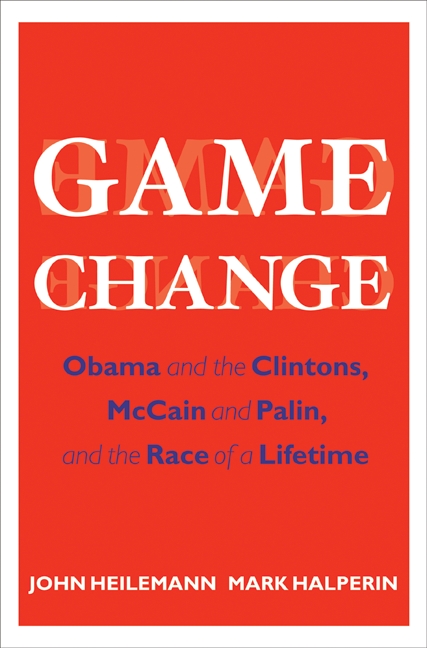
REVIEW: Game Change


A blow-by-blow tactical recap of the 2008 primary and general presidential elections, Game Change is a mind-blowing and eye-opening look behind the curtain in American Presidential Politics. What Otto Van Bismark said about laws and sausages (it's best not to watch them being made) can be equally applied to the minting of candidates; readers of this book will be startled at how impulsive, random, and junior-varsity the process is to crown the leader of the free world.

A few observations on the primary characters:

Hillary: Clearly the person best-suited and most deserving of being President. Foiled and propelled at times by her husband and drama-prone staff, Hillary fell victim to the resistance of her party's leadership to Clinton-Family Domination and the Media's infatuation of the hail-Mary narrative of Obama.

Obama: The coolest candidate in both senses of the world. Always confident, always in control, perhaps to the point of arrogance or megalomania. While his rhetoric has always been praised, Game Change reinforces the view that Obama has been weak on substance. Very weak. In spite of poor debate performances and long-shot odds (even though the establishment Democratic Party backed him), Obama was able tap into the right message, lift the right spirits, and win the impossible victory.

McCain: RISK LOVING... but what can you expect from a pilot? Curses like a sailor, but then again he was in the Navy. What you see is what you get, and as a regular good ol' guy, it's probably best he's not in the White House

Palin
: Eager if extremely, extremely naive. An undereducated Alaskan mom who really had little business outside of her state and certainly not in politics. She was catapulted onto the national stage by sheer, dumb, cosmic chance caused by the impulsiveness of McCain's VEEP decision (one that that needed to be a "game changer") and the complete lack of vetting. Fast and loose with the truth, though I'm not sure if she's a liar or if she just doesn't get it. Even McCain's staff twisted with regret when they learned exactly how completely unfit she is to be President

The Media: A violin to be played by the most talented maestro. Dutifully broadcasted any faux-outrage put out by the usually quite rational and understanding candidates. Completely ineffective as a vehicle for vetting and testing candidates as social narrative always dominates. Clearly the most embarrassed party in Game Change.

Read it
Skim it
Skip it

A Chance to Renew Faith in the Catholic Church

Today marks the opening of Holy Week, the dramatic close of Lent when Catholics commemorate Christ’s triumphant ride into Jerusalem, the institution of the last supper, the crucifixion and resurrection. It is the holiest week for Catholics, and also serves as the final step of Christian initiation for those adults who choose to join the Church.


Holy Week also provides an opportunity for the faithful to renew and reinvigorate their spiritual life. Christian faith implores its followers to lead a life of constant conversion - to be always on guard against those actions that separate us from God and to regularly recommit to the basic tenets of Christ’s teaching, most fundamentally universal love.


This year, that message from the Pope has been clouded by the ongoing sex abuse scandal that has rocked the Church to its core. In his homily at this morning’s Palm Sunday mass, the Holy Father struck a defiant tone, asserting that he would not be intimidated “by the petty gossip of dominant opinion.”


As a Catholic, I want to stand behind that sentiment. I want to rally around the head of my church in the most trying time of his office.


But the meaning of this week won’t let me.


For decades, the Church’s leadership has led a closeted existence. While preaching the values of Christ, too many priests, bishops and Vatican officials knowingly put Catholic children in the jaws of sexual predators. Instead of exposing the crimes of the wayward priests, and turning them over to police for criminal prosecution, a fraternal network of priests and bishops shuffled the pedophiles from parish to parish and diocese to diocese.


In recent weeks, the media has shed new light on the role of Pope Benedict XVI in the unfolding scandal. While archbishop of Munich in 1980, then-Bishop Ratzinger allowed a priest who molested children to return to pastoral work. And after being appointed to the Congregation of the Doctrine of the Faith – the Church’s highest ranking body on matters of dogma – Cardinal Ratzinger refused to defrock a priest who molested at least 200 deaf children in Wisconsin.


Pope Benedict has, past and present, shown remarkably bad judgment. He did not work to fully expose the crimes of priests for the past three decades, and as leader of the Church he has not fully investigated the scandal. (Even now, the Pope seems more interested in cracking down on liberal nuns in the United States than in settling the sex abuse scandal once and for all.)


And for weeks, the response from the Vatican has been neither introspective nor compassionate. The Church has generated excuse after excuse, with the Pope trying to push responsibility off on other officers while ignoring that, as a bishop and cardinal, the buck often stopped with him.


I do not dislike my Pope and I am not entirely disenchanted with my Church. But the office of the pope requires moral legitimacy. Any leader of the Church – at any level – who tried hiding abusive priests instead of bringing them to justice should stand aside.


Holy Week gives us, as we will be reminded over the coming days, an opportunity to renew our faith. The Holy See should also use it as an opportunity to renew our institutions and recalibrate the moral compass of the Church. I fear the true message of Christ will be drowned out by the cries moral outrage until that happens.


March 16, 2010

REVIEW: Brave New World

Aldous Huxley's 1932 novel Brave New World presents a vision of consumerism and mechanization, where social strata are bred into the biology of factory-produced twins, and stuporous stability is the highest government ideal. I found myself captivated by the book's system of society, its veneration of Henry Ford, and culture of instant gratification. If Orwell's vision was pure fascism, this is pure capitalism.

On the downside, Brave New World is nowhere as intellectually deep as 1984. The plot and characters are underdeveloped and inconsequential. Huxley makes the joy of reading solely in its exploration of his (brave new) world, but that can only carry the book so far. Throw in a compelling plot, differentiated tone of story-telling, and dynamic characters and it might have been perfect.

Read it

Skim it
Toss it

March 10, 2010

Guiding Lights of Stewardship

The tactics on display during the trustee election are downright disturbing.

John Replogle ’88 and his campaign team have, from the start of this race, sought to smear the character and accomplishments of Joe Asch ‘79, the petition candidate for trustee. Mr. Replogle has tried to play alumni against each other, availing himself of a brand of politics we know all too well – the politics of fear. With not-so-subtle references to Joe’s articles in The Dartmouth Review, Replogle hopes to prime alumni to paint Joe with the same brush as most do the Review, a tactic as underhanded as it is misleading. (Mr. Replogle has conveniently forgotten Joe’s dozens of articles, letters and interviews in The Dartmouth.)

Mr. Replogle has tried to scare alumni into seeing Joe as both a dangerous reactionary and an overinvested micromanager. In Mr. Replogle’s telling, Joe is – in one breath – both woefully ignorant of how to govern the college and over-informed on the issues that affect her. That his critiques indicate considerable cognitive dissonance seem of little import to Mr. Replogle, whose primary goal of winning has clearly supplanted his desire for anything approaching a fair and open debate.

What’s worse is the remarkably unapologetic bias in The Dartmouth. On the paper’s final day of production for the winter term, the front page bears a story dripping with insinuation and smacking of ulterior motive. With a misleading title suggesting that Joe has attempted to hide aspects of past business dealings, the article’s author intimates that Joe took part in a massive conspiracy to defraud French tax collectors. Then, by parsing quotes given by Joe and his supporters, the author wedges his version of reality into a broader narrative suggesting not-so-subtly that Joe is not qualified to serve on the board.

A real journalist would have painted a far more reasonable portrait for the students and alumni who rely on The Dartmouth for information on everything Big Green. In reality, Joe’s company, which shipped medical utensils to dozens of nations, made the mistake of paying a portion of their taxes to the United States instead of to France. Joe fully cooperated with the tax authorities of both nations, and resolved the issue without further judicial action.

The author of that piece also removed from proper context a paragraph from the endorsement letter I offered on Joe’s behalf. While I did write that, ‘Joe has a professional résumé packed with business experience and financial gravitas that our trustees need — particularly during a time of economic crisis — to help us navigate these hazardous waters,’ The Dartmouth’s reporter failed to point out what followed.

As I wrote next, ‘Those are all details that you can find on his website — and believe me, it’s just a brief sampling of Joe’s experience. But what I in particular feel the need to share is the side of Joe you’re unlikely to find replicated in the pages of The Dartmouth or around the web.’ I then go on to outline my personal relationship with Joe, and the reasons that I will be voting for him as soon as the ballot is available on March 10.

Unfortunately, I have neither the platform nor the time to counter the many examples of disinformation that have been unleashed against Joe over the course of this election. And perhaps I would not be the best person to do so, anyway.

You see, if politics has taught me anything it is this: you are never at your best when you’re angry. Many campaigns have made it second nature for me to take, as a matter of process, attacks against my candidates. It’s like watching members of your favorite football team get tackled – yes, it’s rough, but it’s just part of the game.

What politics does not desensitize you to, though, is watching your friends get sucker punched. I did not enter the trustee race as a political operative; I’m not a part of Joe’s campaign, only offering – as many students, alumni, trustees and professors have – my endorsement. Without the general detachment born of working on the campaign, I am just mad. I am mad at Mr. Replogle for his race-to-the-bottom electioneering. And I am mad at The Dartmouth for playing into that brand of politics by running journalistically misguided stories.

At the outset of this race, I had high hopes for this election. I had immense respect for Mr. Replogle and his professional accomplishments; I just knew Joe, knew his character, and knew that he would make an excellent trustee. Now, I am disenchanted with Mr. Replogle and his campaign.

I still believe that Joe will win, mostly because I have an abiding faith in the ability of Dartmouth alumni to see through the crassly political tactics employed over the past two months. But even with the best possible outcome, the very fabric of our union – those hill-winds that course through all those fortunate enough to share the Dartmouth embrace – has been frayed by petty and crude politicking. Grace and mutual respect must be the guiding lights of our stewardship. Otherwise, we no longer deserve to be vox clamantis in deserto.

February 28, 2010

Review: Lady from the Sea

Terrifying. Fascinating. Thrilling.

These were the words on the tips of our tongues as we emerged from the Moore Theater Friday night, an audience wowed by the dramatic genius of Ibsen's Lady from the Sea. Two and a half hours earlier, we'd strolled into the theater chatting of classwork, finals, how to hide the flowers we'd brought for the cast members. We walked out just as talkative- but with many more superlatives dancing from our mouths.

Did you see- did you hear? Ellida's eyes- Bollette's tears- Lyngstrand's coughs and awkward flowers. Arnholm's "Hm," German tourists, Ballested's horn, Wangel's despair. Did you hear- did you see? The ensemble, the lighting, the music, the language- the heart-wrenching moments and the dark laughs we shared! What happened in that theater? What brought us so close to Ibsen, to the sea?

There are many feet at which to lay the credit for this brilliance; we'll start center stage. Willa Johann '10 starred as Ellida Wangel, the Lady from the Sea, bringing the audience to its figurative knees as she battled the bonds that held her to the sea- and fought also the ties that kept her away from its mysteries. George Neptune '10 as her husband Dr. Wangel was lost in frustration as he watched his wife descend into this strange confusion, an illness all of his medicinal arts could not begin to cure. The family was completed (or rather left artfully separate) with the entrance of Bolette (Talene Monahon '13) and Hilde (Jenny Lamb '13), Dr. Wangel's daughters from his first marriage, each a complex and beautifully acted character in her own right. Bolette's admonishments, desires, and ideas of responsibility and Hilde's morbidly melodramatic sense of humor showcased both actresses' clear natural talent.

Enter Jay Ben Markson '10 as Mr. Arnholm, Bolette's "old" tutor, bringing more than thoughts of tutoring to the stage (and quite a lot of hair gel, as it turns out). His complicated romantic endeavors and well-wrought facial expressions contributed nicely to the piecing of Ibsen's dramatic jigsaw. In brilliant juxtaposition we found David Mavricos '10 as the younger Mr. Lyngstrand, a sculptor with a weakness in his chest and a self-assurance in his art that kept the audience shaking its head at the black irony inherent in his character.

And then- there was the Stranger. Eric Wu '13 brought mystery and power to the stage as Ellida's first dark love. His threatening air and rather impressive jump over the garden fence brought a striking arcane note to the production. Also definitely worth a credit was Jonathan Gunson '10 as Ballested, an intriguingly humorous Jack of all trades who also managed to help with some foreshadowing of Ellida's strange condition.

The production contained a few wonderfully refreshing choices that enlivened Ibsen's script. The ensemble (Torrey Barrett '13, Tomo Berry '12, Jocelyn Duford '11, William Hernandez '13, Grace Kouba '13, Liz Neill '13, and Sophie Palitz '13) built the marine theme to its eventual climax with graceful choreography and surprisingly smooth changes of set, made more impressive if one realizes that the women at least did it all wearing corsets and heels. Also very impressive were the lighting and set, to the credit of Dan Kotlowitz and Georgi Alexi-Meskhishvili, respectively, and both masterfully fitted to the theme, evoking thoughts of the sea even before the first words were spoken.

These seven showings of Lady also contained a musical surprise- the talents of composer and sound designer Roy Prendergast, best known (to us students at least) for his film credits, including Shakespeare in Love and Caddyshack. Especially appreciable was the music's inclusion of both drama and humor- to tell the truth, it reminded one of the changeable nature of the sea (remarkably appropriate, I'd say).

Deep bows and curtsies are of course due to the director, Jamie Horton, and Laurie Churba Kohn, the costume designer. The creative genius of both is more than evident!

And with that, I'll end my song of praise. Bravo and brava to all; resoundingly, solidly, and absolutely, Lady was a great success.

February 5, 2010

For the Love of Dartmouth

What a week it has been.

The Thayer school forced its students to [briefly] evacuate the building due to an unfortunate accident. Hanover Police announce that they’re (re?)-launching a war on underage drinking at the College. The Winter Carnival committee told us they’ve learned from the catastrophic Moosilauke Lodge-turned-dirty-snow-pile travesty of last year’s wintertide festivities.

Oh, and then there’s the candlelight vigil on the Green, where concerned students enjoin the Ghosts of Christmas Past, Present and Future to visit President Kim and the Trustees ahead of their meeting to discuss fiduciary strategy.

What’s next? My money’s on The Dartmouth publishing that Barry Scherr is actually John Edwards’s lovechild.

It’s unfair, really. Why does all of the craziness have to unfold after I leave Hanover? All I get to watch is this freak snow storm plough DC in ways that could make Ron Jeremy blush.

In all seriousness – what is happening to Hanover? Did our swine flu fevers addle us so? Is this all a jealous response to the South getting more snow-related news coverage than New England? (Because to be honest, you can have the snow. I ran toward the Mason-Dixon to avoid another gross winter, thank you very much.)

In any normal week, Hanover Police would win the “WTF, mate?” award for most ridiculous, ludicrous or otherwise idiotic idea. Scrapping a plan to engage the Greek system on campus to find shared solutions to shared problems – namely destructive behavior resulting from boozy over-consumption – HPo decided to announce a new plan. Now they’re going to launch “sting operations” at Dartmouth fraternities.

Brilliant, Barney Fife! Send agents posing as underage students into frat parties to bust the evildoing brothers. Nevermind that a stringent Dartmouth ID check at the door will allow frats to hedge against risk. Oh, and this one little problem: Students are gonna drink anyway. Except now, they’ll binge before going to that brotastic party.

But cooperating to accomplish mutual goals is so ‘90s, anyway. This is the nation that invades sovereign states in the face of international disapproval. Less talk, more action. What could possibly go wrong?

(And to Hanover Police Chief Giaccone, who told the students who didn’t care for his for-the-greater-good despotism to “go to another Ivy League school,” here’s a clue (because you obviously haven’t one): Dartmouth is the main reason you get a big department, neat cars and cool toys. Chug on that, dude.)

Sadly, the most recent issue born as a yoke upon the shoulders of many students is even more shortsighted and lamentably irresponsible. The Students Stand with Staff crowd has juiced up the Hope Express of 2008 with enough amphetamine to make Lenny Bruce uncomfortable. Wishful thinking is fine, but it has to be tempered with truth telling from time to time.

Dartmouth must deal with its $100 million structural deficit. No way around it. Spending the endowment is not an option. And, despite my best efforts, I don’t think Obama’s gonna send any TARP funds our way.

Layoffs will happen. Nobody likes that idea, but it is an economic reality. During boom times, Dartmouth added more staff – support and administration – than it needed. I sympathize with students who want cuts to be made on the highest wages, and want the wealthiest parents to pick up more of the tab to avoid layoffs. (I worked for John Edwards in 2008, and then worked for the Democratic Coordinated Campaign effort in the fall of that year. I get the soak-the-rich argument, I do. But it just can’t work in this context.)

Cutting wages on our best talent risks losing top performers. Raising tuition for those who can afford it (which is fewer than half of our students, by the way) risks our applicant pool falling sharply. Both put us at a significant competitive disadvantage.

Raising hell to avoid any layoffs is a quixotic gesture and a terrific mistake.

Here is the program – get with it: If you want to help the staff, then do some quantitative legwork and figure out ways to minimize staffing cuts; propose realistic solutions to ensure that cuts are made across the board; and fight so that support staffers aren’t unnecessarily targeted. And, for the love of all things Big Green, don’t take compensation and benefits negotiations off the table.

It doesn’t seem like that long ago that I left the College on the Hill, but it also seems that much has changed. With all this craziness, it’s enough to make me wanna come back. Good thing for you I’m snowed in.


Finally, someone who knows what they're taking about.

Douglas Irwin, the Robert E. Maxwell ’23 Professor of Arts and Sciences in the Department of Economics, finally breaks the chorus of whining from mostly English professors protesting the college's planned (and unfortunately necessary) layoffs. Emotional responses are one thing, but, as Professor Irwin shows, logic and analysis are another.
To make up the $100 million structural budget deficit through a tuition hike, Dartmouth’s 5,000 students would have to cough up an extra $20,000 per year. Are Dartmouth students and their parents willing to pay more so that Dartmouth does not have to make significant adjustments to its expenses? Do students pay Dartmouth to provide employment to the people of the Upper Valley, or do they pay Dartmouth to hire the right number of people to provide them with a first-rate educational experience?

February 1, 2010

Review: WiRED

In twenty-four hours, a lot can happen. You could write that ten-page essay just in the nick of time for your English class, for example. Or you could eat four straight meals at Foco, including your midnight snack. Or you could... write, direct and act a play?

Sounds implausible, sure, but they've done it- the writers, directors, cast and crew of the WiRED twenty-four-hour play event have done it. The plays were written overnight from 8pm Friday to 8am Saturday; the actors entered into the equation from 8am to 8pm. And at 8pm was the performance. The one all-out performance, the culmination of all their hard work, and- you guessed it- the way I spent my Saturday evening.

There was not only one play, either, but three, and each with a certain restriction- one character of each had to speak all in titles. The first (assigned the use of song titles) was a lighter comedy with the serious theme of love found in spite of adversity, spun off from the "balloon incident" from not too long ago. Audience members laughed along as Falcon evacuated the dance floor and fell in love with "Jenny from the Block." The Block Tutoring, that is.

The second play (assigned the use of book titles) was much more solemn. Thomas, defended by his best friend Jonathan, immersed himself in the world of literature and fell in love with an equally literature-obsessed woman, Vanessa- who, we learned at the end of the play, was not a woman at all, but instead a figment of Thomas' vivid imagination. At this revelation the audience sighed and shook their heads in appreciation; I guess we hadn't been expecting tragedy.

And the third play? It was assigned the use of movie titles and was a wonderful mixture of love and sarcasm, complete with a touching ending and "Awwws" from those watching. The (not-so)classic story of a waitress rescued from her mundane and cynical life by a beekeeper wearing a bee costume was heartwarming, and the interjections from assorted drunk, air-headed and grumpy characters were hilarious.

Overall, I'd call this term's WiRED (yes, that's right! It happens every term) a great success- the actors were invested in their craft despite the occasional use of scripts, and the plays themselves were surprisingly deep and appropriately comic.

[[[And don't forget to catch the production of MACBETH, 8pm Thursday, Friday and Saturday in the Bentley!]]]